The Meditative Training Cycle
A Universal Mind-Training Framework
INTRODUCTION
What is The Meditative Training Cycle?
The Meditative Training Cycle, or MTC, is a powerful framework that enhances the effectiveness of any meditation technique where we direct and sustain attention on a specific meditation object.
That object may be:
The sensations of the breath or body, as in Goenka-style Vipassana
The sensations in the feet during Walking Meditation
A koan to contemplate in the Zen tradition
The Meditative Training Cycle was developed by Oded Raz as a synthesis and extension of principles and practices presented in Culadasa’s The Mind Illuminated. It originated to support Mind Muar’s meditation method (The Playful Path to Awakening), but its principles are universal. Use it in your practice, whatever it may be, and you’re guaranteed to accelerate your progress.
Acknowledgement
Both The Meditative Training Cycle and The Playful Path to Awakening build upon concepts, terminology, and practices presented in Culadasa’s The Mind Illuminated. His brilliant work provided an important foundation for their development. The MTC extends that foundation with additional distinctions, structures, and practices developed through years of teaching and working with meditators worldwide. This ongoing development is consistent with Culadasa’s support and encouragement to use his work in innovative ways.
For a transparent, source-grounded comparison of TMI and the MTC, see the MTC installment of the TMI and TPP comparison project.

NOTE: the article contains detailed diagrams, and is best viewed on a computer screen.
MEDITATION IN A NUTSHELL | MTC
At its core, the Meditative Training Cycle is a simple flowchart that illuminates key aspects of the meditative mind-training process.
We’ll begin with a quick overview of its graphic elements and how they connect - then explore each part in greater detail:
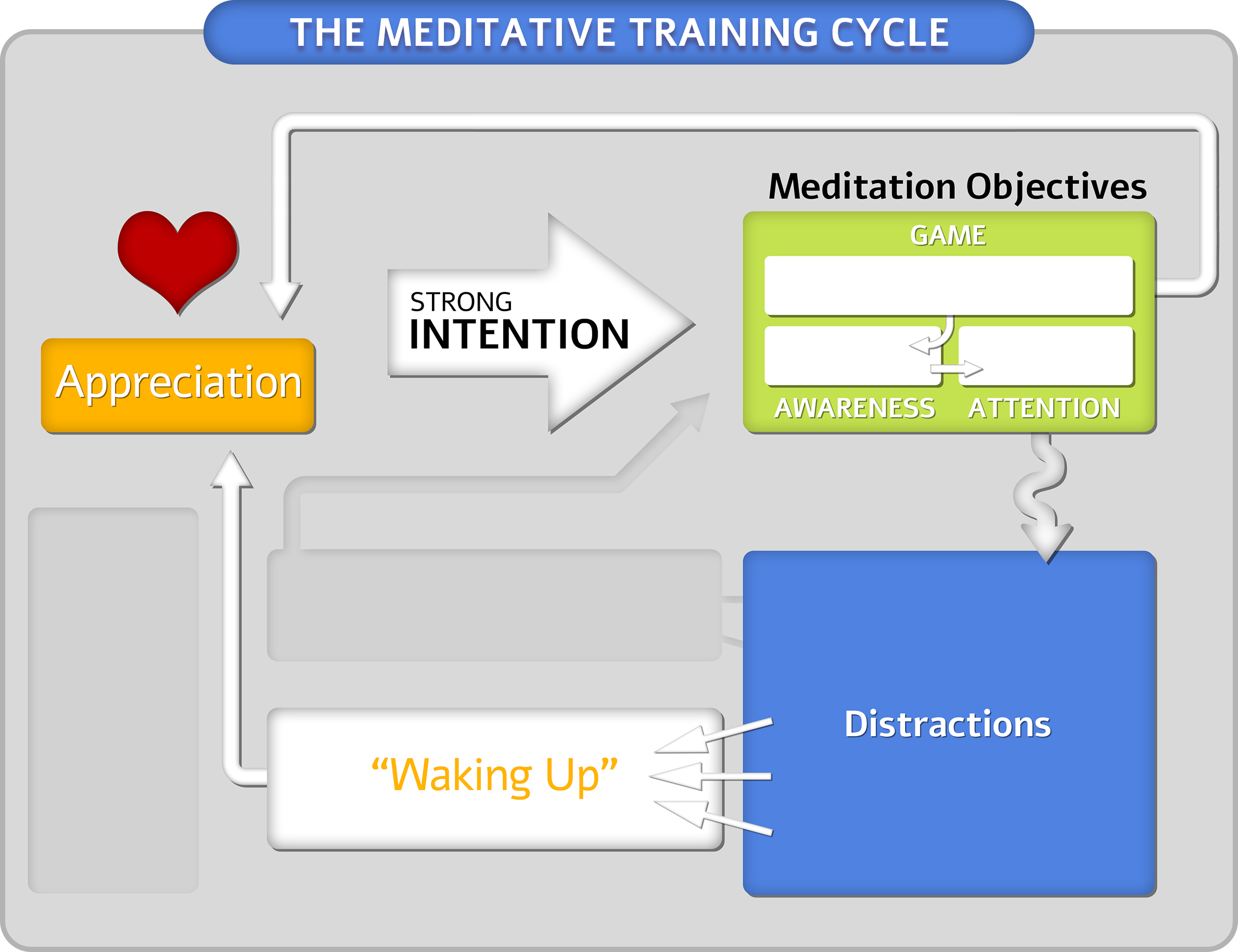
With the Meditative Training Cycle, we begin our meditation by cultivating a sense of Appreciation for sitting down to practice, determined to work diligently with a loving, gentle, unhurried, playful, and compassionate Attitude.
Then, we set a Strong Intention to fully engage with the Meditation Object - the sensations of the breath, for example.
In a perfect world, we’d be able to sustain our attention on this object for as long as we like. In reality, however, the mind inevitably gets caught by a Distraction, which may lead to forgetting the meditation object and drifting into a period of mind-wandering, where we think about other things.
Eventually, we Wake Up - realizing the mind is now engaged with something other than what we intended, like a memory, a thought, or a plan.
That’s the moment to show Appreciation for the part of the mind that noticed the distraction, and offer it some positive feedback: “Excellent! Let’s do it again. Let’s notice more often.”
After celebrating this recognition and returning to the present moment, we gently, lovingly, and playfully repeat the cycle:
Set a Strong Intention to engage with the Meditation Object for as long as we can, accept the inevitability of getting caught by Distractions, and when we Wake Up and notice it’s happened, respond with Appreciation and encouragement.
By following this simple flow, we continue the cycle until we hear the bell marking the end of the session.
That was the Meditative Training Cycle in a nutshell. Now, let’s zoom in on each of its elements to gain a deeper understanding.
APPRECIATION
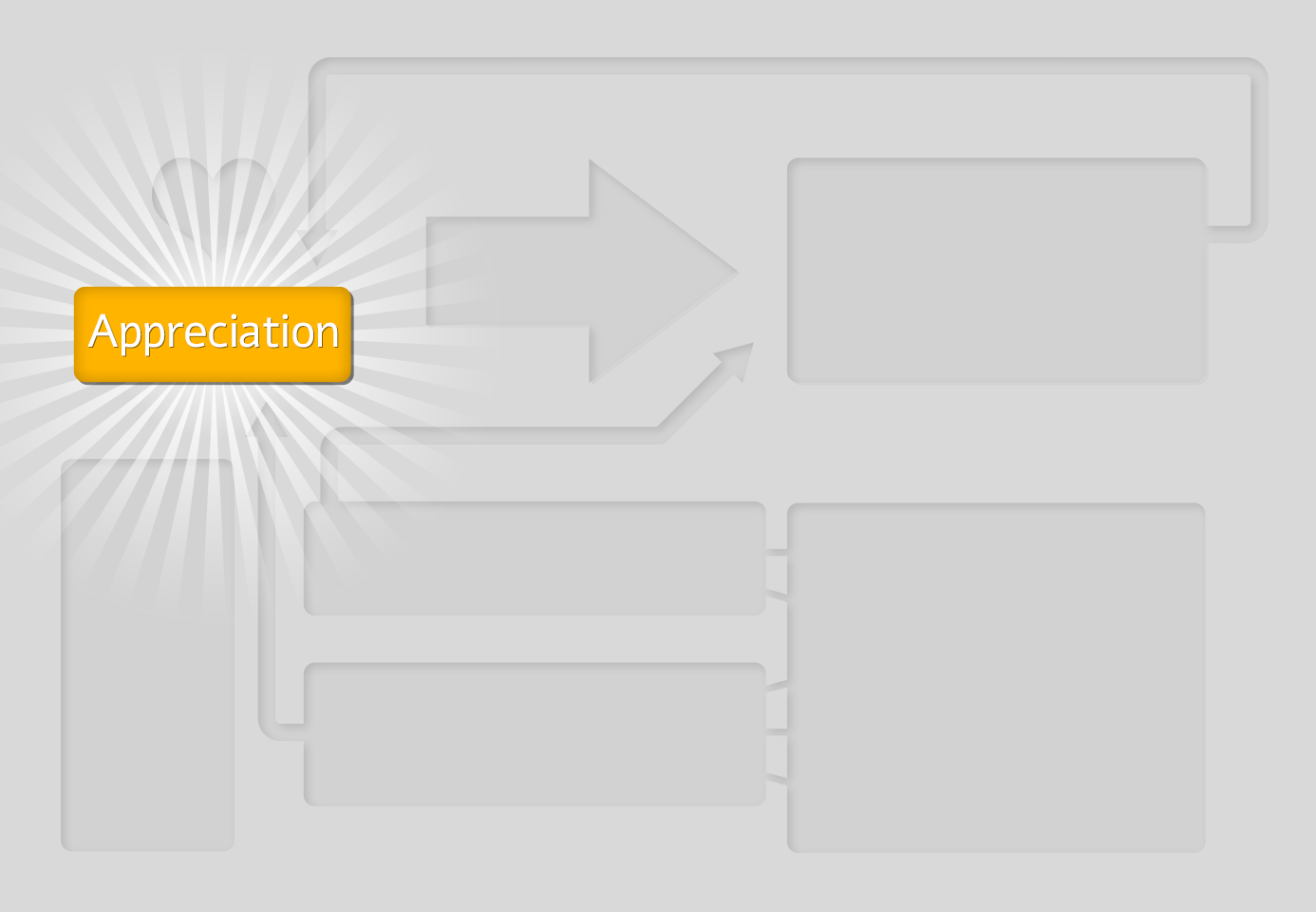
Appreciation is always our starting point, because fundamentally, the very act of sitting down to meditate is a success in and of itself.
It signifies that we’ve overcome the pull of watching TV, scrolling through social media, tackling daily tasks, or engaging in other activities that compete for our attention.
Remember: Most people don’t meditate at all, and even among those who do, maintaining a daily practice is often a real challenge. So, the moment you do sit down, you’ve chosen to invest time and energy in your long-term well-being - and that’s something to celebrate.
THE HEART | Right Attitude
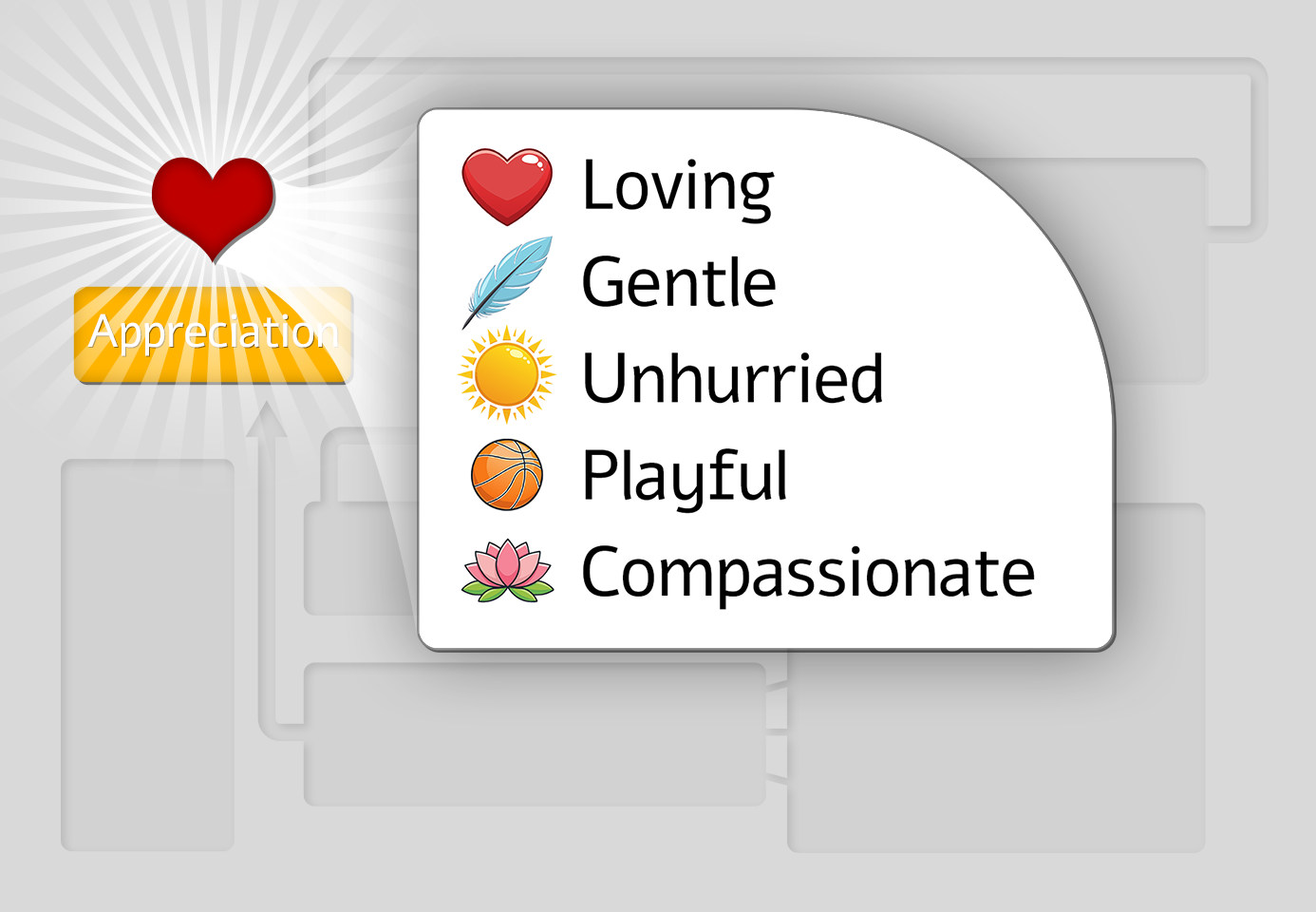
The Heart symbolizes the Right Attitude to hold throughout the meditation - Loving, Gentle, Unhurried, Playful, and Compassionate:

Loving
Having a loving attitude means you train your mind the same way you’d train your young children - with care, patience, and warmth.
It’s about bringing genuine affection into your practice - treating yourself like a lovable, learning child, not some random adult on a crucial test.
While there is value in investigating the mind with professional objectivity, like that of a doctor or a surgeon, make sure your focus on the method and its results never comes at the expense of your humanity. For that, all you need is love.

Gentle
Be gentle - like a feather.
Meditation is a delicate, gradual process that rewires the mind to operate with greater ease and clarity. Think of it like tending to a valuable bonsai tree: you need gentle hands and precise tools - not work gloves and a chainsaw.
This principle also balances our tendency to be harsh with ourselves, especially when we make mistakes or miss the mark. Be as gentle as you’d be with your child learning to ride a bicycle: a tender push and a pat on the back are far more effective than shoving and yelling.

Unhurried
Like the sun, taking all day to cross the sky from east to west, take as much time as you need to train your mind through meditation.
Don’t cut corners. Don’t look for shortcuts. This is not a race, and there’s no need to rush. Rushing ahead is like building a house of cards: It may rise quickly - only to be blown away just as fast. Build your meditative temple patiently, brick by brick, and it will serve you for a lifetime.

Playful
Meditation, like life, is just a game. Approach it with the wonder of a child on a playground, rather than the seriousness of an adult at a boring day job.
Let curiosity lead you: “What will happen next?” “What’s this piece of the puzzle?” “What might I discover?” Paradoxically, the lighter we take the process, the likelier we are to succeed. That’s why I named my method The Playful Path to Awakening - because it turns the path into an adventure, not a chore.

Compassionate
Having compassion toward someone begins with accepting them as they are, where they are, without the illusion that they should or could be any different. That’s just as true for you.
We’re not seeking perfection. Give yourself credit for your courage - for bravely facing the mental, physical, and emotional challenges of meditation. If you’re doing the best you can, the best you can is good enough.
STRONG INTENTION
After we’ve established the Right Attitude, we move on to the Giant Arrow - symbolizing our Strong Intention to fully engage with the meditation object.
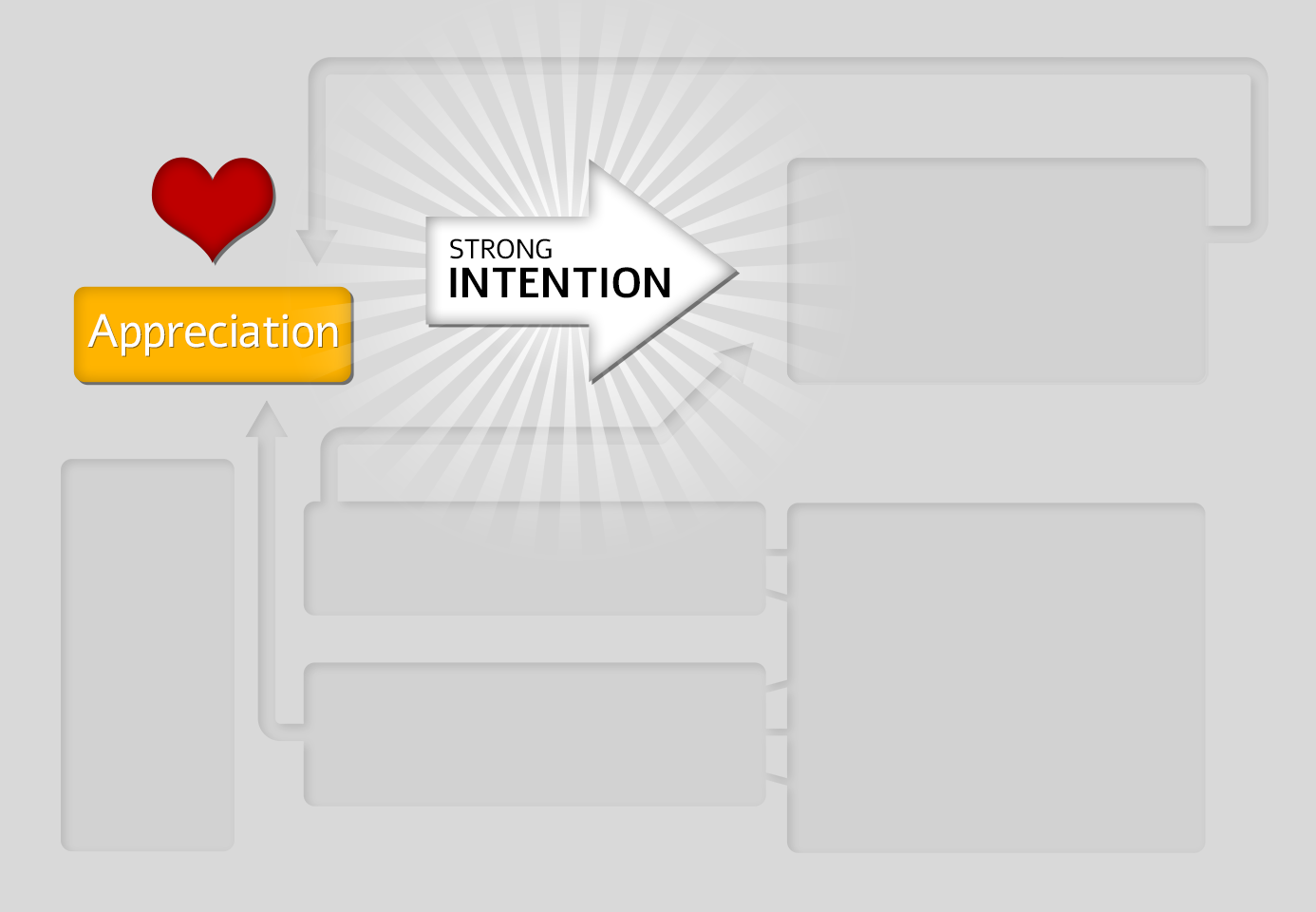
It’s a key component for directing and sustaining attention, because everything we decide to do consciously begins with holding an intention for something to happen.
What separates a Strong Intention from a vague intention is the following set of clear comprehensions:
“I know where I am right now”
“I know where I want to go”
“I know what I need to do to get there”
“I know what results will mark my arrival”
“Now is the time to head in that direction”

The Playful Path to Awakening includes several skillful means for cultivating and sustaining Strong Intentions - these will be shared in future articles. To receive guidance sooner, feel free to reach out.
THE TRIAD | Three Meditation Objectives
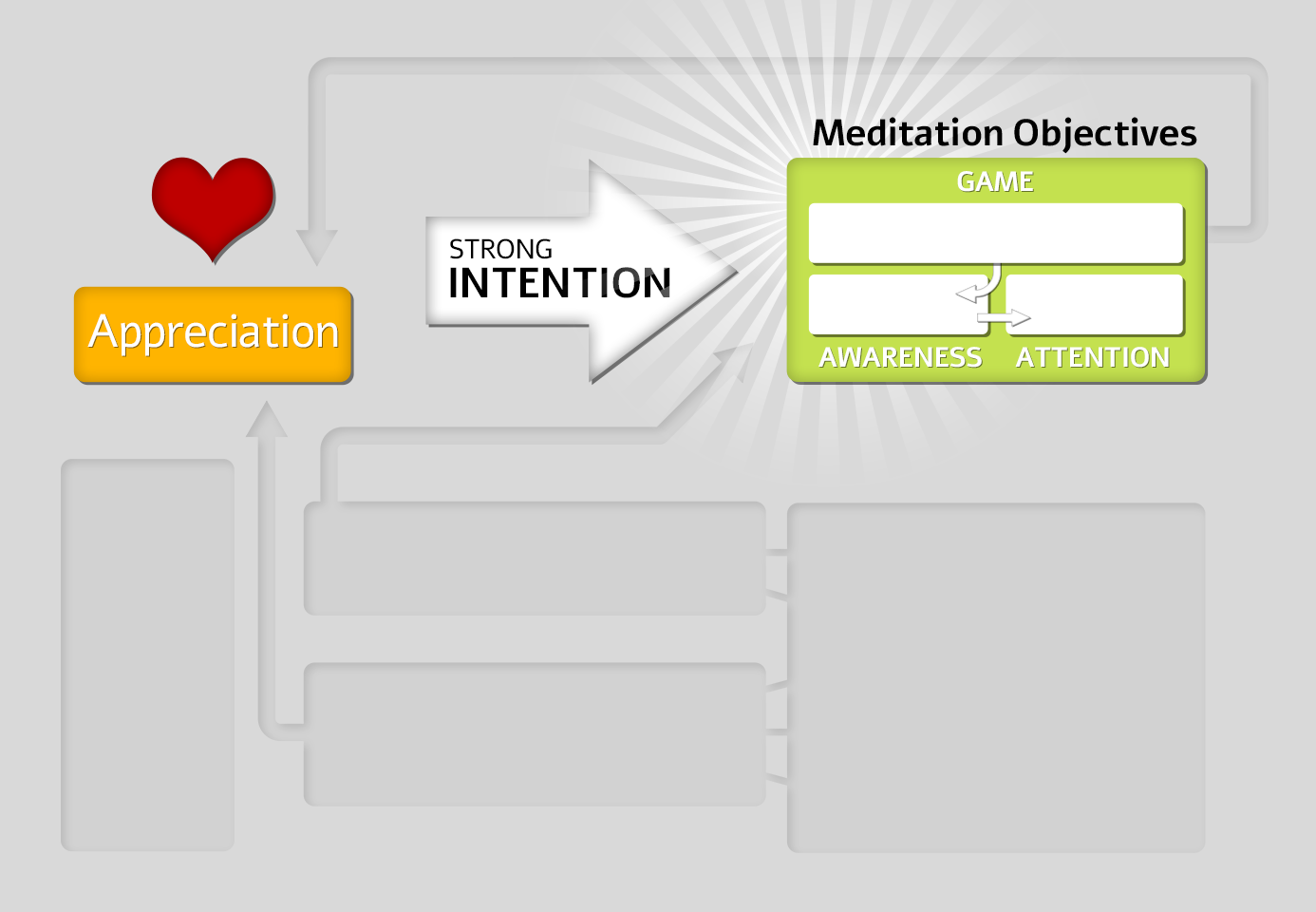
Driven by a Strong Intention, we now engage with the meditation object. But instead of focusing on a singular “object,” we expand this element into three distinct Meditation Objectives:
The “Game” (meditative technique)
The scope of Awareness
The center of Attention
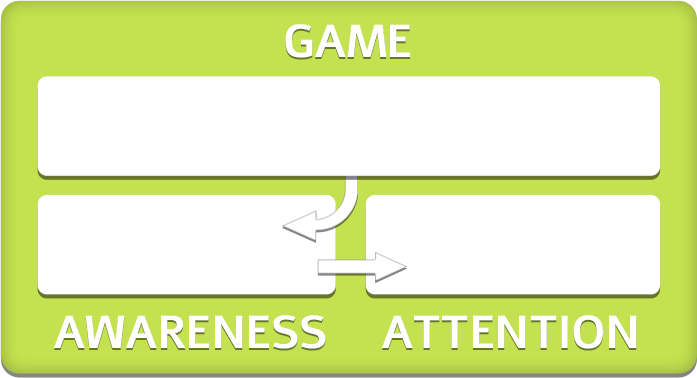
The three objectives are closely linked and equally essential to our success, so we often refer to them collectively as The Triad. Let’s explore them one by one:
The Game
The Meditative Game is “what needs to be done.”
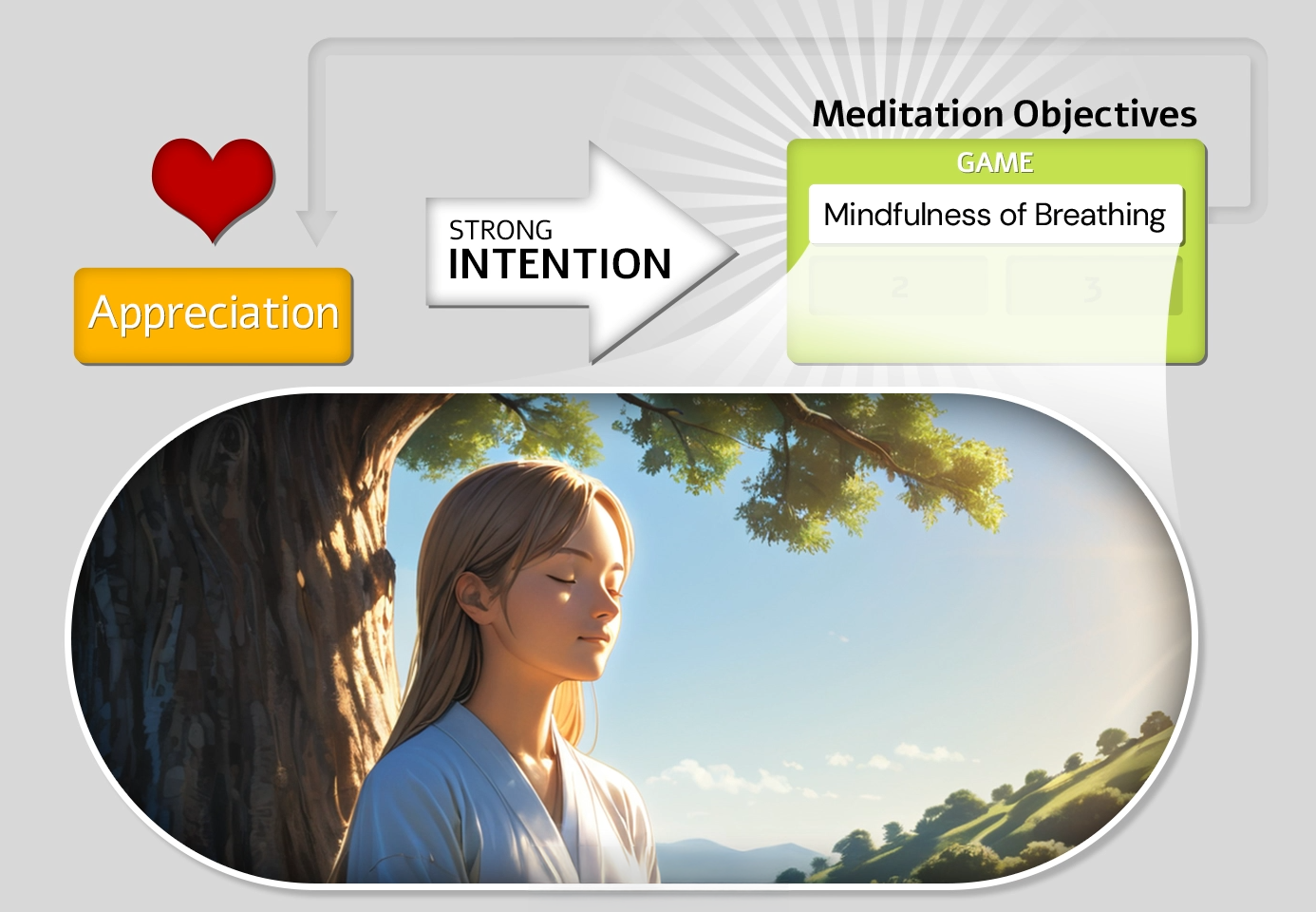
For example, it might be:
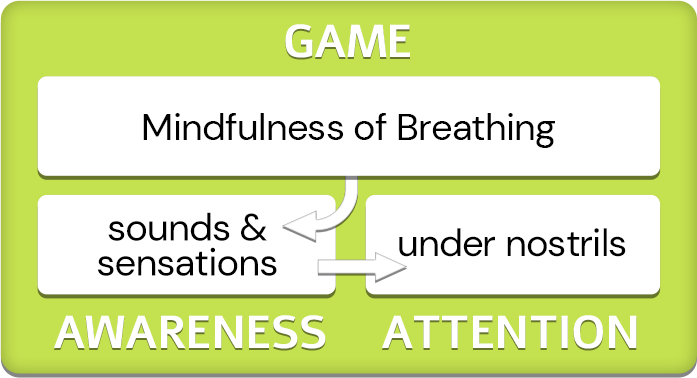
Following the sensations of the breath beneath the nostrils, above the upper lip (Ānāpānasati - Mindfulness of Breathing)
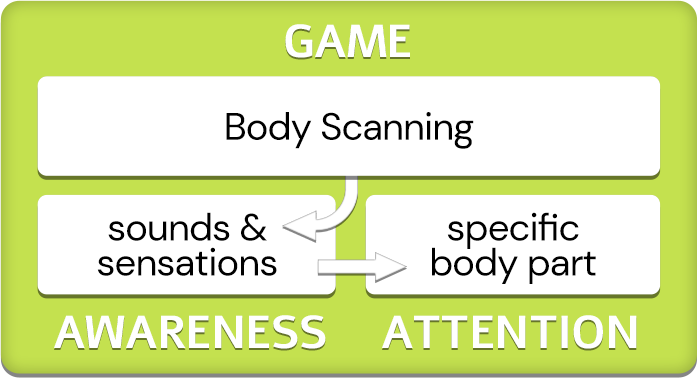
Scanning for sensations throughout the body (Body Scanning Meditation)
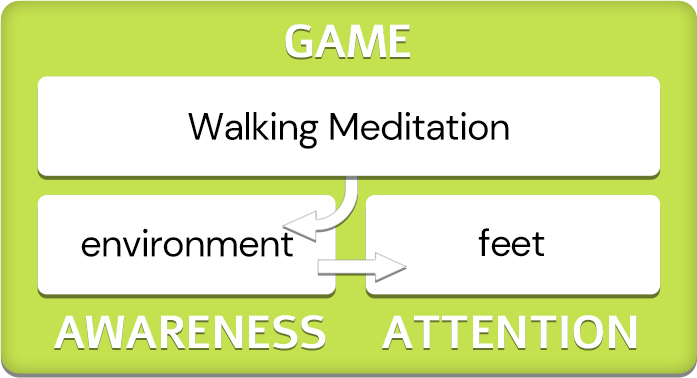
Investigating the sensations in the feet while we walk (Walking Meditation)
As mentioned earlier, the Meditative Training Cycle was originally developed to support the meditative games of The Playful Path to Awakening, but feel free to apply it to any meditation technique that includes an element of directing and sustaining attention on a specific object. It will be just as effective.
AWARENESS & ATTENTION
To play the Game, we use Awareness and Attention - two core components of consciousness that work together as we train the mind in meditation.
Due to their remarkable importance, we must understand their unique characteristics, clearly distinguish between them, and understand how they interact. This understanding is essential for everything that follows in the meditative journey in general, and in the Meditative Training Cycle specifically.
For this reason, Attention & Awareness get this top-level section. We’ll explore them in depth, then return to complete The Triad.
Awareness
Awareness includes absolutely everything that takes place in conscious experience. It’s like a broad stage filled with physical and mental objects: sounds, sights, thoughts, sensations...

Attention
Attention, on the other hand, is like a narrow spotlight. It allows us to select specific objects of interest from within Awareness and explore them in greater detail.

Domains of Awareness
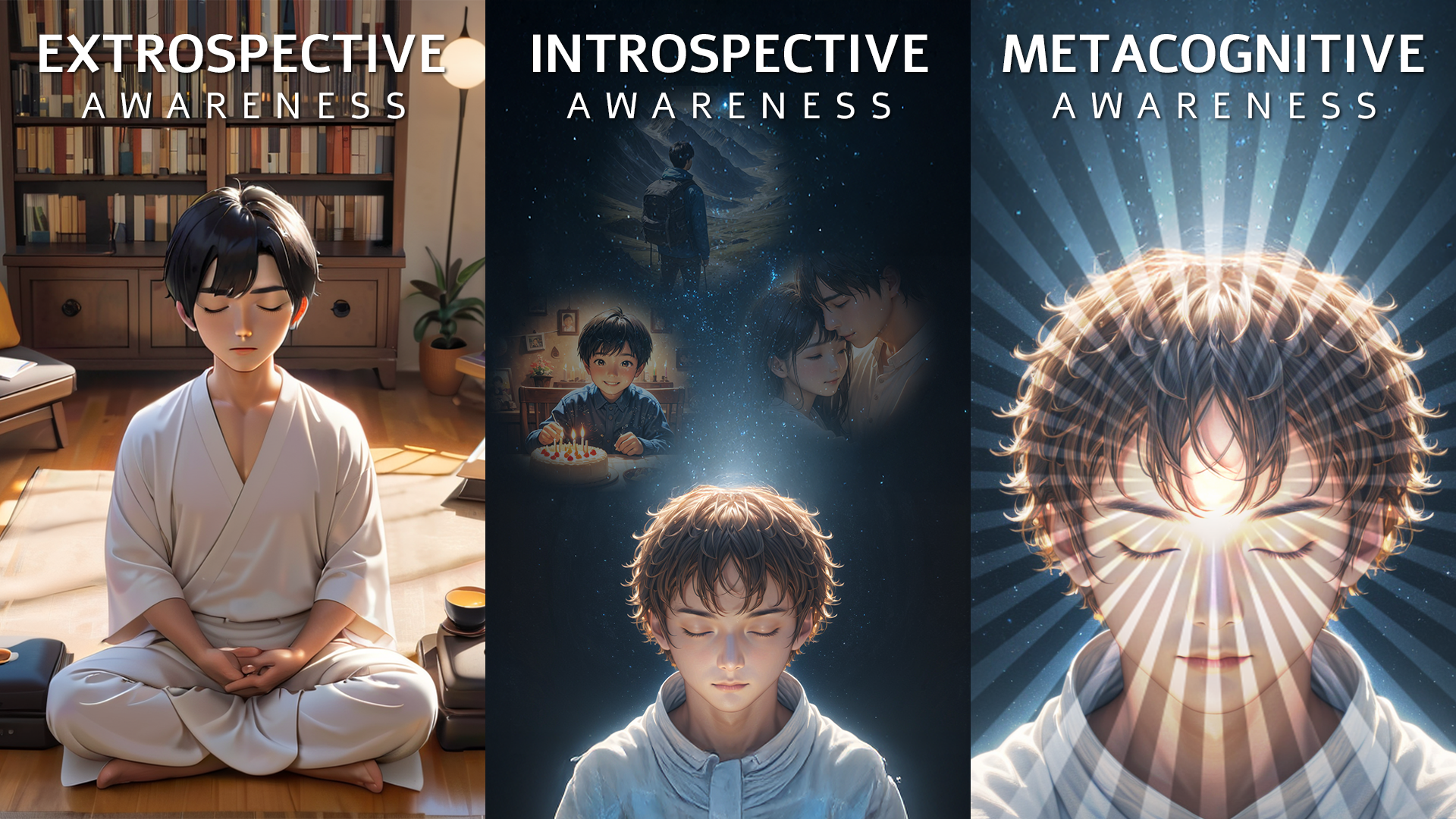
Since Awareness is such a vast field, capable of containing countless objects, we divide it into three domains:
Extrospective Awareness
Introspective Awareness
Metacognitive Introspective Awareness
(1) Extrospective Awareness
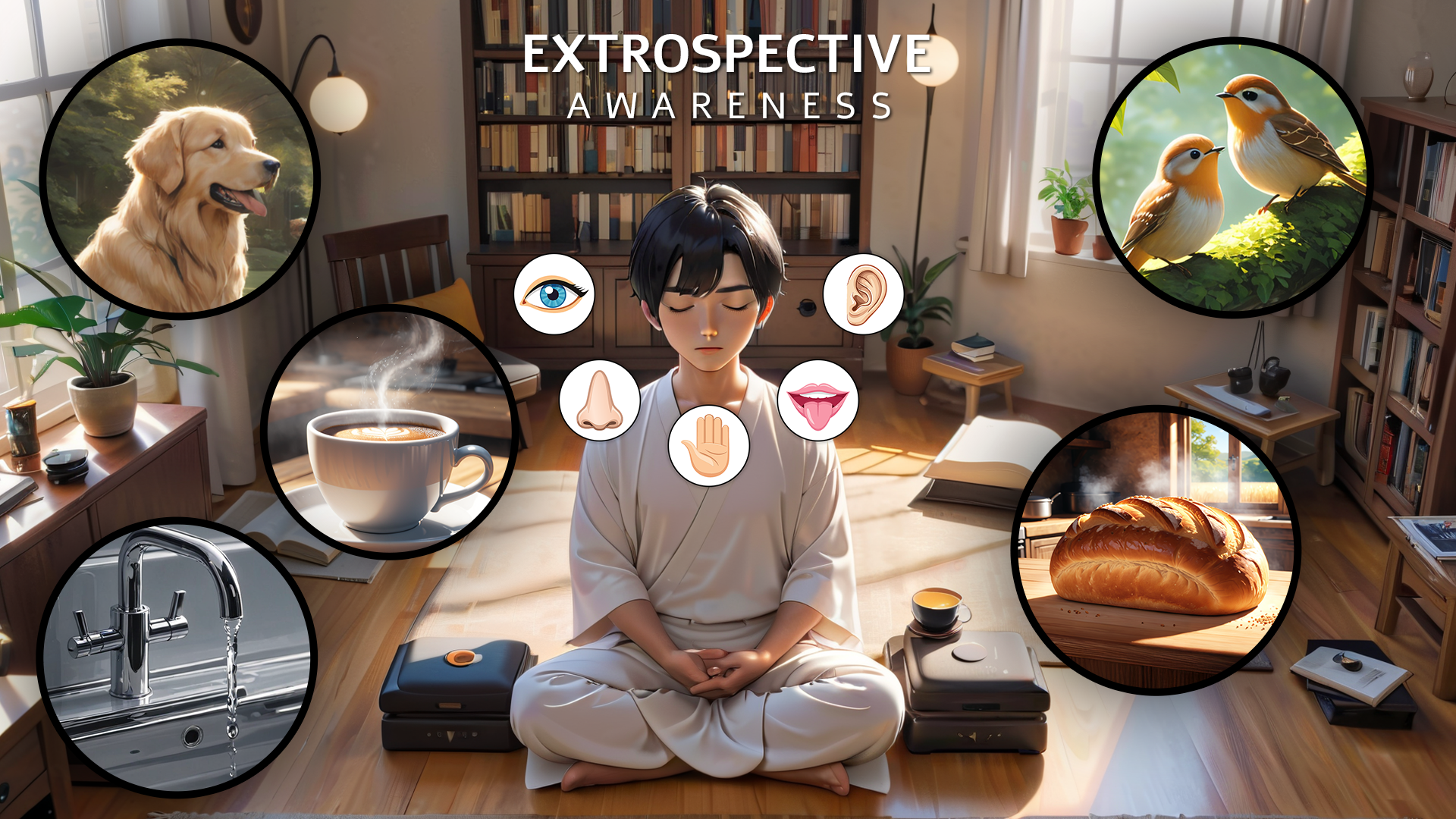
Extrospective Awareness includes physical objects out there in the world - those we experience through the five senses:
The view outside the window
The sound of tweeting birds
The smell of fresh coffee
The taste of bread
The warmth of soft clothes
(2) Introspective Awareness
Introspective Awareness relates to mental objects appearing within the mind, such as:
Childhood memories
Thoughts about loved ones
Plans for the future

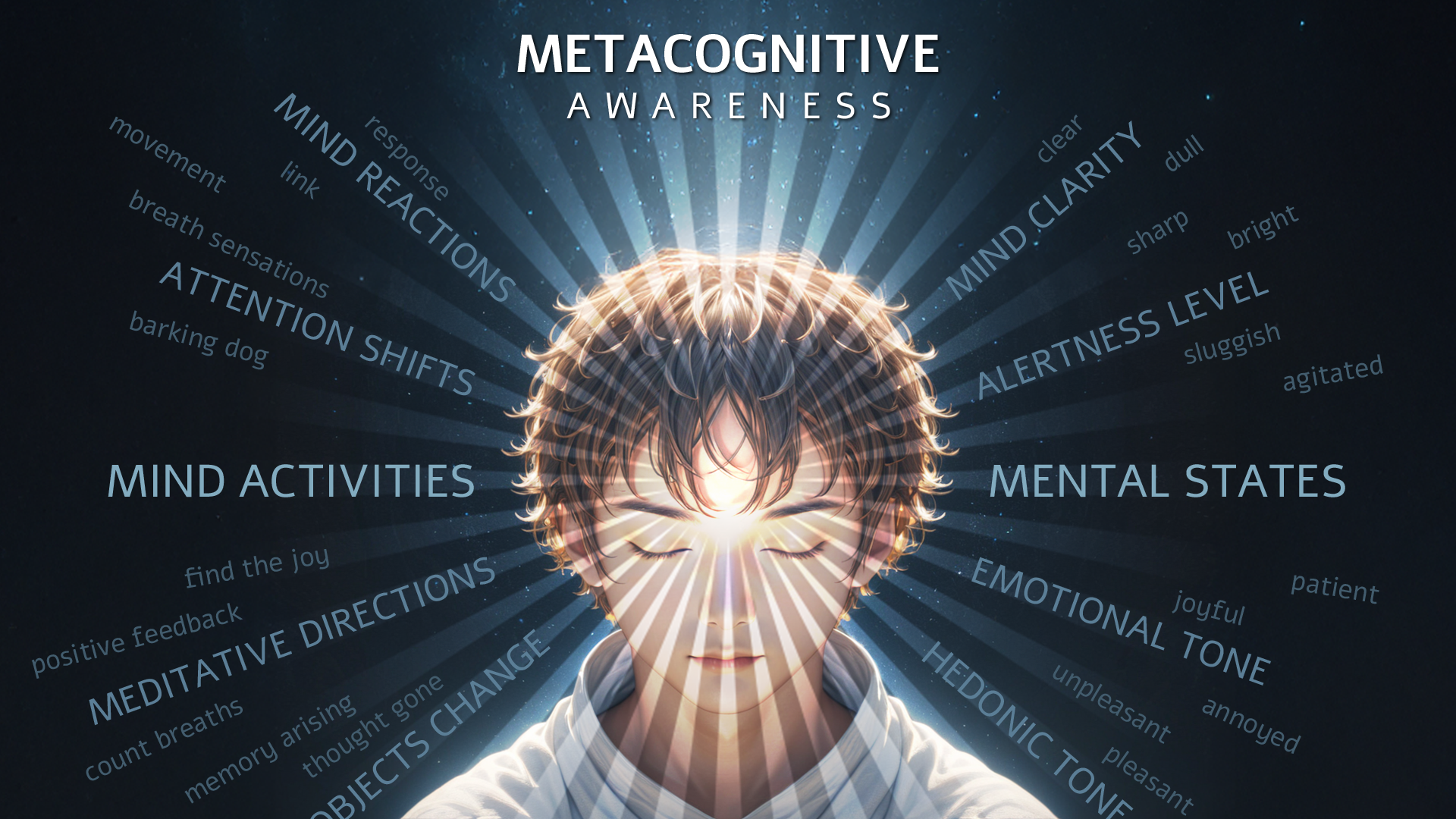
(3) Metacognitive Introspective Awareness
Metacognitive Introspective Awareness is the ability to observe our state of mind and track its activities in real time - to be aware of what the mind is doing while it’s doing it.
Where to Start
Extrospective Awareness is always the first domain we wish to establish.
Because it deals with the factual truths of the present moment, it serves as a grounding anchor - helping protect us from getting lost in the mind. Without it, we tend to overuse Attention, focusing so narrowly on the meditation object that we lose touch with the rest of our experience. Paradoxically, that’s exactly what makes us more vulnerable to Distraction and Dullness. Instead, we should balance Attention with an equally bright Peripheral Awareness - remaining softly aware of our surroundings while staying focused.
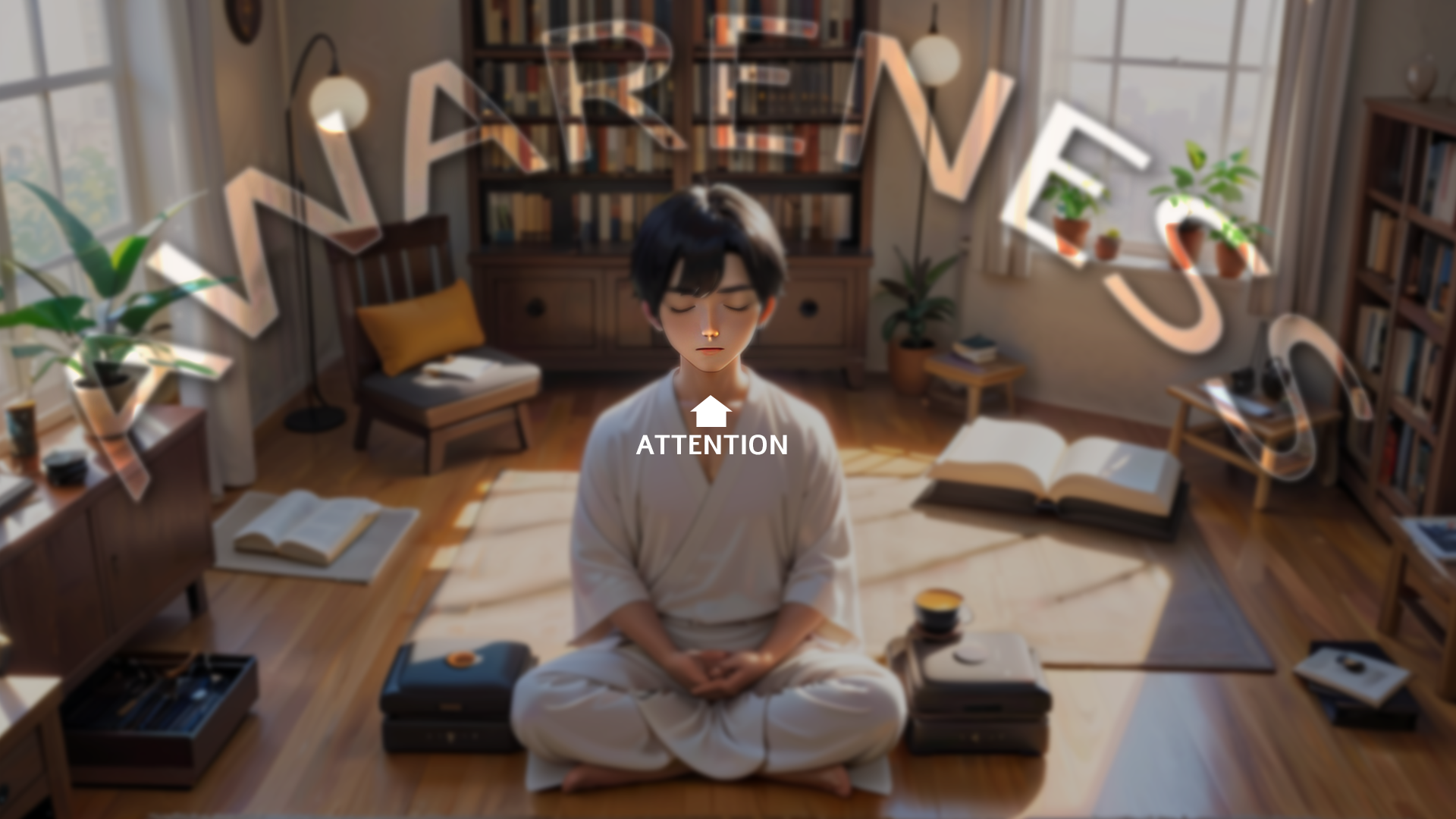
Once we become skilled in maintaining Extrospective Awareness, we can begin to establish the other two domains.
There’s much more to say about Attention, Awareness, and the techniques that strengthen them, so they’ll each have their own article in time. To receive guidance sooner, feel free to reach out.
THE TRIAD | Examples
Now that we’re familiar with all three elements of The Triad, let’s see how these Meditation Objectives work together:
Ānāpāna Meditation
Keep your Awareness open to sounds and bodily sensations, while directing your Attention to the sensations of the breath beneath the nostrils, above the upper lip.
Body Scanning Meditation
Remain Aware of your surroundings, while using Attention to investigate sensations in specific areas of the body.
Walking Meditation
Maintain Awareness of your environment, while focusing Attention on the sensations in your feet.
By performing the Meditative Game at hand while maintaining peripheral Awareness and directing Attention where it’s needed, we reduce the likelihood of getting caught by Distractions. Let’s explore those as well.
DISTRACTIONS
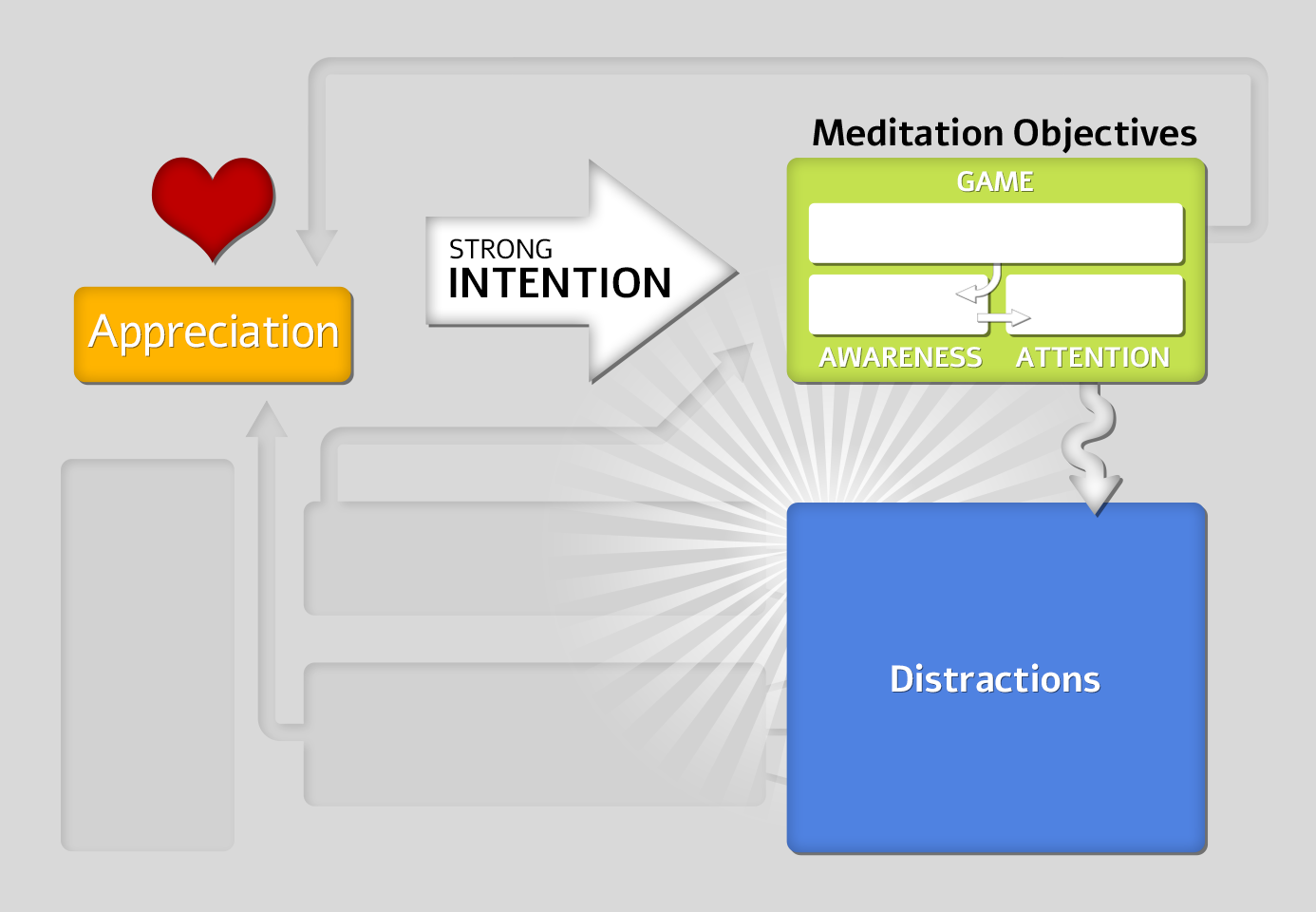
First and foremost, it’s crucial to understand that getting caught by distractions is both normal and inevitable.
Getting distracted is not your fault. It doesn’t make you a bad meditator, and it doesn’t mean something went wrong. It’s simply what healthy, well-functioning human minds tend to do.
In line with this truth, the Triad in the MTC is connected to the Distractions block with a squiggly arrow - symbolizing that we don’t choose to be distracted. We slip into distractions, uncontrollably.
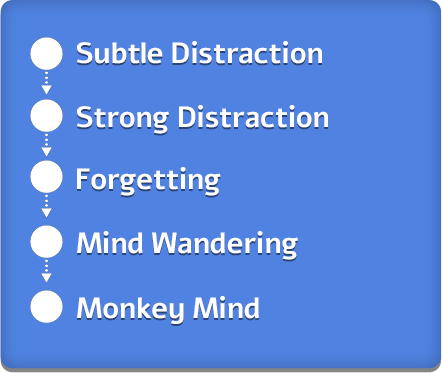
Unless counteracted with Mindfulness, the power of distractions tends to grow progressively:

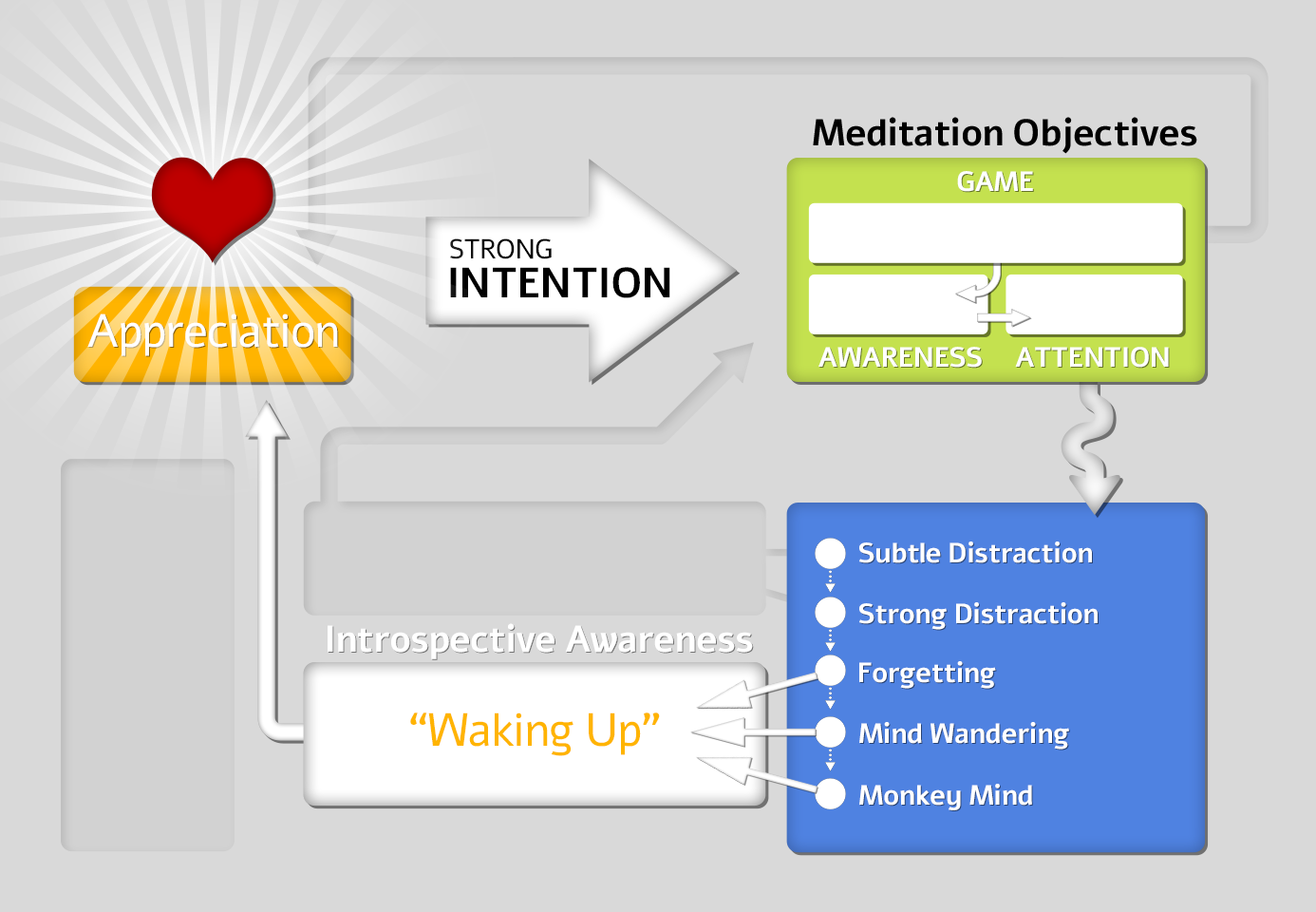
Subtle Distractions turn into Strong Distractions, which lead to Forgetting the Meditation Objectives, and eventually a period of Mind-Wandering, where we think about other things. When thoughts start jumping rapidly from one thing to another, it’s called Monkey Mind.
Let’s examine this natural chain of events more closely with an illustration:
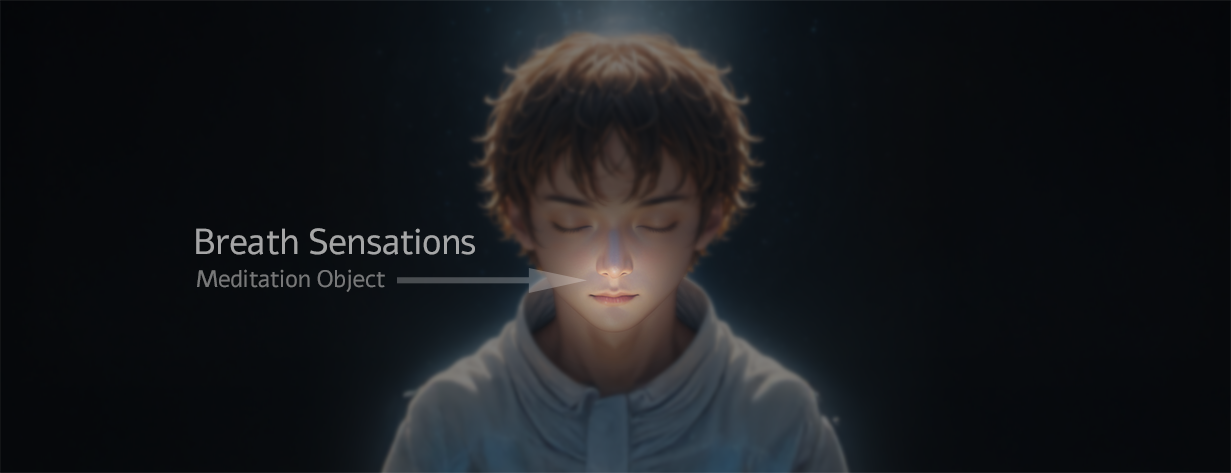
We sit down to meditate and direct our Attention to the sensations of the breath beneath the nostrils, above the upper lip.
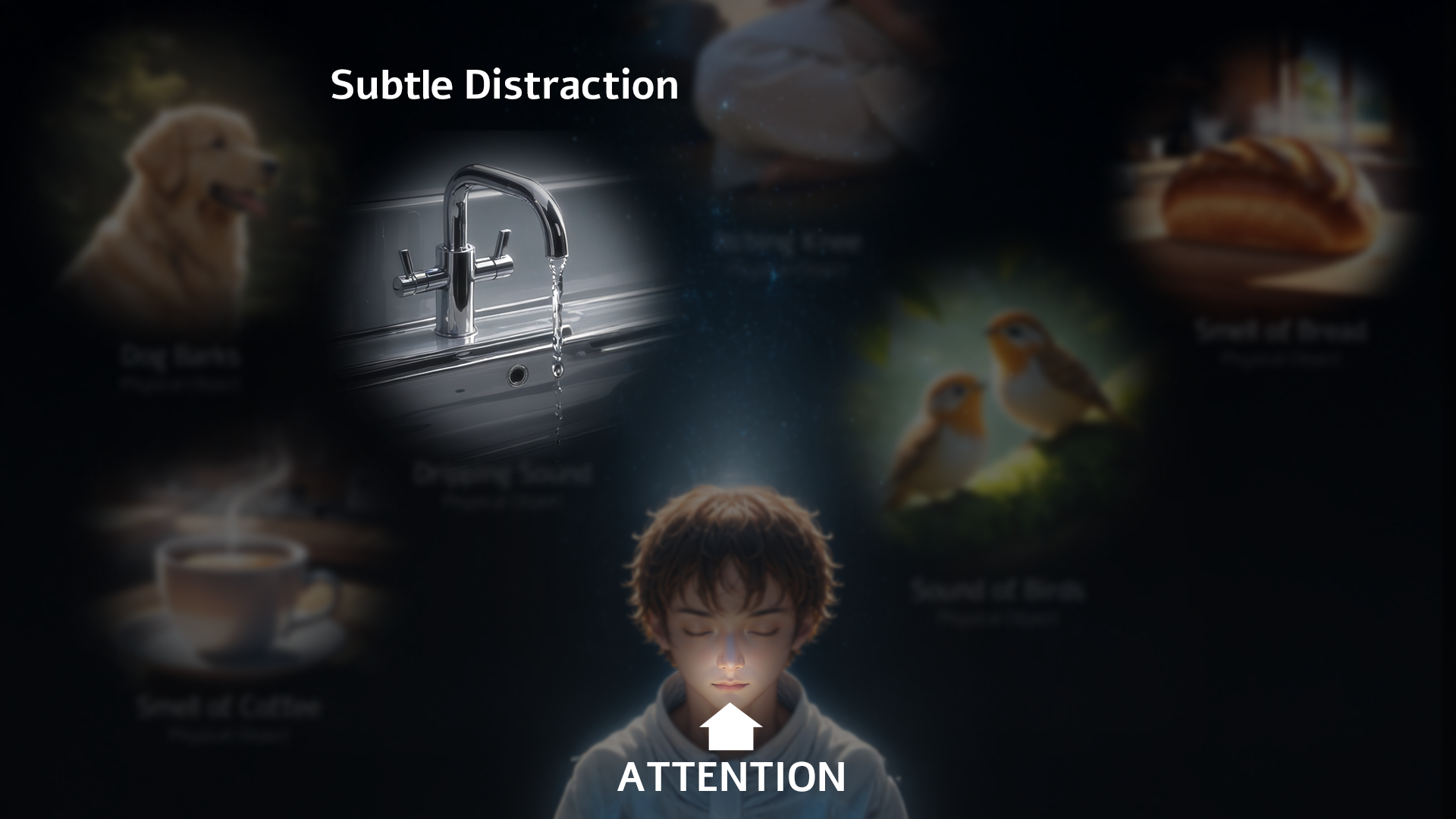
Meanwhile, physical and mental objects are present in Awareness. They may come from the outside world, like the sound of a dripping faucet, or from within the mind, like a thought or a memory.
When one of these objects begins to compete with the breath for Attention, it becomes a Subtle Distraction.
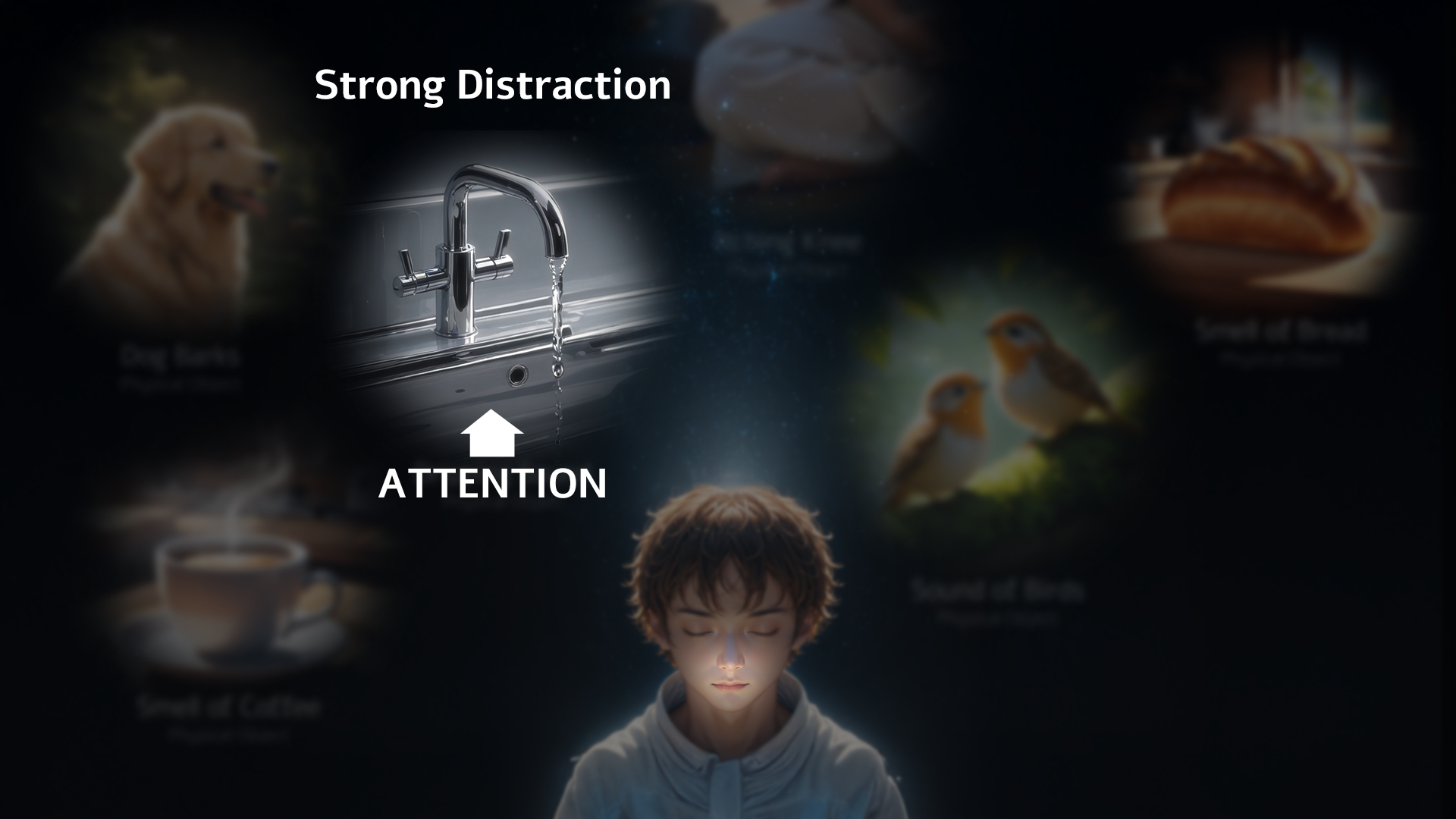
If we don’t notice the Subtle Distraction, or gently set it aside, Attention may drift toward it automatically. We might still be vaguely aware of the breath in the background, but now the distraction has taken center stage. At this point, it becomes a Strong Distraction.
The longer Attention remains on a Strong Distraction, the likelier the sensations of the breath will fade from Awareness. When they disappear completely, and we don’t even remember we’re here to meditate, that’s Forgetting.
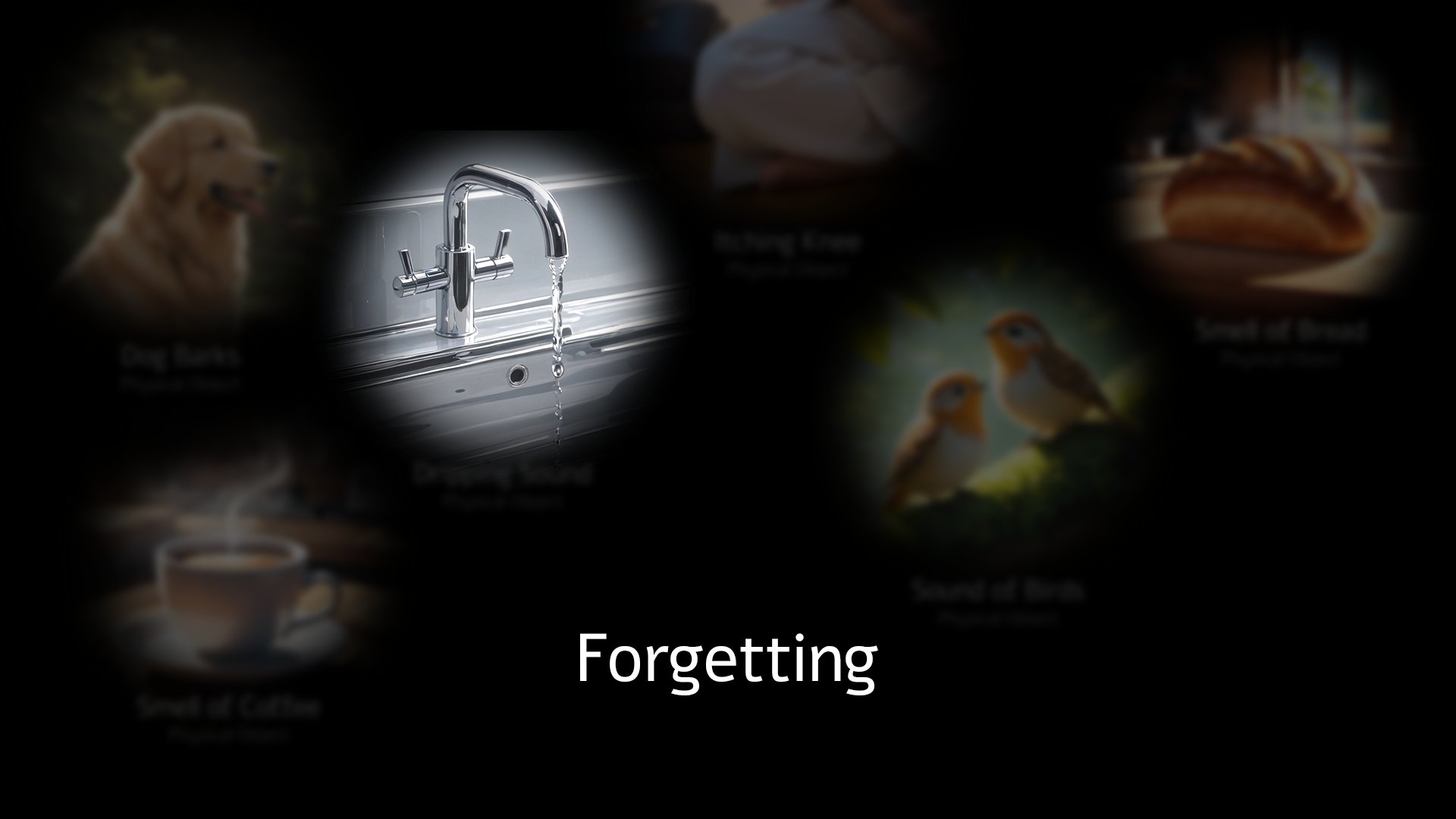
With the breath no longer serving as an anchor, and the intention to meditate forgotten, the mind begins to drift freely from one thought to another, associating without any conscious control. That’s Mind-Wandering.

If the mind is restless - jumping rapidly from one thought to the next, briefly grabbing one idea, immediately dropping it, and leaping onto the next without pause, like a monkey swinging from branch to branch - we fondly call it Monkey Mind: the ultimate case of getting lost in distraction.

Note: In TMI, “Strong Distractions” are called “Gross Distractions.” I prefer using the word “strong,” since “gross” carries connotations of disgust, which may generate negative judgment and aversion. Instead, “strong” conveys a simple fact: the distraction was strong enough to pull Attention away. Neutral language supports the cultivation of Equanimity (one of the Seven Factors of Enlightenment), so it is widely used throughout The Playful Path to Awakening.
WAKING UP
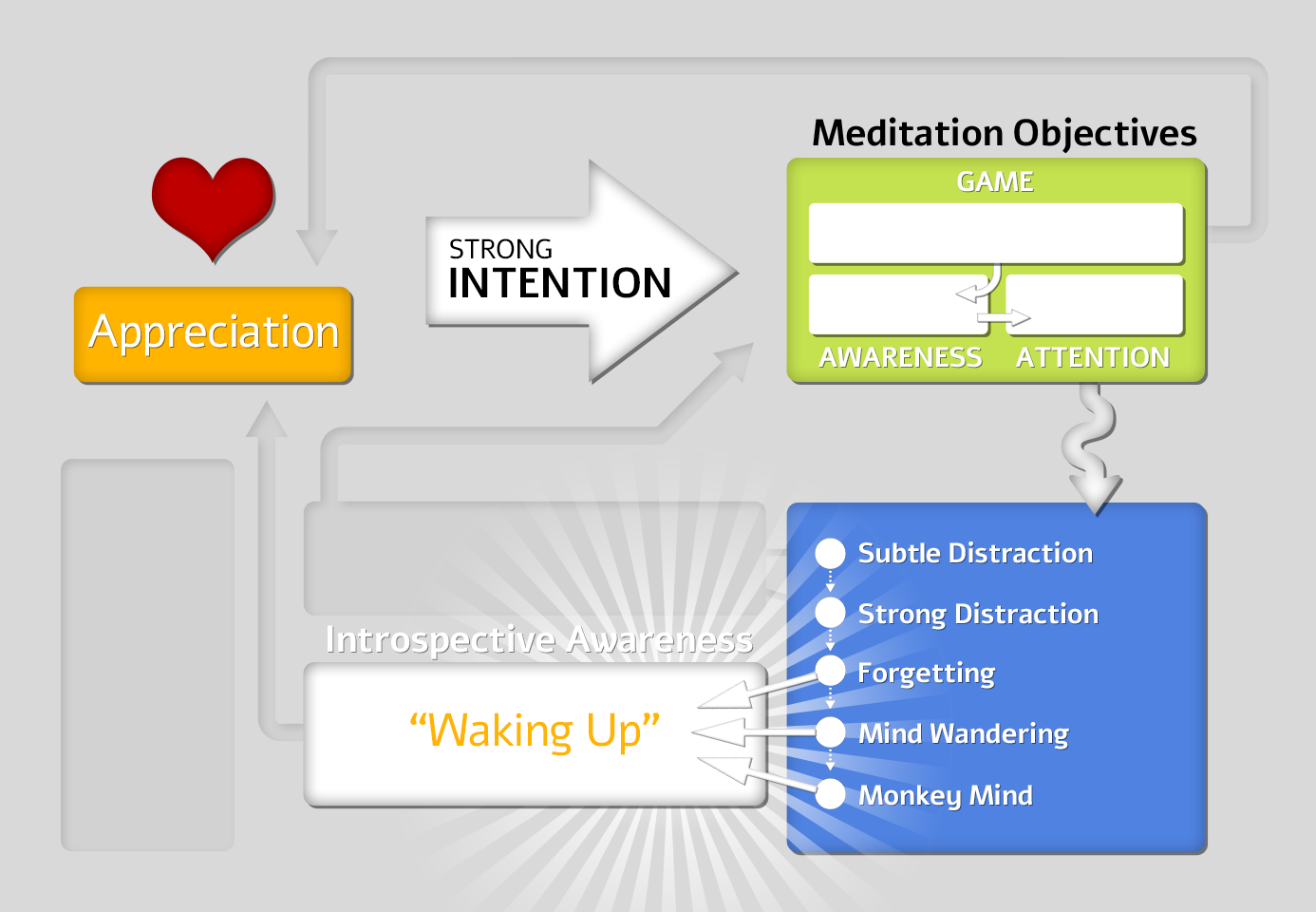
Sooner or later, we’ll Wake Up - noticing that the mind is now engaged with something other than what we intended.
Example: “Oh! I wanted to follow the sensations of the breath… but now I’m thinking about flamingos!”

This realization, too, happens without any conscious control. It’s a spontaneous moment of Introspective Awareness - becoming aware of what’s happening within the mind.
At first, this awareness may arise only after Attention has already wandered away from the Meditation Objectives. With training, however, a new mental service gradually develops within the domain of Metacognitive Introspective Awareness: the ability to recognize shifts in Attention and raise an alert whenever there’s a gap between the original intention and what actually occurs in a given moment.
The best way to develop this mental service, making it more frequent and eventually continuous, is through Appreciation.
APPRECIATION | ongoing
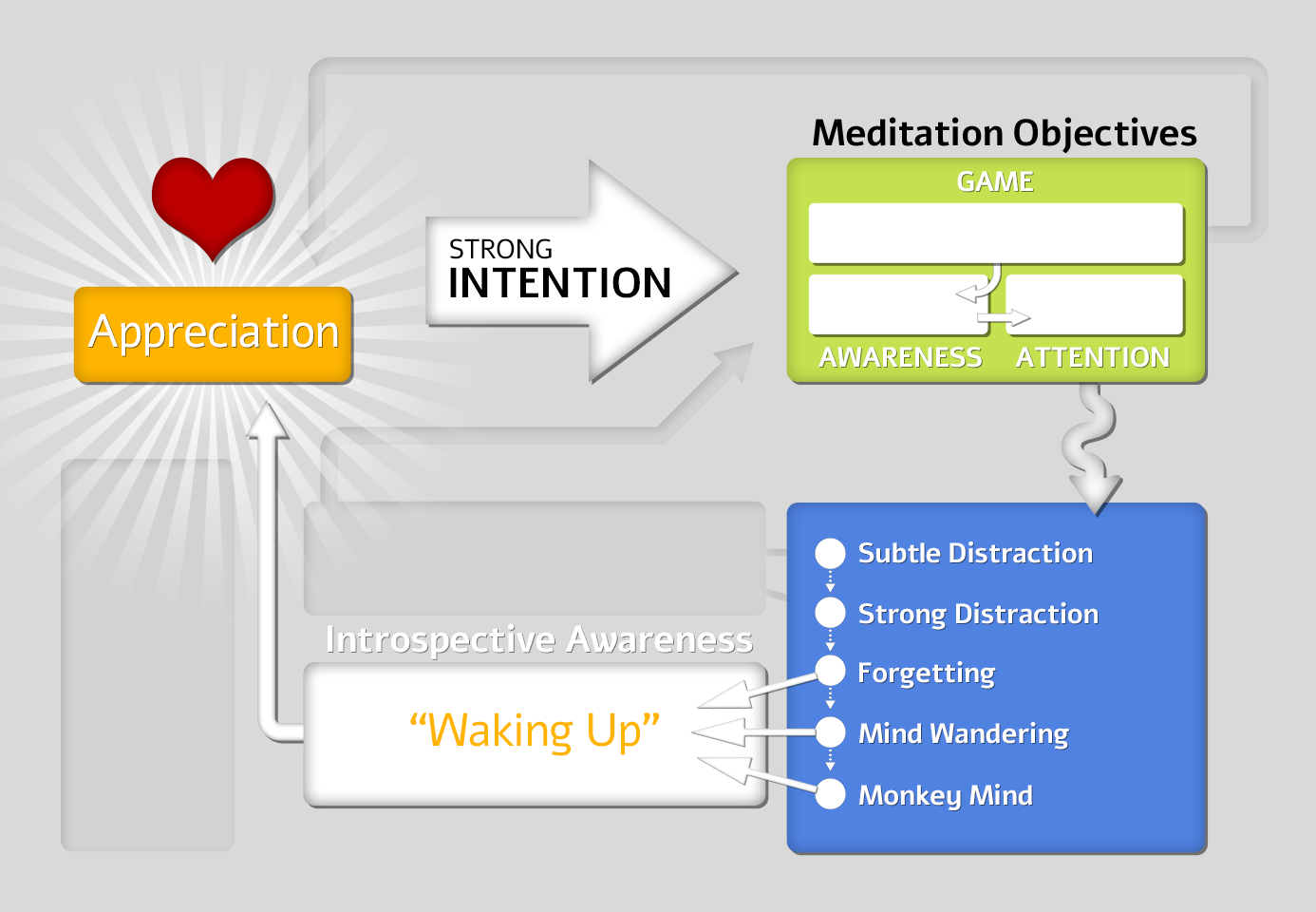
After Waking Up, it’s time to show Appreciation by offering positive feedback to the part of the mind that noticed the distraction: “Excellent! Let’s do it again. Let’s notice more often!”
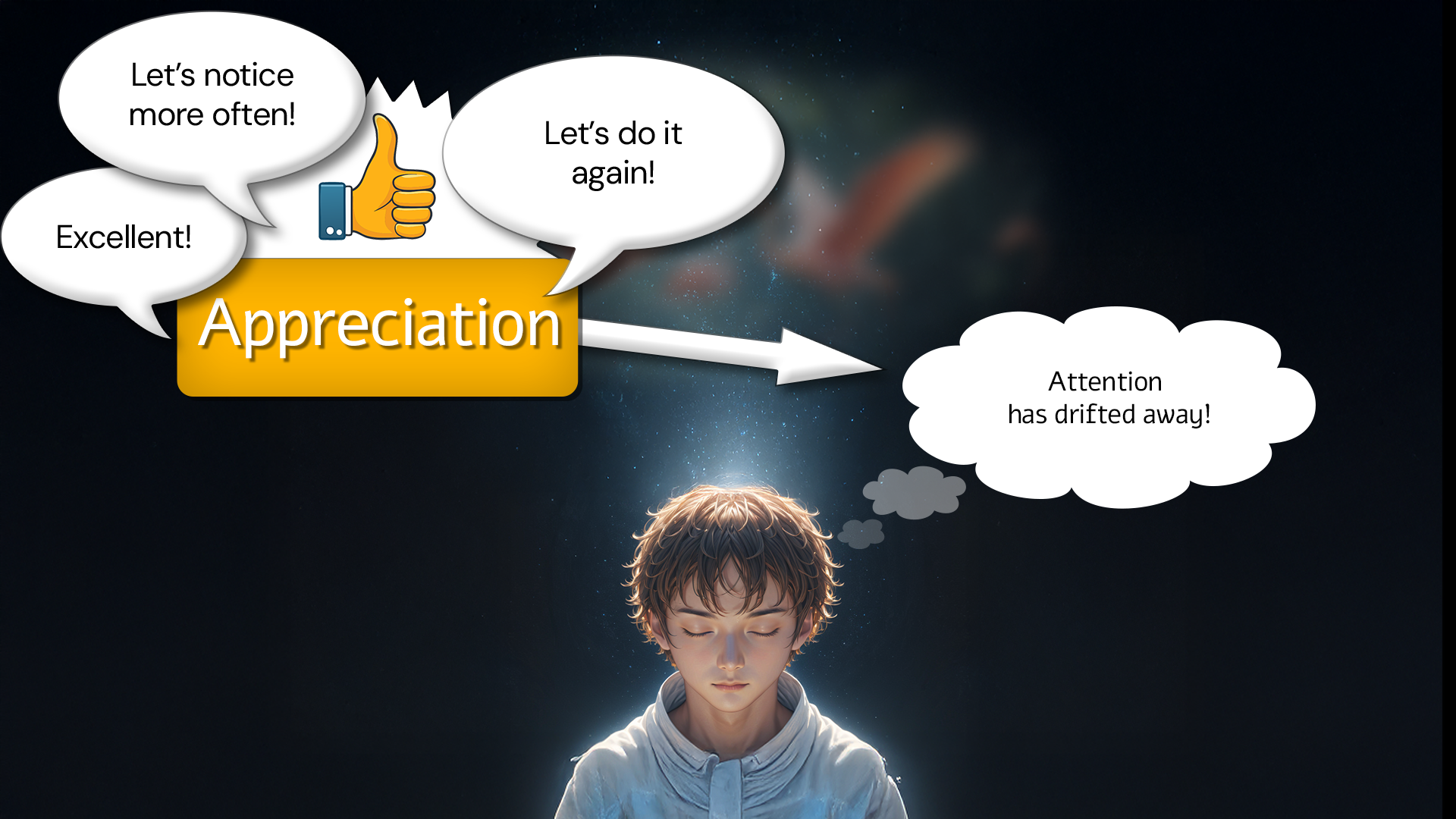
Positive feedback is the most effective way to strengthen that mental muscle, making it more powerful, more vigilant, and quicker to respond.
By contrast, if we take Waking Up for granted, meet it with indifference, or get frustrated for having been distracted, we end up punishing that helpful part of the mind - the very part that caught the shift in Attention and gave us a chance to correct course.
Doing so is counterproductive and can seriously stunt our progress - because it sends the mind the wrong message: that noticing distractions is irrelevant or unwanted. When the mind starts receiving that message repeatedly, it becomes less likely to wake us up in the future.
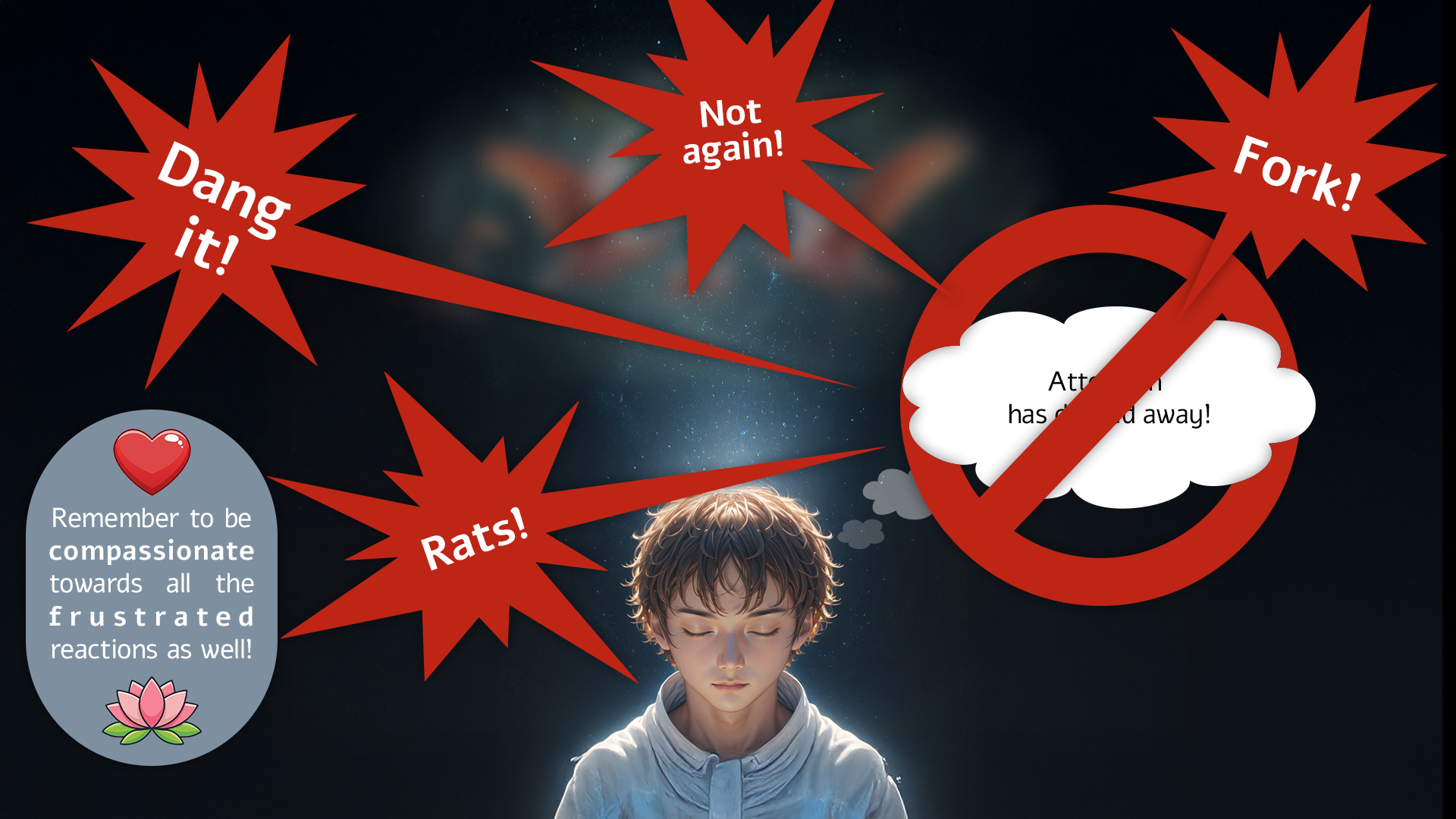
So, if you take only one thing from this article, let it be this:
You don’t have control over getting distracted, you don’t have control over noticing you got distracted, but you can influence your reaction when you wake up to the fact that it happened. That’s the heart of the mind-training process.
Train the mind like you’d train a beloved pet - a treat and a smile are far more effective for encouraging the behavior you want than scolding or neglect.
THE HEART | ongoing
Following Appreciation, we return to the Heart.
The distraction may have stirred up negative feelings, thoughts, or sensations. So, we bring things back into balance with the Attitude we wish to cultivate: Loving, Gentle, Unhurried, Playful, and Compassionate.
Then, rekindling our Strong Intention, we diligently return to the Game.
THE UPPER LOOP
Do note that as we practice with the Meditative Training Cycle, we don’t have to get distracted before revisiting Appreciation and Intention. We can continue to cultivate them mid-game by taking the Upper Loop:
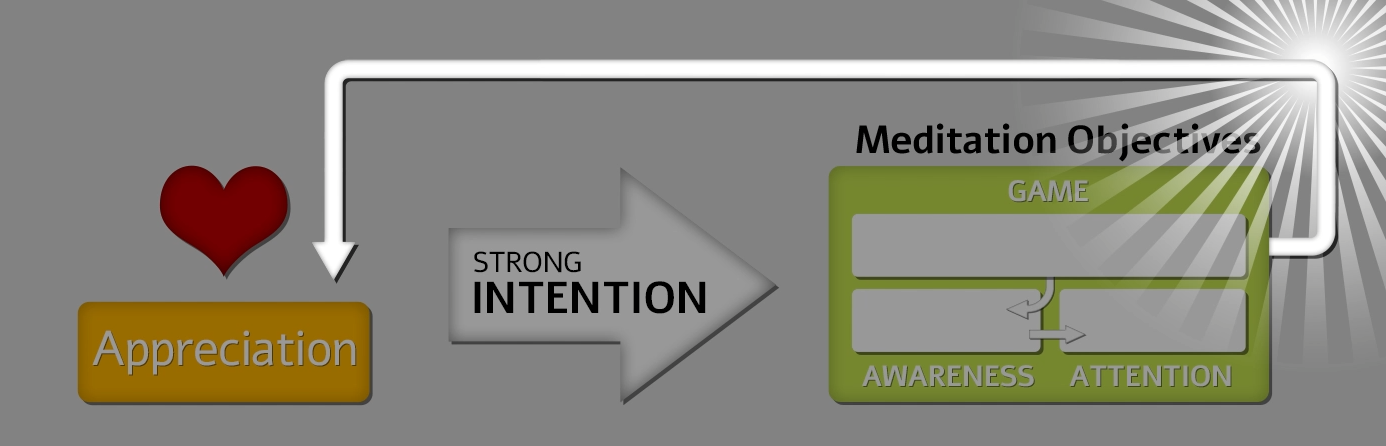
The Upper Loop is helpful in two kinds of situations:
When we’ve established a stable, distraction-free state, and are ready to move on to the next meditative challenge
When we’re mid-practice and want to reinforce a positive action or outcome, like completing a phase of the Meditative Game or achieving a desired result.
Example:
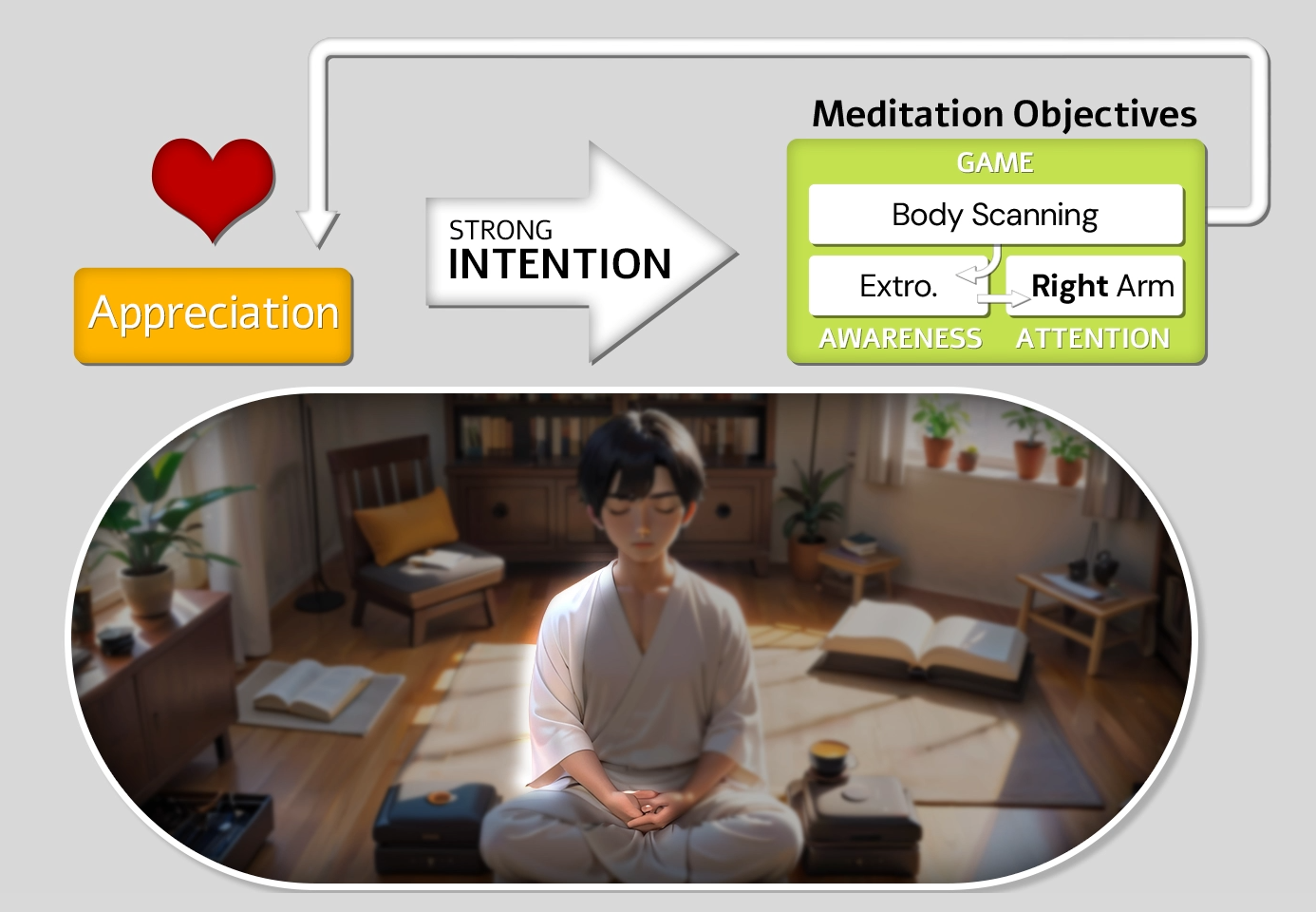
While Body Scanning, we finish scanning the right arm.
Then, we take the Upper Loop back to Appreciation - “Wonderful! Well done!”
Now, let’s set a Strong Intention to scan the left arm.
With the Triad we’re…
Playing the Game...
Maintaining peripheral Awareness...
Scanning for sensations with Attention...
Take the Upper Loop back to Appreciation…
…and the Cycle repeats.
STEP IN & GO BEYOND
With the guidance in this article, you can get started and achieve results.
As you head out to try the Meditative Training Cycle, remember that learning to use it can itself be approached as a Meditative Game. Be playful, take all the time you need to grow familiar with it, and review this article whenever you want to refresh your memory and refine your practice.
What’s Next?
Since the Meditative Training Cycle is essentially a framework, it can be thought of as a kind of “gaming console” capable of hosting a variety of Meditative Games.
Together, the MTC and the Meditative Games of The Playful Path to Awakening strengthen our meditative skills, gradually giving rise to higher, more refined meditative states. Their development can be mapped and understood through The Elephant Path, a traditional visual roadmap of the gradual mind-training process.
As we progress up The Playful Path, the MTC reveals additional elements:
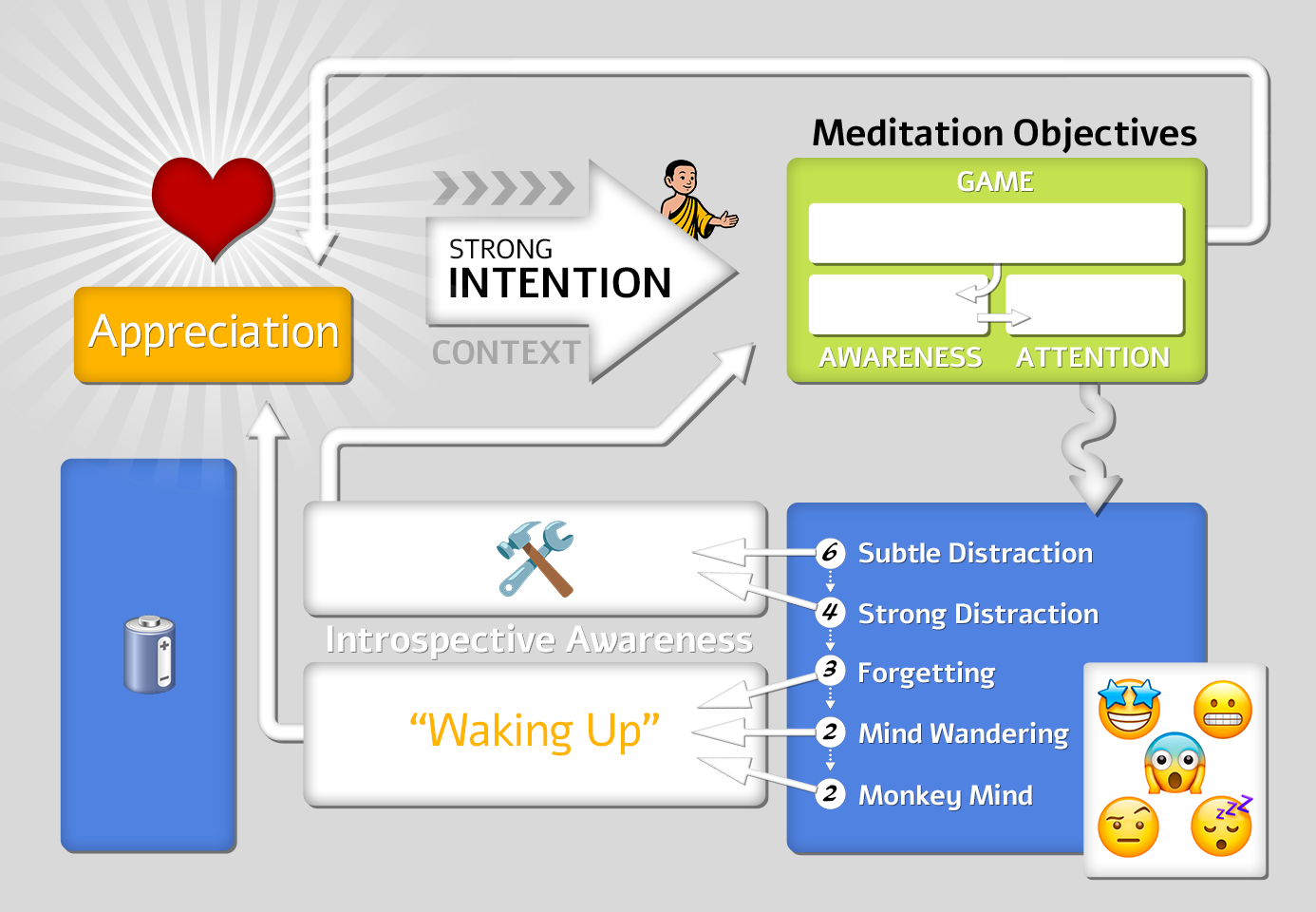
It adapts to support the nuances of advanced meditation techniques, offers tools for overcoming challenges, and unlocks deep meditative absorptions (Jhānic states), realizations about the true nature of reality, and profound insights with long-lasting, liberating effects. It leads all the way to Awakening.
If you aspire to reach this noble destination, I’d be happy to be your guide.
THE PRINTABLE VERSION
A printable, retreat-friendly version of The Meditative Training Cycle is included in the downloadable Playful Path document.
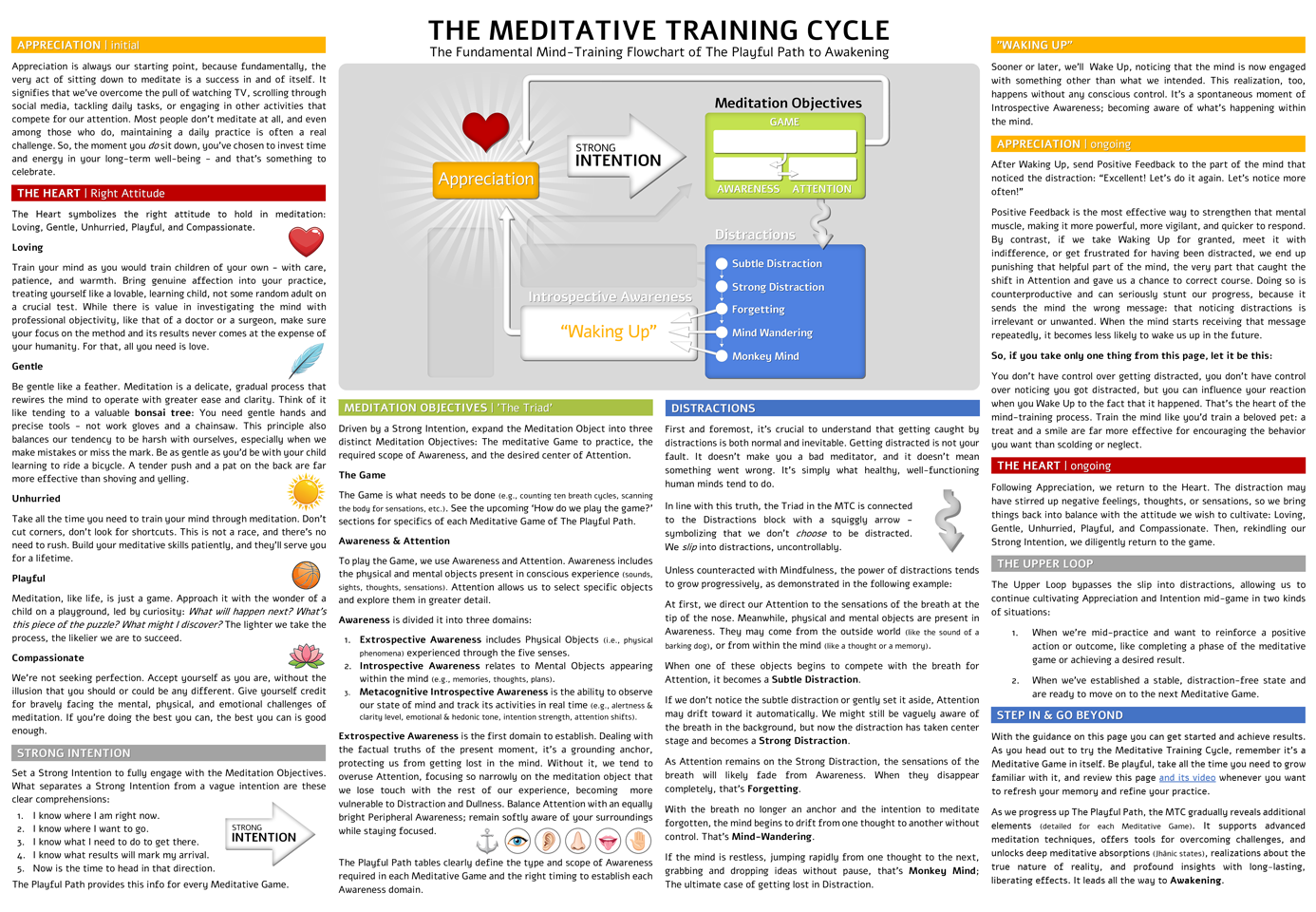
For those who wish to integrate these teachings into their practice space or meditation center, it is also available as a high-quality poster. Its properties are similar to the descriptive version of The Elephant Path Poster we offer.
Reach out for more details.