The Elephant Path
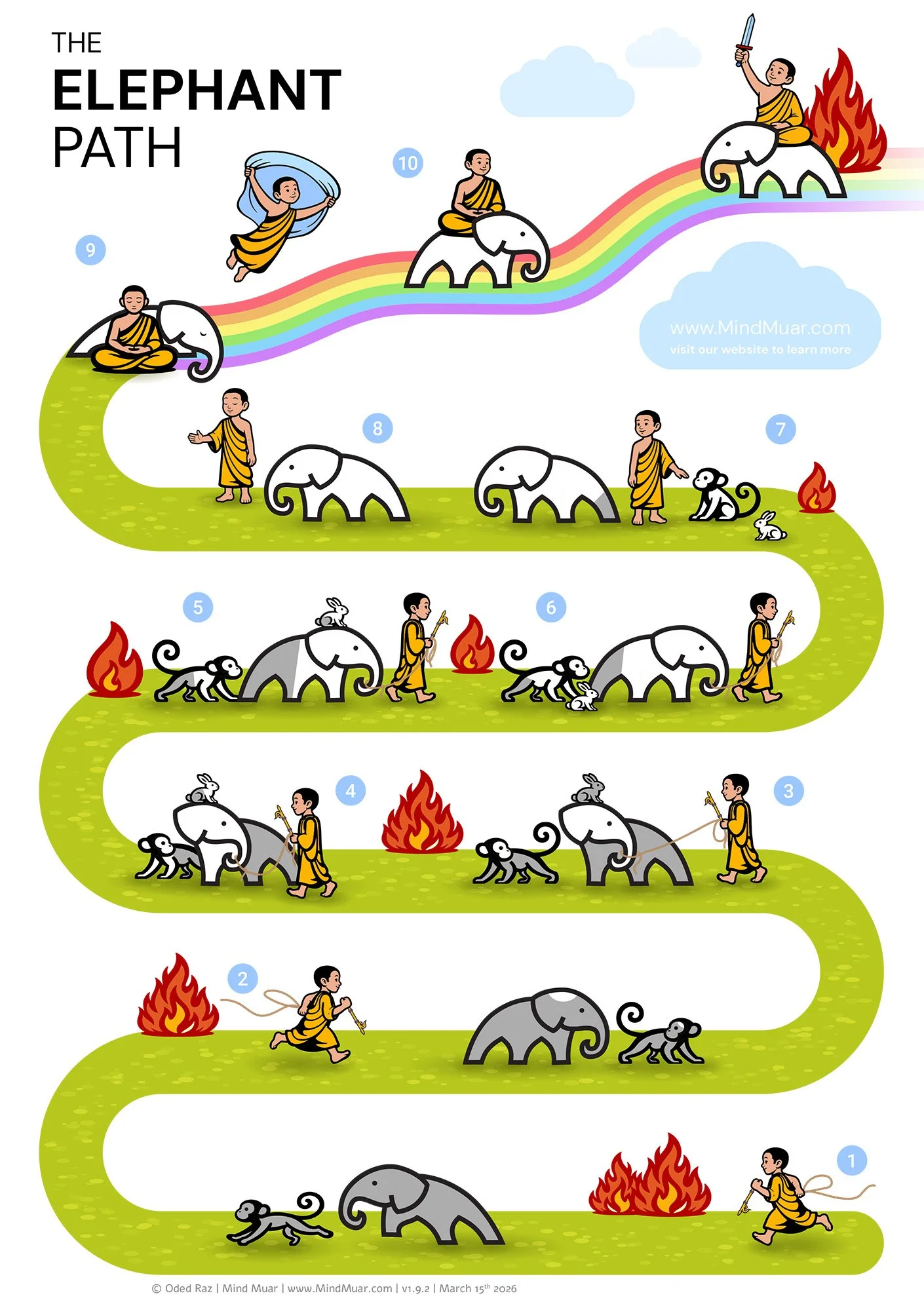
The Elephant Path Meditation Map
INTRODUCTION
What Is the Elephant Path?
The Elephant Path is a visual representation of the gradual mind-training process cultivated through samatha–vipassana meditation.
Originating in the 4th century with the Buddhist monk Asanga, it is a traditional roadmap popularized in The Mind Illuminated by Culadasa. Here, we present our revised, contemporary version of the model that focuses on the mental states we aim to cultivate. Its practical dimension (i.e., “what to do”) is outlined separately in Mind Muar’s Playful Path to Awakening, through its Meditative Games. They naturally move us through the Elephant Path stages without addressing them directly, simplifying the journey. The two paths complement each other, forming one integrated training system.
CONTEXT
The Traditional Context of the Elephant Path
The Elephant Path rests within a broader traditional framework - the Buddha’s Four Noble Truths and Noble Eightfold Path - and reflects the cultivation of mental clarity through disciplined meditation (Samādhi).
To learn more, see our Solid Traditional Foundations.
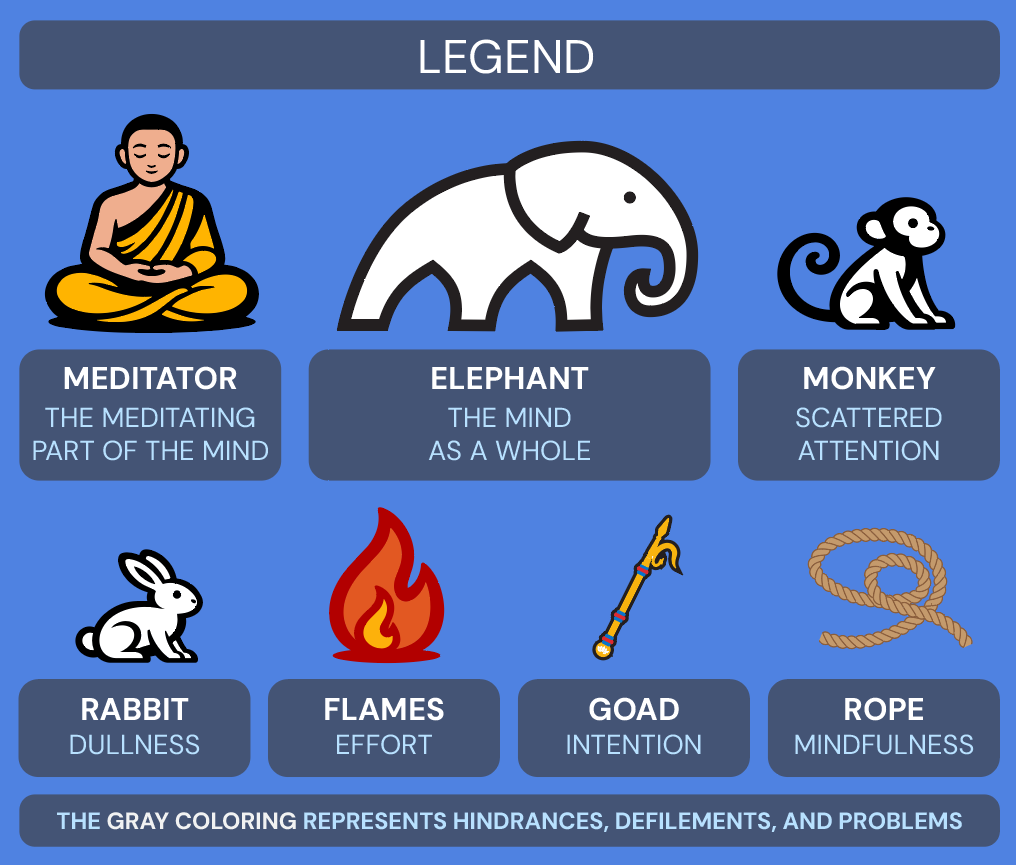
LEGEND
The Meditator - the part of the mind leading the meditative process
The Elephant - the mind as a whole
The Monkey - scattered attention
The Rabbit - subtle dullness
The Flames - required effort
The Goad - strong intention
The Rope - vigilant mindfulness
Gray Coloring - hindrances, defilements, problems:
The Five Hindrances - sensory desire, aversion & ill-will, laziness & lethargy, restless worry & remorse, doubt
The Seven Problems - procrastination & resistance; distractions, forgetting, and mind-wandering; Impatience; monkey-mind; self-doubt; dullness, drowsiness, and falling asleep; pain and discomfort
Defilements - mental obstructions and unwholesome qualities
THE TEN STAGES OF THE ELEPHANT PATH
STAGE ONE
ESTABLISHING A PRACTICE
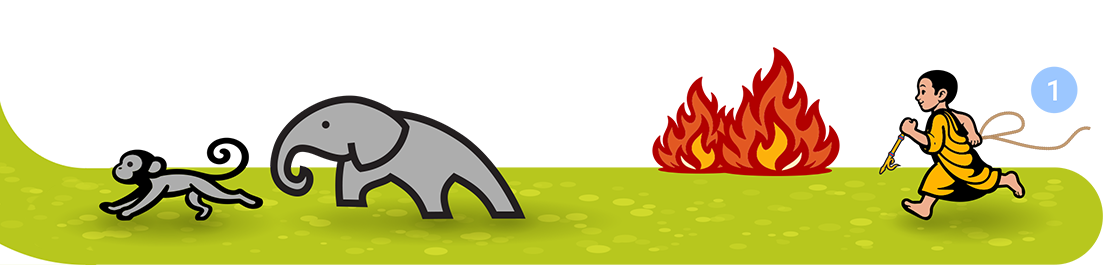
We start our journey with an untrained mind that behaves like a wild elephant. It is tainted grey by distractions, hindrances, and problems, and its attention is scattered, represented by the running monkey. Luckily, the determined meditator (the part of the mind that decides to follow the meditation instructions) comes to the rescue. His tools are the rope of vigilant mindfulness and the goad of strong intention. Chasing the mind takes a lot of effort, represented by the roaring flames. This is the most challenging stage of all.
STAGE TWO
INTERRUPTED ATTENTION & MIND-WANDERING
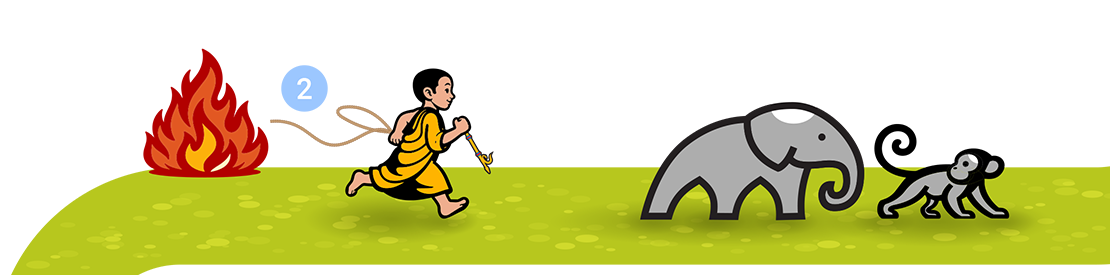
At this stage, the meditation session is mostly marked by mind-wandering. Less time is spent on the meditation object, as attempts to sustain attention are often interrupted by distractions. However, the elephant and the monkey now walk rather than run, signifying improvement. A first patch of white appears on the elephant’s head, showing that laziness, resistance, procrastination, and doubt are beginning to lose their grip. The monkey’s head also lightens, indicating that episodes of wandering attention are becoming shorter and less dominant. The meditator gradually closes the gap.
STAGE THREE
EXTENDED CONTINUITY OF ATTENTION
At this stage, the balance flips: the meditation session is mostly marked by sustained attention on the meditation object, and less time is spent mind-wandering. The elephant and the monkey continue to get whiter, as hindrances, problems, and forgetting are reduced. They are looking back at the meditator, now close by, signifying their response to his flame-fueled efforts. The meditator and the elephant gently hold the rope of mindfulness, allowing them to cooperate through mutual trust rather than a subduing force. The rabbit on the elephant’s head represents subtle dullness, which might lead to drowsiness and sleep - a new challenge to recognize and overcome.

STAGE FOUR
CONTINUOUS ATTENTION
At this stage, we no longer forget the meditation object, even when caught by distractions. It is also marked by the surfacing of charged memories and strong emotions in a process called Purification of Mind. The elephant and the monkey have slowed enough that slack appears in the meditator’s rope. The elephant grows whiter, indicating that laziness and lethargy are weakening. The monkey’s whitening signifies that mind-wandering is mostly overcome. The rabbit also whitens, reflecting the growing ability to recognize and counteract subtle dullness. Effort is still required, represented by the flame.

STAGE FIVE
INCREASING MINDFULNESS
At this stage, we increase the power of mindfulness, becoming extremely alert and attentive. Gradually, attention intensifies and clarity grows, until the vividness of conscious experience reaches new heights. The meditator takes the lead, using the goad of strong intention to guide the half-white elephant. Laziness and lethargy have been overcome, while other hindrances continue to weaken. The half-white monkey is tailing behind, no longer a strong distraction. The rabbit is half-white as well, indicating that dullness has become subtler. The flame is smaller, since the training now demands less effort.

STAGE SIX
SUBDUING SUBTLE DISTRACTIONS
At this stage, we begin to monitor the states and activities of the mind itself with metacognitive awareness, on our way to subduing even the subtlest of distractions. The meditator no longer needs to goad the elephant with intentions as often, as it follows him willfully most of the time. The monkey tailing behind has little influence, and is almost completely white, like the elephant. The hindrances are significantly weaker. The rabbit of dullness no longer burdens the elephant. Only a small flame remains, indicating that some effort is still required. Entering a state of flow, the practice becomes easier and more satisfying.

STAGE SEVEN
EXCLUSIVE ATTENTION & UNIFICATION
At this transitional stage, our energy is directed toward sustaining the distraction-free, dullness-free state, until it becomes effortless. The vigilant meditator allows the elephant to walk ahead, while guarding it from the monkey and the rabbit, so they don’t regain their destabilizing influence. The elephant is now almost entirely white, showing that most hindrances no longer intrude during meditation, except for the lingering tendencies of ill-will and agitation born of worry and remorse. A small flame continues to burn, as effort is still required to maintain this stability.

STAGE EIGHT
MENTAL PLIANCY & MEDITATIVE JOY
This blissful stage is marked by intense mental and physical pleasure. We enter the wondrous realm of deep meditative absorptions (jhānas), and experience intense meditative joy (pīti), as the practice becomes effortless. The meditator and the elephant reach full cooperation, as the elephant calmly aligns with every suggestion made by the meditator. The monkey and the rabbit have disappeared, as scattered attention and dullness no longer threaten the meditation. The elephant is now completely white, indicating that all hindrances are overcome. The flame has vanished as well, since effort is no longer necessary.

STAGE NINE
COMPLETE PLIANCY & TRANQUILITY
The meditator sits in deep meditation while the serene elephant rests at his side. This stage is marked by profound tranquility and equanimity, arising as the meditative joy matures and subsides. Pliancy becomes complete, encompassing both mind and body. We can enjoy hours of comfortable, effortless, stable meditation. The mind becomes extremely sharp, able to investigate reality and gain deep insight into its true nature. This is one of the most rewarding, wholesome, sustainable states of consciousness a human being can ever experience.

STAGE TEN
TRANQUILITY & EQUANIMITY
At this final stage, the qualities of stable attention, powerful mindfulness, joy, tranquility, and equanimity (fully developed śamatha) are no longer limited to meditation - they persist in daily life. The path ascends to the sky as a radiant rainbow, and the meditator flies above it, conveying the newfound sense of lightness and energy. Later, the elephant carries the meditator effortlessly on its back, symbolizing their harmonious integration. The mind has profoundly transformed, operating with clarity, efficiency, and ease.

BEYOND STAGE TEN
MATURE INSIGHT & AWAKENING
Time to light the fire again and make the final effort necessary for awakening (bodhi). The meditator turns around, now directing his efforts toward gaining wisdom and insight (vipassanā), represented by the sword he wields. His new challenge is to cut through ignorance and uproot the deepest mental defilements still buried in the depths of the mind. One by one, he severs the ten fetters* that bind his existence, becoming fully liberated.

* The ten fetters are: identity view, doubt, attachment to rites and rituals, sensory desire, ill-will, material desire, immaterial desire, conceit, restlessness, and ignorance.
THE PRINTABLE VERSION
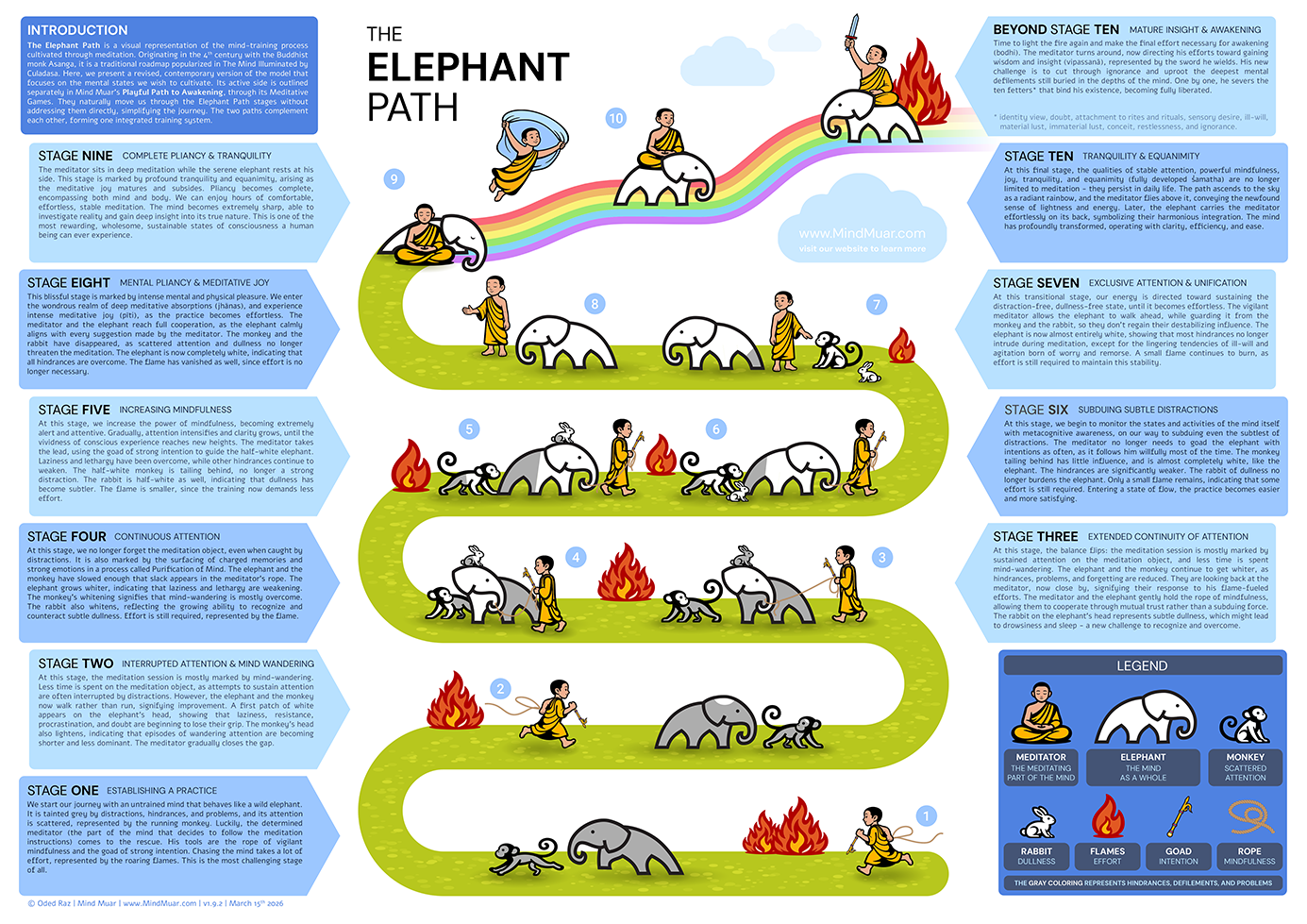
A printable version of The Elephant Path illustration is included in the downloadable Playful Path document. For those who wish to integrate this map into their practice space as both a functional reference and an aesthetic work of art, it is also available as a high-quality poster in two versions and multiple sizes.