Solid Traditional Foundations
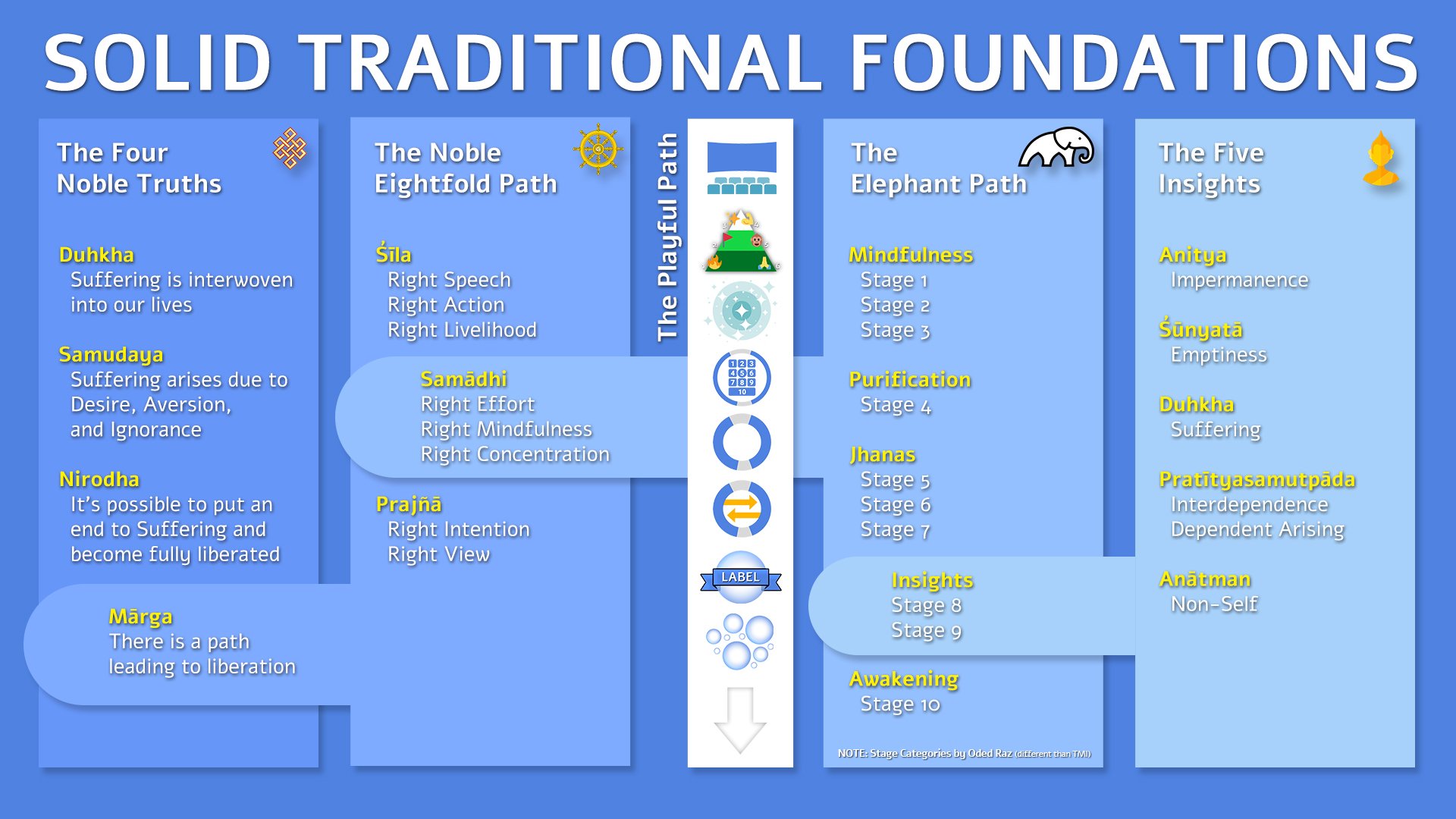
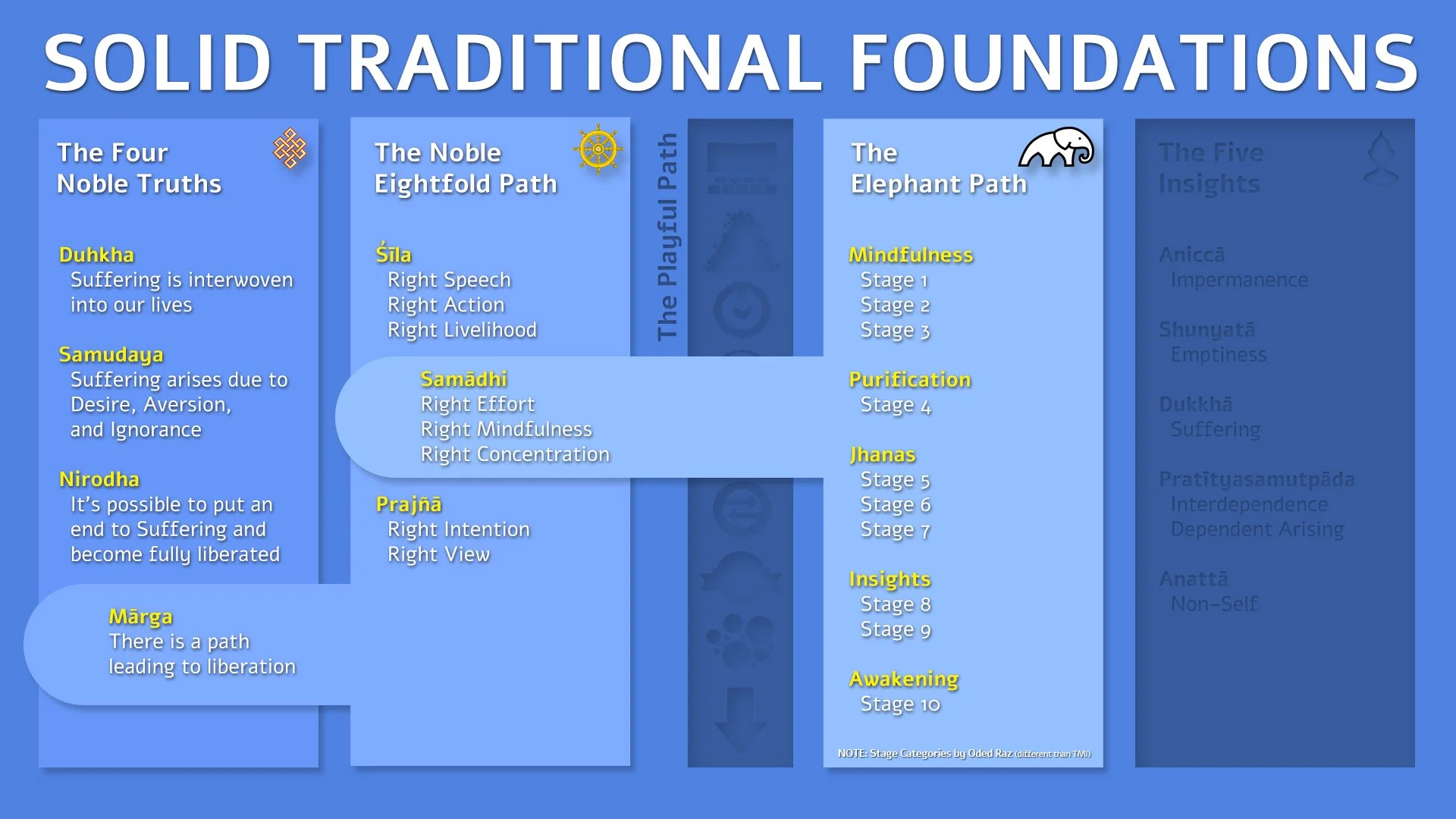
Our meditation method rests on solid traditional foundations:
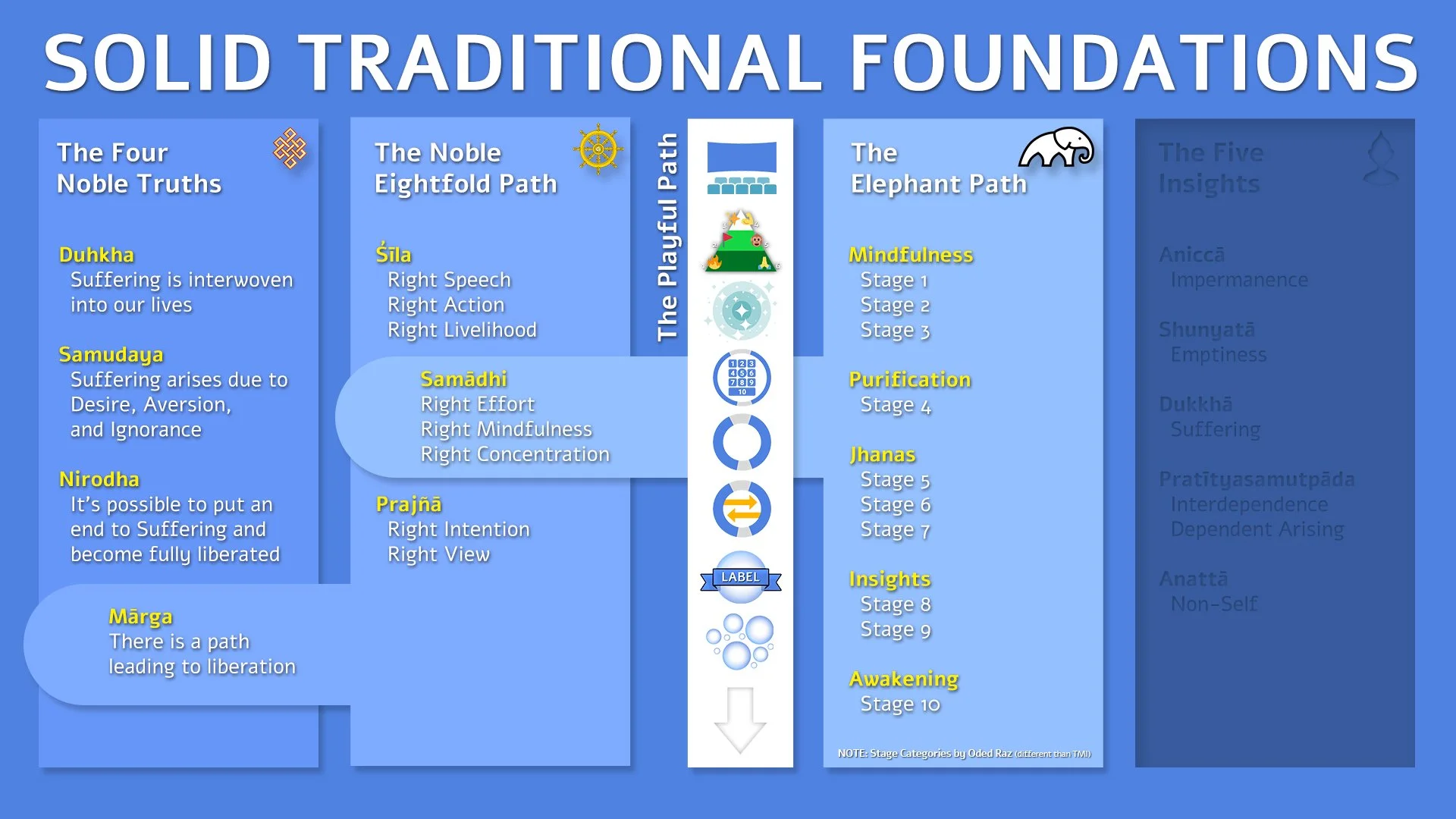
The Buddha’s Four Noble Truths and Noble Eightfold Path, and Asanga’s Elephant Path, as outlined in The Mind Illuminated by Culadasa. Its practical aspects are emphasized and further developed by The Playful Path. Together, they support the maturation of Five Insights that lead to Awakening.
INTRODUCTION
This article is part of the Meditation Adventure class, “Context for the Meditative Journey.”
It will help you see both the forest and the trees by placing meditation within the broader Buddhist framework, clarifying its purpose and where it leads.
The article outlines the traditional roots of our teachings, traces their later expression in Buddhism, shows how they are presented in The Mind Illuminated, and introduces original elements unique to Mind Muar. We encourage you to follow your curiosity and explore these subjects through independent research. You’re also welcome to ask questions on our Discord server; we’ll happily reply.
NESTED STRUCTURE
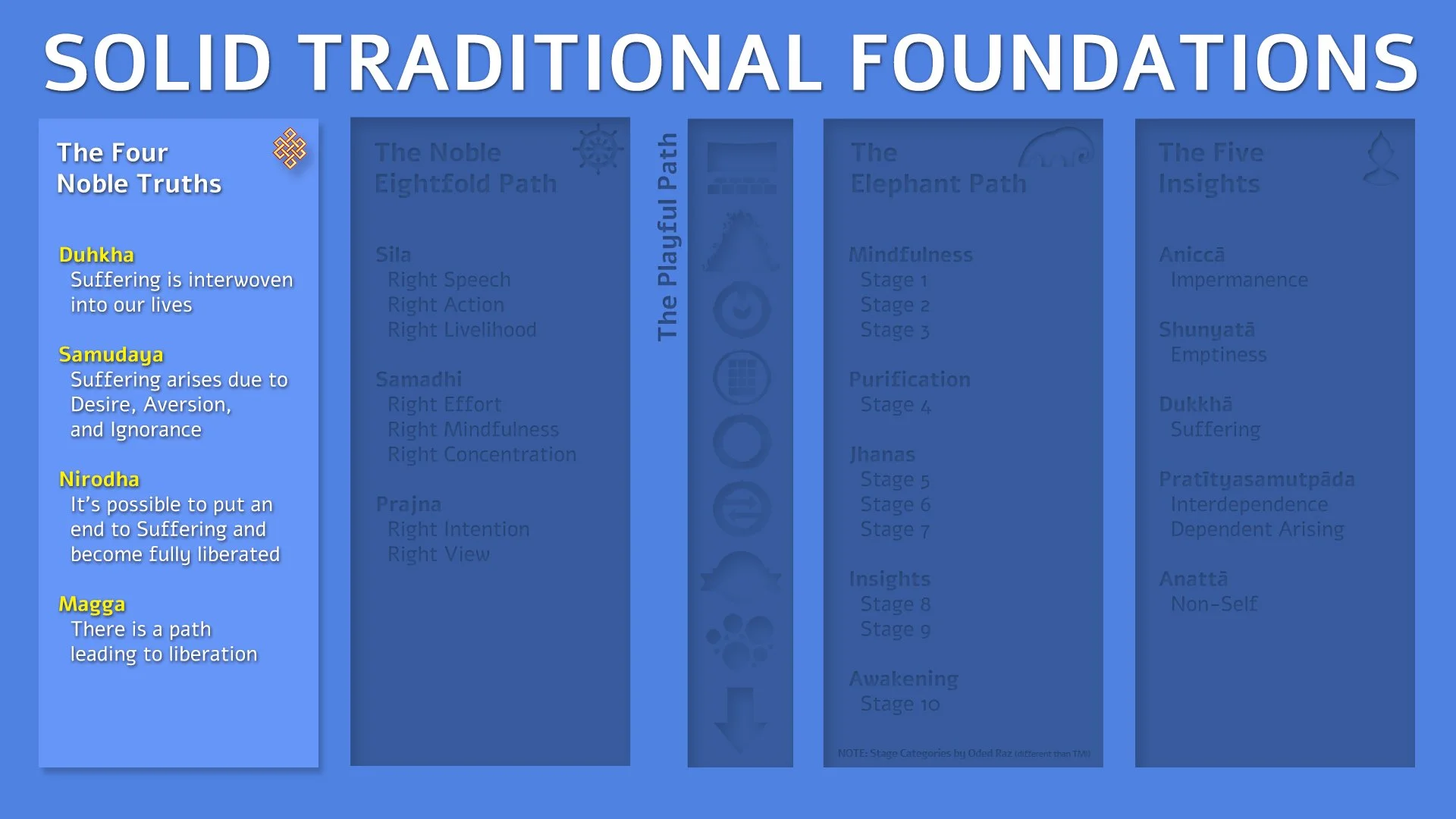
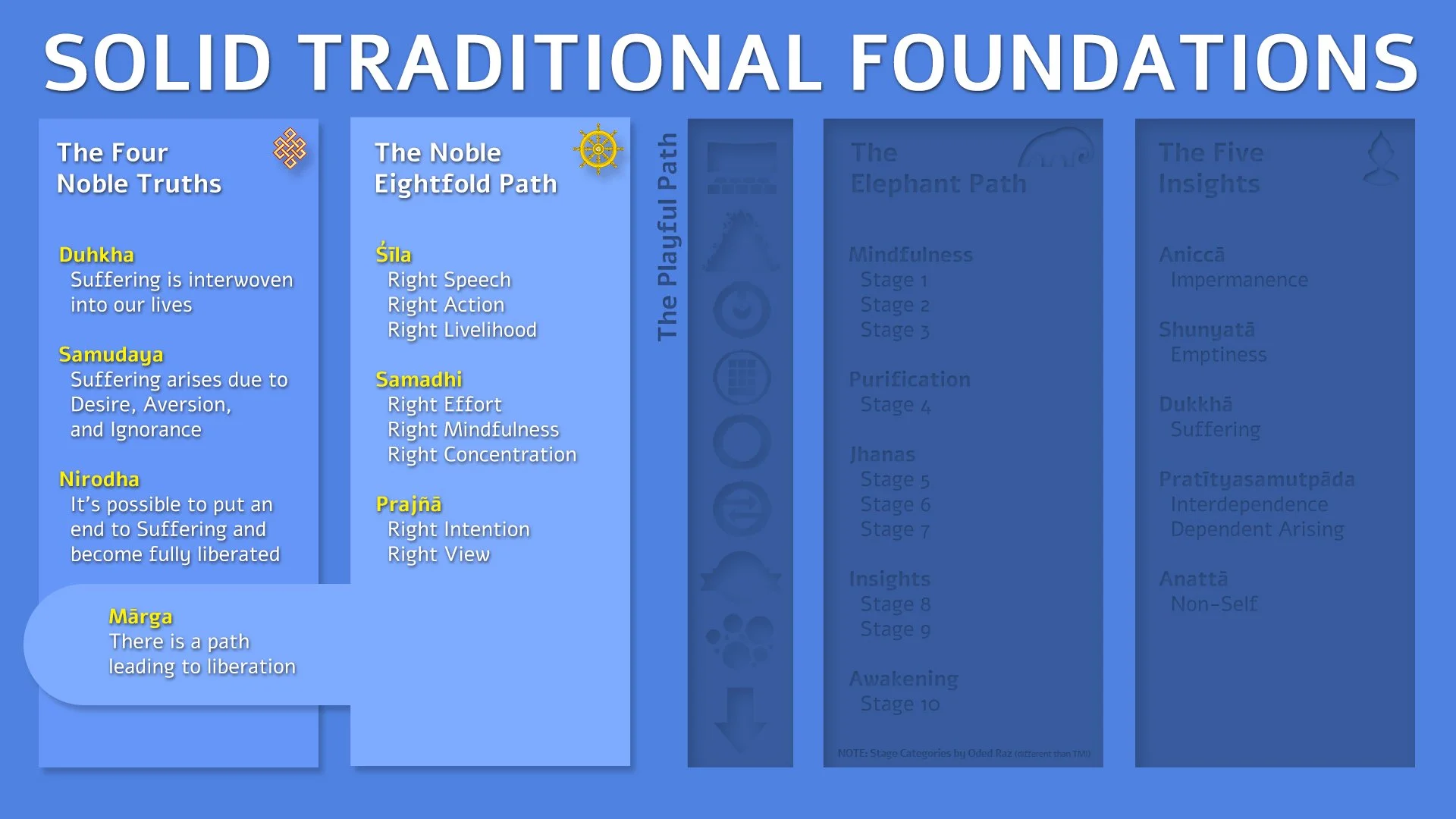
The blue diagrams provide context by showing how each foundation is nested within the one preceding it, helping us understand our meditation method’s place within the broader Buddhist framework.
LANGUAGES
The yellow terms in the blue diagrams are written in Sanskrit, reflecting the influence of later Buddhist traditions (Mahayana) on our teachings. To include early Buddhism (Theravada), whose scriptures were written in Pali, the article presents both Sanskrit and Pali terms alongside their English equivalents. In some cases, the spelling has been simplified.
THE FOUR NOBLE TRUTHS
The Four Noble Truths are The Buddha’s foundational teaching on the nature of suffering and the path to liberation. Like a skilled doctor, the Buddha recognizes the illness, identifies its cause, knows it is curable, and prescribes an effective treatment:
1st - Suffering (Duhkha / Dukkha)
Suffering is interwoven into human existence. As listed in the Mahā Satipatthāna Sutta, suffering is:
birth, old age, death
sorrow, lamentation, pain, grief, and despair
association with the unloved
separation from the loved
not getting what one wants
clinging to The Five Aggregates
2nd - Origin of Suffering (Samudaya / Samudaya)
Suffering arises through the mind’s tendency toward Craving (Trishna / Tanha, meaning “thirst”). This core concept can be further understood through The Three Poisons at its root:
Desire grasps at what seems pleasant or fulfilling.
Aversion pushes away what feels unpleasant, painful, or threatening.
Ignorance misperceives the true nature of reality, giving rise to illusions and false assumptions.
3rd - Cessation of Suffering (Nirodha / Nirodha)
It’s possible to put an end to suffering and become fully liberated. When the mind is free of craving, clinging, and ignorance, we find True Peace (Nirvāna / Nibbāna).
4th - Path (Mārga / Magga)
There is a path leading to liberation: the Buddha’s Noble Eightfold Path, outlined in the next section.
THE NOBLE EIGHTFOLD PATH
Formulated by Gautama the Buddha in the 5th century BCE, The Noble Eightfold Path consists of eight practices leading to liberation from suffering and to true peace. They cover three essential aspects of a virtuous life:
Supporting inner peace through ethical conduct (Śīla / Sīla)
Cultivating mental clarity through disciplined meditation (Samādhi / Samādhi)
Developing liberating wisdom through insight (Prajñā / Paññā)
Note: The ordering presented here is aligned with Mind Muar’s pedagogical approach and differs from the traditional order in the Buddhist canon.
ETHICAL CONDUCT (Śīla / Sīla)
Right Speech (Samyag-Vāc / Sammā-Vācā)
Right Speech involves:
Abstaining from lying, backbiting, slander, and any talk that could lead to hatred, enmity, or disharmony among people.
Refraining from harsh, rude, or abusive language, as well as idle, useless gossip.
Speaking the truth with words that are friendly, benevolent, pleasant, meaningful, and useful - at the appropriate time and place.
Right Action (Samyak-Karmānta / Sammā-Kammanta)
Right Action aims to promote moral, honorable, and peaceful conduct in one’s life:
Abstaining from killing or harming living beings
Not taking what is not given (i.e., stealing)
Avoiding harmful sexual conduct (e.g., adulterous, non-consensual, exploitative, manipulative, deceptive, addictive, or involving minors)
Right Livelihood (Samyag-Ajīva / Sammā-Ajīva)
Right Livelihood means earning a living through a profession that is honorable, blameless, and harmless to others. Trades and occupations that bring harm to others should be avoided, including:
Arms and lethal weapons
Drugs and intoxicating drinks
Poisons
Killing living beings
Slavery and human trafficking
Businesses that rely on deceit
Mind Muar extends this principle to refraining from gambling or other zero-sum financial activities, and advises choosing professions that generate genuine added value for the world and its inhabitants.
MEDITATIVE STABILITY (Samādhi / Samādhi)
Right Effort (Samyag-Vyāyāma / Sammā-Vāyāma)
Right Effort involves directing one’s energy toward four specific mental goals:
Preventing unwholesome states of mind from arising
Abandoning unwholesome states that have already arisen
Cultivating wholesome states of mind that have not yet arisen
Developing and perfecting wholesome states that are already present
Right Mindfulness (Samyak-Smrti / Sammā-Sati)
Right Mindfulness involves developing attentiveness across four specific domains:
The physical body (e.g., breath, posture, bodily processes)
The sensations in the body (e.g., their hedonic tone, arising and passing, with or without clinging)
The mind itself (e.g., states of mind such as focused, scattered, distracted, stable, exalted, or liberated)
The phenomena within the mind (e.g., hindrances, distractions, sensory and conceptual objects, and the seven factors of enlightenment)
These domains are thoroughly explained in the Mahā Satipatthāna Sutta.
Right Concentration (Samyak-Samādhi / Sammā-Samādhi)
Right Concentration involves cultivating stable attention to the point of entering four stages of deep meditative absorption (Jhāna / Dhyāna):
Desires and unwholesome states are abandoned, while meditative joy (Piti / Piti) and happiness remain.
Intellectual activity subsides in favor of single-pointed attention, while meditative joy and happiness are retained.
Meditative joy subsides and transforms into mindful equanimity.
All that remains is pure awareness characterized by deep tranquility and profound equanimity, with all sensations of happiness or sorrow fading away.
These meditative absorptions create the ideal conditions for acquiring insight and developing wisdom, the third aspect of The Noble Eightfold Path.
WISDOM (Prajñā / Paññā)
Right Intention (Samyak-Samkalpa / Sammā-Sankappa)
Also translated as “Right Thought,” meaning:
Thoughts rooted in renunciation or detachment
Thoughts of love and non-violence extended to all living beings
Thoughts free from selfish desire, hatred, and violence
Right View (Samyag-Drsti / Sammā-Ditthi)
Right View is also translated as “Right Understanding.” It is the highest wisdom that sees the true nature of reality and understands phenomena exactly as they are. Right View combines an intellectual understanding with a deep, intuitive, non-conceptual knowing that develops and matures through meditation. This wisdom is reflected in The Five Insights, outlined later in this article.
THE ELEPHANT PATH
The Elephant Path, originating in the 4th century with the Buddhist monk Asanga, is a visual representation of the gradual mind-training process cultivated through Calm-Abiding and Insight meditation (Śamatha-Vipaśyanā / Samatha-Vipassanā). This is the meditation technique we teach here at Mind Muar.
In its classical Tibetan presentation, the model outlines nine stages of settling the mind. It culminates in calm abiding (Śamatha/Samatha), upon which insight practice (Vipaśyanā/Vipassanā) is developed. In The Mind Illuminated, Culadasa adds an initial stage dedicated to establishing a consistent practice.
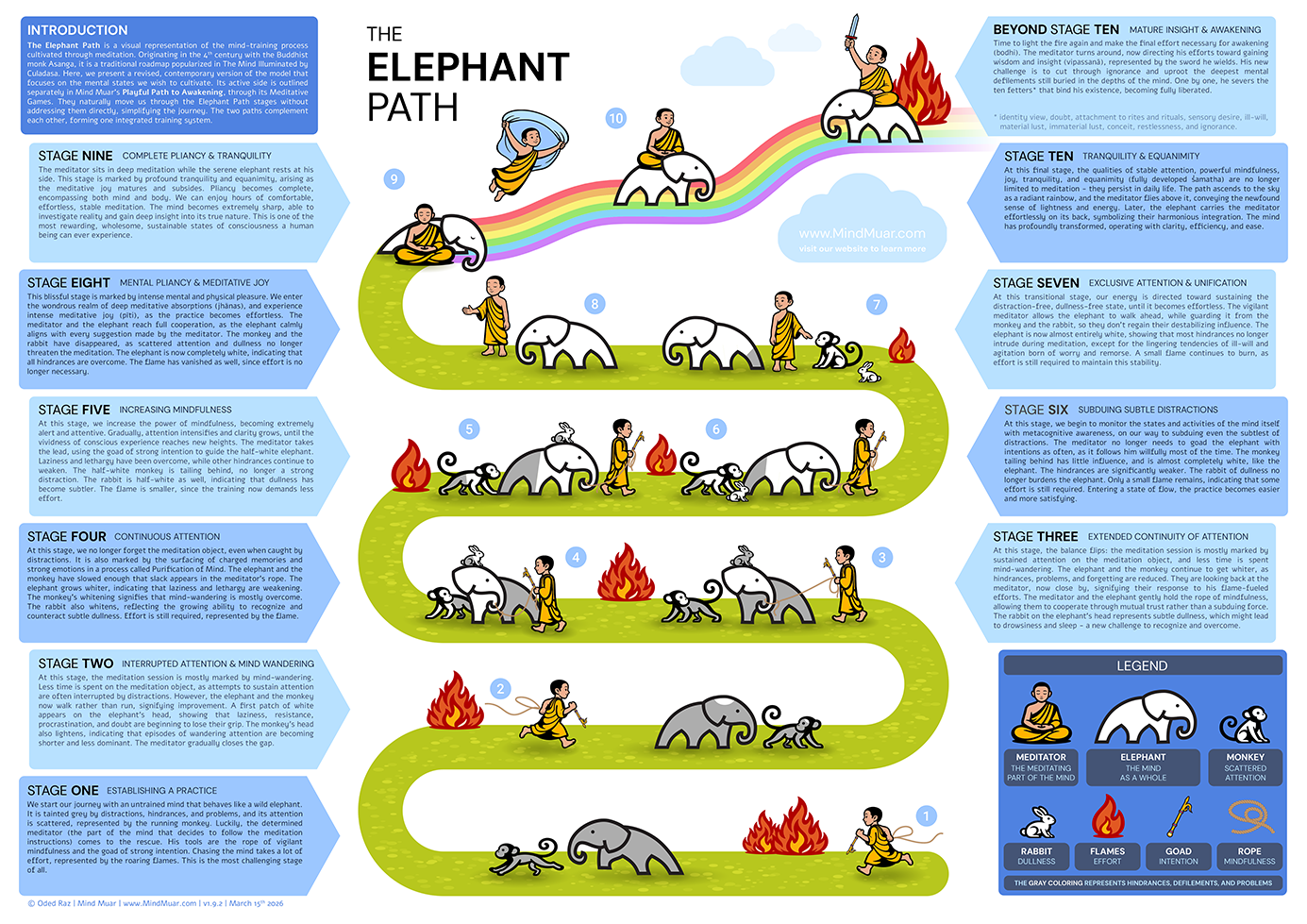
Inspired by Culadasa’s work, Mind Muar offers a revised, contemporary version of the model. It focuses on the mental states we aim to cultivate, as outlined in a dedicated article on our website. We also divide the path’s ten stages differently, grouping them by their central theme:
1-3 - Cultivating Mindfulness
4 - Purification of Mind
5-7 - Entering Meditative Absorptions
8-9 - Acquiring Insight
10+ - Awakening
Cultivating Mindfulness (Smrti / Sati)
The theme of stages one, two, and three is the development of bright awareness and stable attention - key factors in the cultivation of powerful mindfulness. These are the core tools we use throughout the meditative journey to overcome distractions and investigate the conscious experience.
Purification of Mind (Citta-Viśuddhi / Citta-Visuddhi)
The theme of the fourth stage is the meditative processing of deep unconscious material. As the mind grows calm and stable, charged memories and powerful emotions begin to surface in awareness. When met with equanimity and acceptance, these conditioned formations (Samskāra / Sankhāra) gradually release, allowing deep psychological healing.
Entering Meditative Absorptions (Dhyānas / Jhānas)
The theme of stages five, six, and seven is creating the conditions necessary for high meditative states to arise - the Jhānas. The power of mindfulness increases, distractions are subdued, and eventually, effort is no longer needed.
Acquiring Insight (Vipaśyanā / Vipassanā)
At the eighth and ninth stages, we effortlessly abide in Jhāna. The mind is sharp, stable, pliant, and ideal for exploring the true nature of reality. The theme of these stages is the arising of insight - profound, intuitive realizations that transform our understanding of ourselves and our world. These insights are outlined in the final section of this article.
Awakening (Bodhi / Bodhi)
At the tenth stage and beyond, when our meditative qualities persist in daily life, the theme is applying the effort necessary for Awakening. We continue to develop wisdom and insight, cut through ignorance, and uproot mental defilements, until we become fully liberated.

THE PLAYFUL PATH
The Playful Path, an original tool inspired by The Mind Illuminated, is where Mind Muar introduces its own innovation into these traditional models. The Playful Path simplifies Culadasa’s approach to meditation by creating a clear separation between the mental states we wish to cultivate on The Elephant Path and the actions we need to perform in meditation.
The Playful Path is a series of meditative games that naturally move us through The Elephant Path stages without addressing them directly. The two paths complement each other, forming one integrated training system.
The meditative games are designed to systematically develop the essential mental skills required for Awakening, including bright awareness, stable attention, powerful mindfulness, and profound equanimity.
Each meditative game comes with clear instructions, a laid-out rationale for its contribution, and well-defined objective indicators of success. This allows progress to be guided by concrete, observable results.
The Playful Path emphasizes joy and playfulness as central qualities that support effective and sustainable meditation practice over time. It also includes precision tools for overcoming challenges commonly encountered in meditation, such as mind-wandering, physical or emotional discomfort, dullness and drowsiness, agitation, impatience, desires, aversions, doubts, and more.
By clearly outlining the complete training process, The Playful Path ensures that we make the most of the time and energy we invest in meditation.

THE FIVE INSIGHTS
Culadasa speaks of five key realizations that form the core insights leading to direct Awakening. Traditionally, these insights are rooted in The Three Marks of Existence, Dependent Arising, and the empty nature of The Five Aggregates.
Impermanence (Anitya / Anicca)
This is the fundamental truth that all phenomena are in a constant state of change. No mental or physical object remains constant over time.
Emptiness (Śūnyatā / Suññatā)
This is the understanding that everything we experience is constructed and fabricated by the mind. All phenomena are empty of inherent self-nature and do not intrinsically possess the qualities we attribute to them.
Suffering (Duhkha / Dukkha)
This is the direct realization of how craving and clinging create suffering. It is closely connected to the clear comprehension of the Four Noble Truths.
Interdependence (Dependent Arising, Pratītyasamutpāda / Paticcasamuppāda)
This is the realization that all phenomena arise in dependence on causes and conditions. Nothing exists independently; phenomena arise through a web of interdependent conditions. Control is ultimately an illusion.
Non-Self (Anātman / Anattā)
This insight extends the understanding of emptiness - if all phenomena are empty, then we too are part of that same empty process. As this insight deepens, we recognize the illusory nature of a separate “I” (the ego-self) - a useful yet fictional construct of the mind. The maturation of this insight is often the final step, after which Awakening occurs.