An Extraordinary Experience
A Dark Vortex in Meditation:
Distraction, Insight, or Jhana Territory?
A Meditator’s Question:
During meditation, I had an experience impactful enough that I’m looking for guidance from more experienced practitioners. I hope I can describe it clearly without sounding completely unstable.
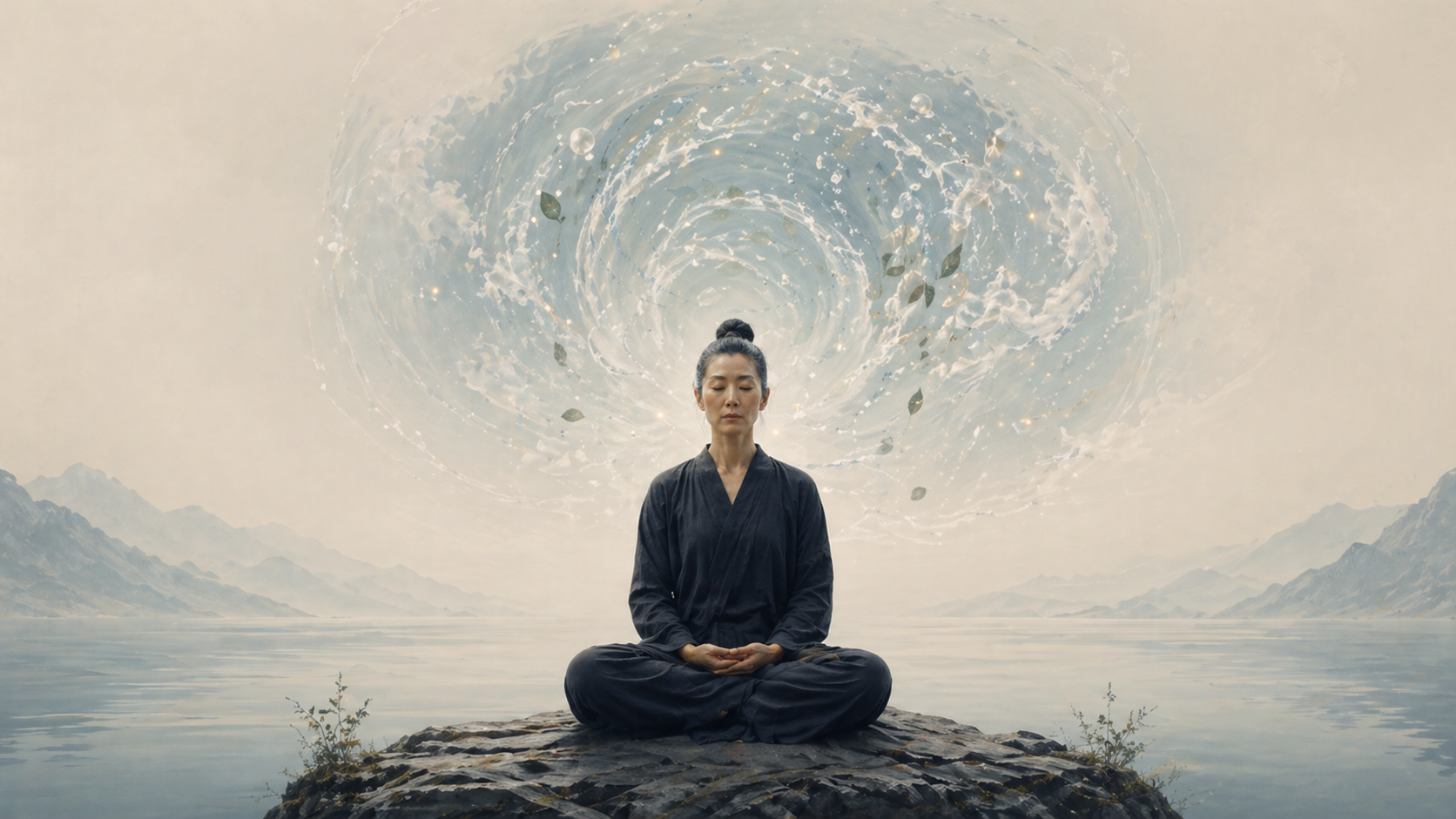
In the front and upper part of the head, extending inward from behind the forehead, there appeared a sense of density, pressure, and force. It felt like a dark ocean vortex - a dense center surrounded by a powerful current. The current seemed to affect everything nearby in a strange push-pull way, as though the center pulled at its surroundings while preventing direct access to itself.
The body, sounds, thoughts, attention, awareness, and intentions all seemed to be carried away from the center and around it, like foam, leaves, or driftwood circling the rim of a whirlpool. I am quite familiar with handling distractions and dullness, noticing and directing attention, and keeping awareness open. But when this phenomenon first appeared, it felt as if attention, awareness, and intentions were unable to penetrate through the dense center. Instead, they remained at a certain distance around it, faded and small, almost like whispers beneath the sound of rushing water.
I could only discern the edges of the phenomenon indirectly, by noticing how everything else gathered around its boundary without being allowed or able to pass through it. It did not feel dull, but it also did not feel vibrant. If I had to assign it a color, it would be dark rather than bright - like a murky hollow on a stormy night.
The body, or perhaps the conceptual feeling of the body, seemed to be pushed downward and around it, as though carried by the surrounding current. There was also a distinct sense that if I focused directly behind the forehead, I might be pulled inward, like being drawn toward the center of the whirlpool. Because of that, I avoided focusing on it directly.
The phenomenon itself did not feel frightening or worrying, apart from what I attributed to it once it appeared. At the same time, it did not feel pleasant or wholesome, nor did it inspire curiosity or a wish to explore it further.
I do not currently wish to have an insight experience, because I would like to avoid the difficult aspects I have heard about, such as the Dark Night, dissociation, depersonalization, or insight without joy. My intention in learning meditation is first and foremost to develop a refined capability of attention and awareness - basically, the jhanas - as much as one can influence the direction of practice.
For context, I would describe myself as practicing around Stage 6 of The Elephant Path. I sit for 45 to 60 minutes daily, sometimes for two sessions per day. This experience arose around the 40-45 minute mark of an hour-long sit. At that point, the mind had settled, attention was doing its thing, awareness was open, and metacognitive introspective awareness (MIA) was more or less present.
I am at the stage where I can sort of understand what MIA is, but I do not yet have a solid grasp on the distinction between it and introspective awareness.
Does this make sense as a familiar meditation experience? How should one relate to this kind of dense, dark, vortex-like phenomenon in practice? Should it be explored, ignored, treated as a distraction, or approached in some other way?
Oded’s Answer:
Thanks for sharing. It sounds like a powerful experience. I’m happy to make sense of it together.
First, let me assure you: you’re not “unstable.” Such extraordinary experiences are normal and expected as we move beyond Stage 6 of The Elephant Path into the realm of the Jhanas. It’s a good sign that your efforts are bearing fruit. It’s a notable milestone in your practice, from which new experiences and realizations can gradually emerge, should you navigate them carefully and skillfully.
As for the phenomena you describe, they sound like initial Piti - turbulent meditative joy. It can manifest in wild and unusual ways as the unified and purified mind begins to release the energy once stored in inner conflict, making it available to the whole mind-system. To use Culadasa’s analogy in TMI, it’s like a roaring mountain stream. While Culadasa speaks of turbulent water bashing against jagged rocks, you describe a dark ocean vortex, with foam, leaves, or driftwood circling its rim - but the process itself is identical. You’re experiencing the tension between new pathways and lingering blocks, which give rise to unique sensations and bizarre images in both body and mind.
Next, let’s talk about how to work skillfully with such experiences. My first recommendation would be to set a clear goal of remaining as equanimous as you can in the face of the fireworks. “Cool guys don’t look at explosions.” The remarkable novelty of such experiences is a powerful distraction, and the sense that “something important is happening” poses the temptation to direct our attention to explore what’s going on, or to fear that “we’ll miss out.” It also manifests as the mind’s attempt to make sense of what’s happening, through the vivid imagery and analogies you’ve described so beautifully. However, it is a subtle form of the trap of Discursive Brilliance, and should be let go of like any other distraction.
To the best of your ability, be extra-determined to maintain single-pointed, directed attention on the sensations of the breath, while letting the Piti-related drama take place in the background. This means you no longer care about the objects in Introspective Awareness, but shift into working with Metacognitive Introspective Awareness (MIA). I’ll clarify the difference:
Introspective Awareness monitors individual mental objects, like thoughts, memories, and images. MIA, on the other hand, is the refined ability to continuously observe the overall state and ongoing activities of the mind itself. In your case, as the Piti rises, it means you shouldn’t be bothered by questions such as “is this phenomenon like foam circling a whirlpool or being drawn toward a dark ocean vortex?”, but instead observe the objective properties of the conscious experience in which it appears. To cultivate MIA, I recommend starting by identifying states of mind. How vivid and clear is your perception? How’s the level of alertness? What’s the predominant emotional tone (joyful, agitated, impatient, excited)? How’s the hedonic tone - pleasant, unpleasant, or neutral?
The more you succeed in balancing single-pointed directed attention with powerful MIA, the deeper you’ll enter the jhana. Eventually, it will become stable, require less or no effort, and the extraordinary Piti will subside in favor of tranquility and equanimity.
Now, let’s talk about Insight (vipassana). You said you don’t want an Insight experience because of its potential negative aspects, and I understand your concern. However, I must clarify that whether you like it or not, you’re already in Insight territory. Insights into the true nature of reality aren’t something you “do”; they present themselves of their own accord. Therefore, it’s better to be prepared for their arrival and even welcome them. Aversion, as you probably know, is a source of suffering, so paradoxically, the attempt to escape a negative experience might be the very thing to bring it forth.
The good news is that samatha, the joyful, equanimous, tranquil state of mind accompanied by powerful mindfulness and stable attention, can significantly reduce the negative effects of Insight, or even eliminate them completely. You already got a taste of samatha, and with practice, it’ll become more powerful and refined.
Beyond that, as long as you’re well-informed and well-guided, you have little to worry about. The Dark Night is not mandatory, and even if it does present itself, it can be skillfully dealt with and overcome. I assure you, the true peace that awaits when the Insights fully mature is far better than any temporary jhanic state achieved by samatha alone. Don’t settle for half a journey.
Good to have you here - I’m rooting for you.
With Metta,
Oded