TMI & MTC
The Mind Illuminated
&
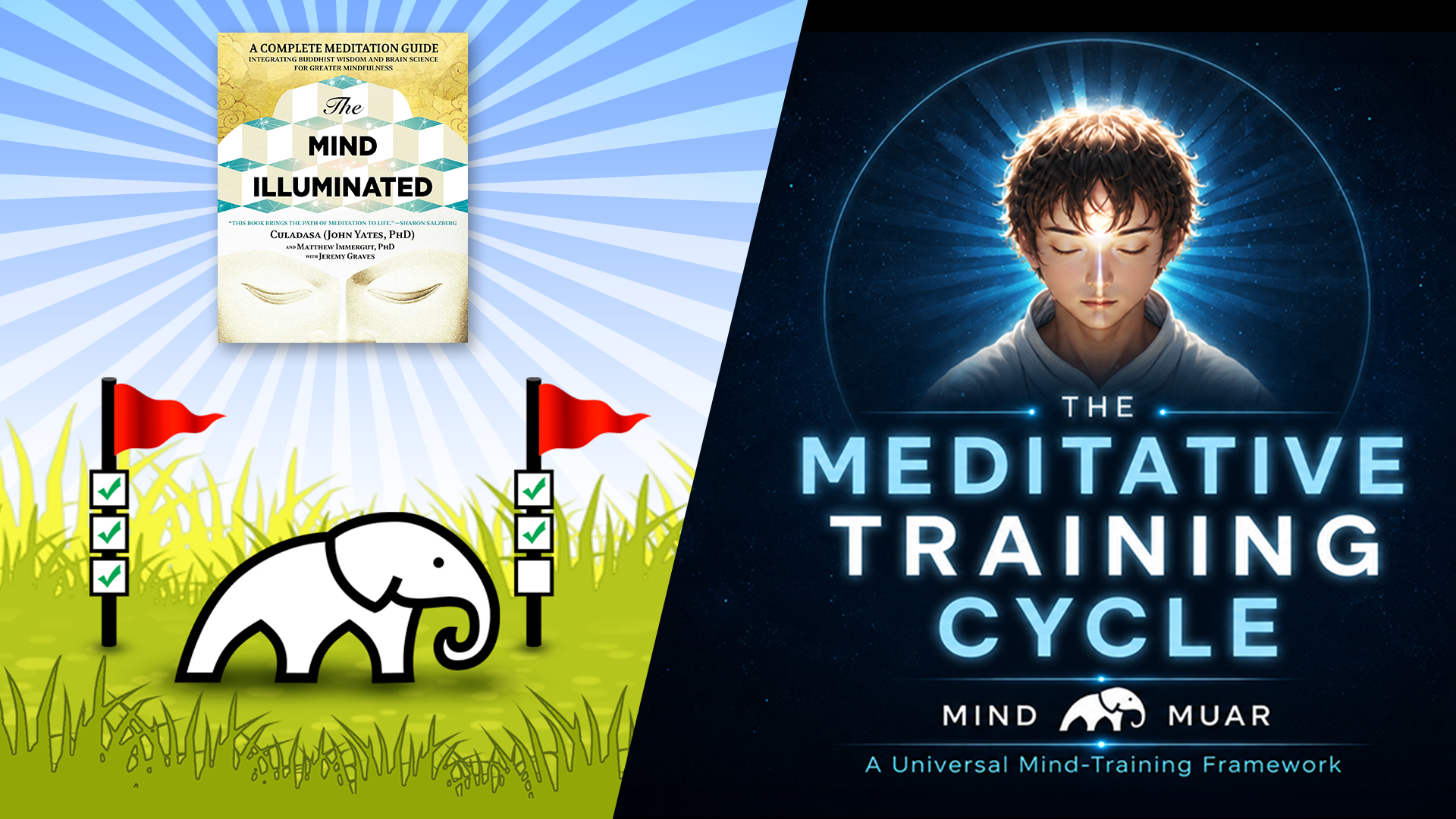
The Meditative Training Cycle
Context for This Comparison
This article is one part of a comprehensive project comparing The Mind Illuminated (TMI) with The Playful Path to Awakening (TPP). Each article examines a specific area of the relationship between the two systems.
This installment focuses on The Meditative Training Cycle (MTC), its foundations in TMI, and the practical and visual developments through which TPP reorganizes those foundations.
The project is guided by a commitment to full transparency, the utmost respect for Culadasa and the body of work he created, and the highest standards of academic rigor. Claims about TMI are grounded in the text and visual materials of The Mind Illuminated. Claims about TPP and the MTC are grounded in Mind Muar’s current public materials. Shared principles, differences in organization and practice, elements TPP makes explicit or adds, and areas TMI explains in greater depth are examined separately.
TPP and the MTC rely on the theoretical models presented in TMI. Their developments concern meditation practicalities, terminology, pedagogy, organization, visual architecture, and skillful means. This comparison credits what is inherited, identifies what has been consolidated or extended, and states where Mind Muar introduces a distinct treatment. References are provided so readers can examine the sources, follow the reasoning, and evaluate the conclusions for themselves.
Overview
TMI supplies the underlying principles of cyclical training used by the MTC: conscious intention directs behavior; Attention and peripheral Awareness work together; distraction is treated as a normal and recurring condition; it is initially recognized through spontaneous Introspective Awareness and, with training, increasingly continuous monitoring develops within Metacognitive Introspective Awareness; and positive reinforcement strengthens useful responses.
TMI’s visual teaching system is broad: it formally lists 57 figures and seven tables and also uses unnumbered diagrams, repeated Stage panels, and multi-page illustrated sequences.
The MTC was developed from a narrower family of six visually related, condition-specific practice-feedback circles across Stages Two through Four, rather than from the whole of TMI’s visual system.
The MTC integrates the circles’ recurring elements into one reusable architecture and assigns fixed visual elements to Appreciation; the Heart, representing Right Attitude; a distinct Strong Intention step; and the Triad, representing the Three Meditation Objectives.
The MTC also depicts the normal and inevitable slip into varying degrees of distraction; multiple recognition, correction, and recovery routes; and an Upper Loop that strengthens Appreciation, Right Attitude, and Strong Intention when distraction is not an issue.
Shared Training Principles
| Aspect | The Mind Illuminated (TMI) | The Playful Path to Awakening (TPP) |
|---|---|---|
| Attention & Awareness | TMI distinguishes Attention from peripheral Awareness and trains their balanced interaction as an aspect of mindfulness. | TPP likewise distinguishes them and defines the relevant scope of Awareness and desired center of Attention so they remain coordinated within the Triad. |
| Cyclical Training Through Distraction and Return | Across six related feedback circles in Stages Two through Four, TMI repeatedly links practice, distraction or its early detection, a corrective response, and return to the breath. The sequence develops from Waking Up after mind-wandering toward proactive and increasingly automatic correction. | The MTC preserves this cyclical learning logic in one diagram: recognize a mismatch at any displayed degree of distraction, appreciate Waking Up, restore Right Attitude through the Heart, renew Strong Intention, and return to the meditation object as expanded by the Triad. |
| Training Through Repeated Intention | TMI teaches that clear intentions, repeated redirection, and immediate positive feedback train unconscious processes that cannot be controlled directly. | TPP makes the same learning process visible as a repeatable loop: establish Strong Intention, play the Game, recognize what occurred, give positive feedback, and return. |
| Appreciation After Recognizing Distraction | TMI instructs practitioners to pause after the “aha” moment, enjoy and appreciate being conscious again, and thereby reinforce the process that recognized mind-wandering. | TPP gives this response a permanent visual element called Appreciation and uses it as the starting point, after Waking Up, and after successful action through the Upper Loop. |
| Non-Adversarial Attitude | TMI distributes the intended attitude across different Stages, practices, interludes, and sections through instructions to relax, enjoy practice, cultivate joy, avoid self-criticism, and apply diligent but non-forceful effort. | TPP consolidates a compatible Right Attitude into a clearly defined visual element: the Heart, whose qualities are Loving, Gentle, Unhurried, Playful, and Compassionate. |
| Attention Without Losing Awareness | TMI warns that excessive narrowing of Attention can weaken Awareness and might lead to dullness. | TPP likewise keeps the relevant scope of Awareness bright while Attention engages the selected object or action. |
Different Ways of Organizing Practice
| Aspect | The Mind Illuminated (TMI) | The Playful Path to Awakening (TPP) |
|---|---|---|
| Cycle Architecture | Stages Two through Four use six related circles, addressing the distraction-forgetting-Waking Up cycle, shortening mind-wandering, increasing introspective awareness, overcoming forgetting through Checking In, correcting Gross Distraction, and the shift toward automatic correction after Gross Distraction and Strong Dullness are overcome. | The MTC integrates their recurring elements into one architecture. Its basic form is learned once, while its resolution expands as later Games and challenges introduce additional detail. |
| Attitude Toward Practice | TMI distributes the intended attitude across different Stages, practices, interludes, and sections through instructions to relax, enjoy practice, cultivate joy, avoid self-criticism, and apply diligent but non-forceful effort. | TPP names and defines this ongoing Right Attitude through five clear qualities represented by the Heart, which remains visibly active throughout the MTC. |
| Nature of Intention | TMI uses intention explicitly throughout its Stage methods and explains how repeated conscious intentions train unconscious processes. It is distributed across instructions and diagrams rather than occupying one fixed visual checkpoint. | The MTC gives Strong Intention a separate visible step that leads to full engagement with the Triad and defines it through five clear comprehensions: current position, destination, required action, completion result, and readiness to begin. |
| Flowchart Routes | The six TMI feedback circles each simplify a particular Stage problem into one ordered teaching route. Read together, they show progressively earlier recognition and more automatic correction, but their alternate routes must be inferred across separate diagrams. | The MTC offers several possible routes within its flowchart, forming more than a single cycle. For example, it places the degrees of distraction together and links each to its relevant response. In its introductory form, Waking Up occurs from Forgetting onward; later forms direct Subtle and Strong Distractions into the Corrections block, initially shown in gray. The Upper Loop returns to Appreciation when distraction is not an issue. |
| Element Labels | The six TMI circles reuse a circular form but change their inner labels, wording, and sequence to address different Stage conditions. | The MTC uses visually distinct elements in fixed locations, allowing the same architecture to be learned once and expanded without changing its basic visual grammar. |
| Distribution of Methods | TMI introduces hindrances, antidotes, correction methods, intention training, and mental-energy explanations across different Stages, interludes, figures, and instructions. | Later MTC forms add these functions as recognizable modules within the same architecture, including Hindrance indicators, a Corrections block, three skillful means for cultivating Strong Intention, and a Mental Energy block. |
What the MTC Makes Explicit
| Aspect | The Mind Illuminated (TMI) | The Playful Path to Awakening (TPP) |
|---|---|---|
| The Heart | TMI does not gather attitude into this exact five-quality framework. | TPP represents Right Attitude through the Heart and defines it as Loving, Gentle, Unhurried, Playful, and Compassionate. |
| Strong Intention | TMI emphasizes clear, repeated intention, but does not package it as a separate five-part checkpoint. | The MTC defines Strong Intention through five clear comprehensions: where we are now, where we want to go, what we need to do, what result marks arrival, and that now is the time to begin. |
| The Triad | Throughout its Stage instructions, TMI specifies a practice, an object or scope of Attention, and a role for peripheral or introspective Awareness. It does not formalize these as three equally essential Meditation Objectives presented together for each of its fundamental techniques and practices. | The MTC expands the singular Meditation Object into three equally essential Meditation Objectives - the current Game, required scope of Awareness, and desired center of Attention - and keeps all three visibly present as the Triad. Because the Triad is part of the MTC, it is included and addressed in every meditative interaction. |
| Recovery and Progression | TMI’s six feedback circles provide related recovery routes, but no single figure combines recognition at every distraction degree with a separate route for reinforcement or progression after successful practice. | The MTC combines both functions: each displayed distraction degree connects to its relevant response, while the Upper Loop reinforces a successful action or moves to the next challenge without first becoming distracted. |
| The Squiggly Arrow | TMI explains that mind-wandering and distraction arise without full conscious control, but does not use a fixed visual symbol to distinguish involuntary movements of Attention from movements rooted in conscious intention. | The Squiggly Arrow from the Triad to Distractions represents the involuntary, inevitable slip into varying degrees of distraction. |
| Expandability | TMI contains teachings on hindrances, corrections, intention strengthening, and mental energy, but does not gather them as modular additions to one cycle. | As Games advance, the MTC adds Five Hindrance indicators, the Corrections block, three skillful means for cultivating Strong Intention, the Mental Energy block, and more, while retaining the same visual architecture. |
What TMI Explains in Greater Depth
| Aspect | The Mind Illuminated (TMI) | The Playful Path to Awakening (TPP) |
|---|---|---|
| Attention & Awareness | TMI gives and visually illustrates a detailed account of the functions, strengths, limits, movements, and interaction of Attention and peripheral Awareness, especially in Figures 4 through 9. | TPP uses these distinctions operationally through the Triad and conveys their basic relationship through simple illustrations. Its explanatory scope is narrower, and readers are directed to TMI for Culadasa’s complete model. |
| Conscious Power and Moments of Consciousness | TMI explains and diagrams distraction, dullness, intention, and mindfulness through conscious power and the Moments of Consciousness model, especially in Figures 27 through 35. | TPP does not offer a competing model; it relies on compatible TMI principles in its practical instructions while leaving Culadasa’s technical account intact. |
| The Mind-System | TMI develops an extensive visual model of interacting sub-minds, information exchange, unification, pacification, cessation, and Insight across Figures 37 through 57. | TPP does not modify or restate the complete Mind-System model and directs readers to TMI for Culadasa’s account. |
| Intention’s Impact | TMI gives a sustained explanation of how conscious intentions gradually reorganize unconscious processes. | TPP turns these principles into direct practice instructions without attempting to replace TMI’s sustained causal explanation. |
What the Comparison Suggests
The MTC is best understood as a stand-alone framework and a practical, easy-to-remember pedagogical companion to TMI: a synthesis and redesign of recurring practice-feedback circles across Stages Two through Four, not a summary or replacement of TMI’s full visual and theoretical system.
TMI explains in intellectual and causal detail why intention, Attention, Awareness, Waking Up, and reinforcement change the mind; the MTC shows practically what to establish, what may happen, how to respond, and how to progress.
The MTC’s first practical gain is consolidation: one expandable architecture replaces the need to remember six visually related, condition-specific feedback circles.
Its second practical gain is integrated process visibility: the diagram presents several routes available under changing conditions within one architecture, rather than distributing them across separate condition-specific circles.
Corresponding Teachings in TMI
The references below use TMI’s stable Stage and Interlude names rather than page numbers, which differ between print and digital editions.
| MTC Topic | Relevant TMI Sections |
|---|---|
| Attention, Awareness, and Meditation Objectives | First Interlude: Conscious Experience and the Objectives of Meditation; Third Interlude: How Mindfulness Works |
| Conscious Intention and Practice | Stage One: Establishing a Practice; Fourth Interlude: The Moments of Consciousness Model; Fifth Interlude: The Mind-System |
| Mind-Wandering, Forgetting, Waking Up, and Appreciation | Stage Two: Interrupted Attention and Overcoming Mind-Wandering, especially The Cycle of Distraction → Forgetting → “Waking Up” and Shortening Mind Wandering, and Extending Attention |
| Introspective Awareness, Labeling, and Checking In | Stage Three: Extended Continuity of Attention and Overcoming Forgetting, especially Extending Attention and Increasing Introspective Awareness and Overcoming Forgetting Through Checking In |
| Gross Distraction, Strong Dullness, and Correction | Stage Four: Continuous Attention and Overcoming Gross Distraction and Strong Dullness, especially Correcting for Gross Distraction and Gross Distraction and Strong Dullness Have Been Overcome |
| Subtle Dullness and Mental Energy | Stage Five: Overcoming Subtle Dullness and Increasing Mindfulness; Fourth Interlude: The Moments of Consciousness Model |
| Subtle Distraction and Metacognitive Introspective Awareness | Stage Six: Subduing Subtle Distractions; Fifth Interlude: The Mind-System, especially Metacognitive Introspective Awareness |
| Hindrances and Antidotes | Second Interlude: The Hindrances and Problems |
| Unconscious Processes and the Mind-System | Fifth Interlude: The Mind-System; Seventh Interlude: The Nature of Mind and Consciousness |
Bibliography
Culadasa (John Yates), Matthew Immergut, and Jeremy Graves. The Mind Illuminated: A Complete Meditation Guide Integrating Buddhist Wisdom and Brain Science. Dharma Treasure Press, 2015.
Raz, Oded. “The Meditative Training Cycle.” Mind Muar, 2026.
Raz, Oded. The Playful Path to Awakening. Version 1.9.6. Mind Muar, 2026.