TMI & TPP
The Mind Illuminated
&
The Playful Path to Awakening
Core Principles and Practice Design
Context for This Comparison
This article is one part of a comprehensive project comparing The Mind Illuminated (TMI) with The Playful Path to Awakening (TPP). Each article addresses a specific area of their relationship.
This installment examines the core principles and organization of practice in the two methods.
The project is guided by a commitment to full transparency, the utmost respect for Culadasa and the body of work he created, and the highest standards of academic rigor.
Claims about TMI are grounded in the text and visual materials of The Mind Illuminated; those about TPP draw on Mind Muar’s current public materials. Shared principles, differences in organization and practice, elements TPP makes explicit or adds, and areas TMI explains in greater depth are examined separately.
TPP builds on TMI’s teachings and relies on its theoretical models. Its developments concern how meditation is organized, learned, practiced, and reviewed. Individual Meditative Games receive detailed treatment in separate installments.
This comparison credits what is inherited, identifies what has been consolidated or extended, and states where Mind Muar introduces a distinct treatment. References are provided so readers can examine the sources, follow the reasoning, and evaluate the conclusions for themselves.
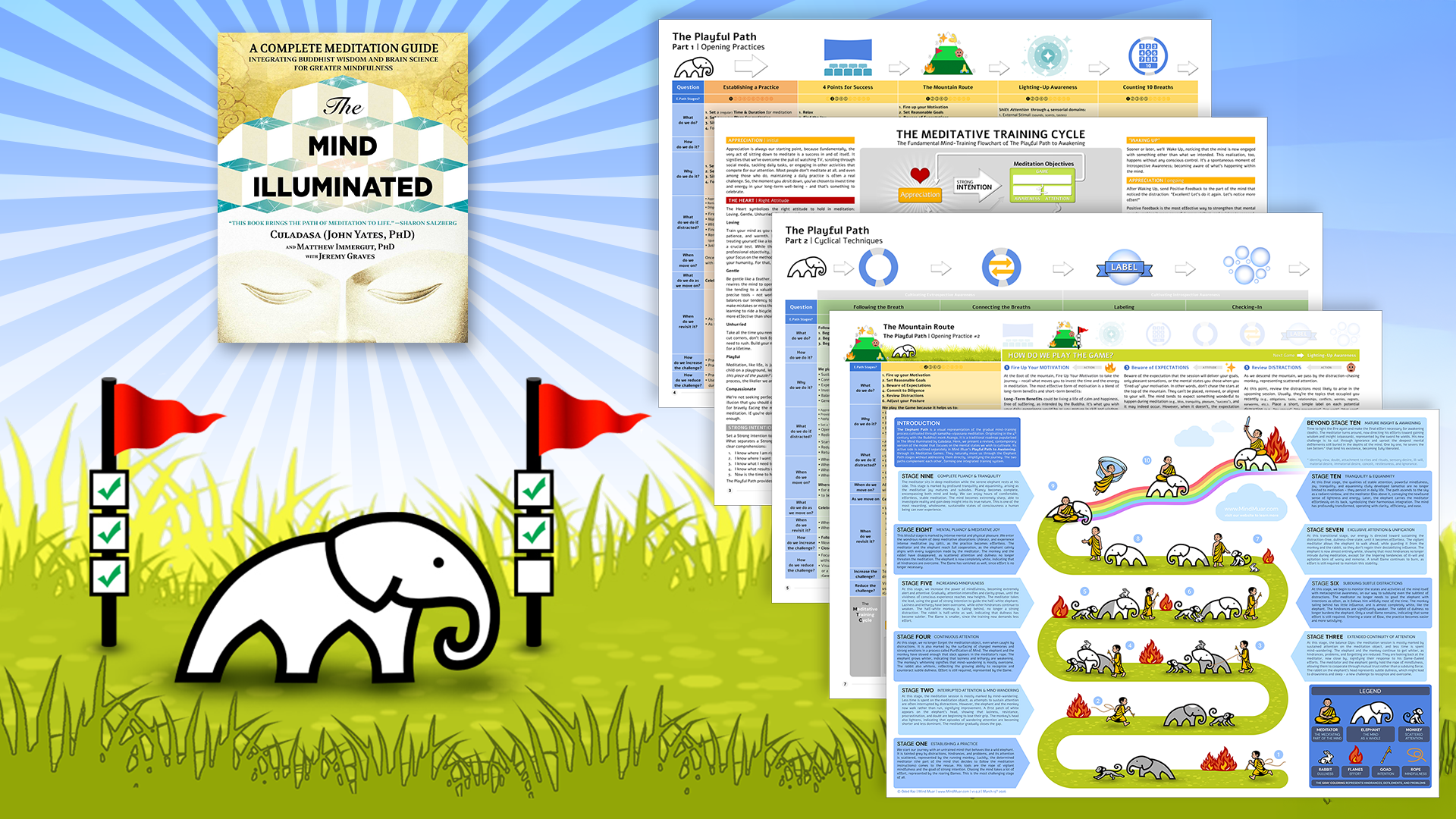
The TPP analysis draws primarily on pages 1, 2, and 12 of v1.9.6, with supporting examples from the Game tables on pages 7–8. The corresponding TMI sections are listed below.
Overview
TMI organizes meditation around Ten Stages of developing skill. Each describes characteristic abilities, challenges, methods, and criteria for mastery. Practitioners recognize their present condition and apply the relevant instructions, moving between Stages as circumstances change.
TPP gives the developmental map and the sequence of actions separate roles. The Elephant Path describes the mental states being cultivated. Meditative Games specify what to do, how to recognize completion, when to revisit an earlier practice, and how to adjust its difficulty. A Game is a purposeful meditation exercise with defined outcomes and indicators of success.
A core practical difference between TMI and TPP concerns how we determine our sequence of actions within a session. TMI asks practitioners to assess their present Stage and select the relevant techniques. TPP organizes practice around a repeating sequence of Meditative Games, with concrete performance criteria and measurable outcomes, while reducing reliance on subjective assessments. By meeting the completion criteria for a series of Games, we progress naturally through the Stages of the Elephant Path without needing to address them directly. Our performance is proof of the maturation of our skills.
TPP also makes playfulness a guiding attitude: engage diligently, enjoy the process, correct mistakes without rejection, and pursue results without craving them. TMI teaches compatible attitudes and itself describes certain breath practices as games. TPP develops these elements into an organizing principle for its wider curriculum.
TMI offers the more extensive public written account of the mind, meditation challenges, advanced development, and supplementary practices. TPP provides a compact, repeatable way to organize training, supported by the Meditative Training Cycle (MTC), a flowchart for intention, practice, recognition, response, and return. Fuller instruction in overcoming challenges, advanced meditation, and complementary practices is available through participation in Mind Muar activities and will be released publicly in future editions.
Shared Training Principles
| Aspect | The Mind Illuminated (TMI) | The Playful Path to Awakening (TPP) |
|---|---|---|
| Liberation as the aim | Develops calm abiding and Insight in the service of Awakening and liberation from suffering. | Explicitly aims at Awakening and liberation from suffering. |
| Skills develop through practice | Repeated intentions and appropriate responses cultivate mental habits; earlier abilities support later ones. | Develops the required abilities through repeated practice, with foundational Games supporting those that follow. |
| Joyful, non-adversarial effort | Teaches relaxation, patience, positive reinforcement, and freedom from judgment and unrealistic expectations. | Defines Right Attitude as Loving, Gentle, Unhurried, Playful, and Compassionate, represented by the Heart in the MTC. Uses Appreciation and positive feedback to reinforce recognition of distractions and success in practice. |
| Repeatable ability | Distinguishes reliable mastery from an isolated experience resembling a later Stage. | Defines Experiential Mastery through consistently achieving the intended outcomes in practice. |
Sources: TMI, Introduction; An Overview of the Ten Stages; Stage One, “The Right Attitude.” TPP, pp. 1–2.
Different Ways of Organizing Practice
| Aspect | The Mind Illuminated (TMI) | The Playful Path to Awakening (TPP) |
|---|---|---|
| Developmental map and actions | The Ten Stages bring together present abilities, challenges, goals, methods, and mastery criteria. | TPP deliberately separates the actions we perform from the mental states we cultivate. The Game sequence guides practice; the Elephant Path maps the developing states. |
| Choosing the next practice | Assess the relevant Stage and work with its current challenges. A technique may serve different goals at neighboring Stages. | Follow the Game sequence and its concrete completion criteria, including measurable outcomes. The next action is linked to demonstrated performance of the current exercise. |
| Starting each sitting | Use the basic preparation and work at the Stage appropriate to current conditions; a previous attainment does not fix today’s Stage. | Begin the sequence from its first Game in every sitting, regardless of how far previous sessions progressed. Re-establish the foundations before continuing. |
| Responding to changing conditions | Move between Stage-appropriate methods as challenges appear or are overcome, including within one sitting. | Use specified revisit conditions to return to an earlier Game. After completing it, resume the later exercise without repeating those between them. |
| The place of playfulness | Enjoyment and relaxed engagement support the method. Stage Three describes Following and Connecting as simple tasks or games. | Defines all meditative practices as Games. Each exercise has value in itself, and progress is pursued with curiosity and freedom from competitiveness. |
| How guidance is presented | Stage chapters supply extensive instructions, with interludes explaining the underlying models and appendices covering supplementary practices. | A concise visual document brings together the sequence, Essential Questions, overview tables, and MTC. Private teaching resources support details beyond the current publication. |
Sources: TMI, Introduction, “How to Use This Book”; An Overview of the Ten Stages; Stages One and Three. TPP, pp. 1–2 and 12.
Raz developed this approach in response to difficulties students reported when applying TMI’s instructions: misidentifying their current condition, skipping foundations, remaining with an exercise too long, or advancing prematurely. TPP addresses these problems by making the Game’s performance criteria the immediate guide for moving through a session, while minimizing the need for subjective assessments.
TPP emphasizes concrete, measurable criteria tied to the Game being practiced. Completion requirements and revisit conditions give practitioners specific checks for deciding whether to keep practicing the current Game, advance to the next, or revisit a previous exercise.
What TPP Makes Explicit or Adds
| Aspect | The Mind Illuminated (TMI) | The Playful Path to Awakening (TPP) |
|---|---|---|
| The Ten Essential Questions | Explains goals, methods, challenges, and mastery within its Stage chapters, without a standard ten-question framework for each practice. | Organizes each Game through ten recurring questions. Their answers combine inherited practices, modified instructions, and additional skillful means. |
| Intellectual and Experiential Mastery | Explains the practice and distinguishes dependable skill from occasional advanced experiences. | Names two aspects of Mastery: knowing the instructions and their rationale, and being able to obtain the intended results consistently. Understanding is one side of the coin; dependable performance is the other. |
| A common progression protocol | Adjusts methods to current challenges and abilities through Stage-specific guidance. | Gives Games an explicit framework for moving on, celebrating completion, revisiting an earlier exercise, and increasing or reducing the challenge. |
| One reusable training flowchart | Uses practice instructions and several related feedback diagrams, with increasingly refined responses to distraction. | Uses the MTC across Games to keep intention, engagement, recognition, appreciation, and correction within a recognizable process. Its detailed relationship to TMI is examined in the MTC installment. |
| Additional practical instructions | Provides the source practices and detailed instructions on which TPP builds. | Makes numerous adjustments and additions to TMI’s practical instructions across the Meditative Games, including modified procedures, new skillful means, and visual aids. |
Sources: TPP, p. 2, “The Meditative Games,” “Mastering the Games,” “The Ten Essential Questions,” and “Meditation in a Nutshell”; pp. 7–8, Game overview tables; pp. 9–11, Meditative Game instructions. TMI, An Overview of the Ten Stages; Stage One, “Six Point Preparation for Meditation” and “A Gradual Four-Step Transition to the Meditation Object”; Stage Two, “A Formula for Success in Meditation”; Stages Two–Four, feedback diagrams.
The Ten Essential Questions provide a consistent framework for learning and applying each Game. We learn what to do, how, and why; how to respond to distraction; when and how to move on or revisit; and how to adjust difficulty and relate the exercise to the Elephant Path. This recurring format makes the instructions easier to locate, learn, and review.
Completing a Game during one sitting and mastering it over time have distinct roles. Completion permits the next step within that session. Experiential Mastery concerns dependable performance across repeated practice.
For a detailed comparison of the MTC and TMI’s related training flowcharts, see The Mind Illuminated and The Meditative Training Cycle.
What TMI Explains in Greater Depth
| Aspect | The Mind Illuminated (TMI) | The Playful Path to Awakening (TPP) |
|---|---|---|
| Models of mind | Explains Attention, peripheral Awareness, conscious power, Moments of Consciousness, and the Mind-System through detailed descriptions and illustrations. | Uses these theoretical foundations in practical instruction. The compact guide does not reproduce their full explanatory treatment. |
| Recognizing and understanding challenges | Explains distinctions among distractions, forgetting, mind-wandering, dullness, and other difficulties, with methods adapted to their changing forms. | Organizes responses around Games and the MTC. TMI remains a detailed reference for understanding the experiences these instructions address. |
| Advanced practice | Provides extensive written guidance for Stages Seven through Ten and for Jhāna and Insight practices. | Describes a path toward Awakening, while v1.9.6 concentrates on its foundational Games. Fuller advanced instruction is available through participation in Mind Muar activities and will be released publicly in future editions. |
| Supplementary practices | Includes substantial appendices on Walking Meditation, Analytical Meditation, Loving-Kindness, the Jhānas, Mindful Review, and Insight-related difficulties. | Complementary practices are available through participation in Mind Muar activities and will be released publicly in future editions. |
Sources: TMI, Introduction, “How to Use This Book”; Interludes One–Seven; Stages Two–Ten; Appendices A–F. TPP, pp. 2 and 12.
What the Comparison Suggests
TPP’s main contribution at this level is an explicit structure for choosing and carrying out the next useful action in meditation. The sequence establishes a starting point; completion criteria guide progression; revisit rules help restore earlier skills; and challenge adjustments keep an exercise workable as ability changes. The intended benefit is less uncertainty about how to proceed, while preserving the theoretical foundations inherited from TMI.
TMI’s main advantage in this comparison is the breadth and depth of its written guidance. It helps readers understand why practices work, distinguish similar experiences, recognize emerging challenges, and investigate advanced development. Its explanations can inform the judgment required to use TPP’s criteria well.
The two complement one another. A practitioner can use TPP to organize a session and consult TMI for the relevant conceptual and technical detail. Where a Game modifies a particular instruction, that difference needs to be examined on its own terms in the dedicated installment. The present overview establishes how the approaches relate; it does not measure their comparative effectiveness.
Corresponding Teachings in TMI
The references below identify relevant chapters, Stages, Interludes, sections, and numbered figures or tables in TMI. These references remain useful across print and digital editions with different pagination.
| Comparison Topic | Relevant TMI Sections |
|---|---|
| Aim of practice and overall structure | Introduction: “Putting This Practice into Context” and “How to Use This Book.” |
| Stages, present conditions, and progression | An Overview of the Ten Stages: “How the Process Unfolds”; “The Ten Stages of Meditative Training”; Figure 1 on non-linear progression; Table 2, “The Ten Stages and Four Milestones.” |
| Intention and dependable skill | An Overview of the Ten Stages: discussion of isolated experiences and mastery; “Cultivating the Right Attitude and Setting Clear Intentions.” |
| Joyful effort and learning through games | Stage One: Establishing a Practice, especially “The Right Attitude”; Stage Three: Extended Continuity of Attention and Overcoming Forgetting, especially the introduction to Following and Connecting. |
| Theoretical foundations | First Interlude: Conscious Experience and the Objectives of Meditation; Third Interlude: How Mindfulness Works; Fourth Interlude: The Moments of Consciousness Model; Fifth Interlude: The Mind-System; Seventh Interlude: The Nature of Mind and Consciousness. |
| Advanced and complementary practice | Sixth Interlude: The Stages of an Adept; Stages Seven–Ten; Appendices A–F. |
Bibliography
Culadasa (John Yates), Matthew Immergut, and Jeremy Graves. The Mind Illuminated: A Complete Meditation Guide Integrating Buddhist Wisdom and Brain Science. Dharma Treasure Press, 2015.
Raz, Oded. The Playful Path to Awakening. Version 1.9.6. Mind Muar, 2026.