THE PLAYFUL PATH TO AWAKENING
THE EXTENDED ARTICLE
An Effective Way to Meditate and Awaken
Inspired by The Mind Illuminated and the work of Culadasa
WELCOME TO THE PLAYFUL PATH
The Playful Path to Awakening is a practical meditation method that trains the mind through a series of Meditative Games, guiding us to True Peace.
These games are designed to systematically develop essential Mental Skills required for Awakening and the ending of suffering: bright awareness, stable attention, powerful mindfulness, and profound equanimity, to name a few.
Each Meditative Game comes with Clear Instructions, a Rationale for its contribution, and well-defined objective Indicators of Success. This allows progress to be guided by concrete, observable results.
The Playful Path emphasizes Joy and Playfulness as central qualities that support effective and sustainable meditation practice over time. This playful attitude works hand in hand with a systematic, methodical approach to training the mind.
It also includes precision tools for Overcoming Challenges commonly encountered in meditation, such as mind-wandering, physical or emotional discomfort, dullness and drowsiness, agitation, intellectual insights, impatience, desires, aversions, worries, regrets, doubts, and more.
A central strength of The Playful Path is its ability to be Personalized to our specific needs. It allows us to recognize where we excel and what we can improve, so we can adjust the practice to match our current skill level.
By clearly outlining the Complete Training Process, The Playful Path ensures that we make the most of the time and energy we invest in meditation.

Acknowledgement
The Playful Path to Awakening (TPP) was developed by Oded Raz, inspired by Culadasa’s The Mind Illuminated (TMI). It draws on concepts, terminology, and practices presented in the book, while introducing original teaching tools and refinements to the practical instructions through its Meditative Games. Its ongoing development draws on years of teaching and working with meditators, in the spirit of Culadasa’s support and encouragement to use his work in innovative ways.
For a transparent, source-grounded comparison, see the TMI and TPP comparison project.
NOTE: the article contains detailed diagrams, and is best viewed on a computer screen.
CREATED WITH YOU IN MIND

You may be a beginner who only recently discovered the many benefits of meditation, an experienced meditator striving for a breakthrough in your practice, or someone already familiar with The Mind Illuminated who’s curious about what this new path has to offer.
In any of these cases, The Playful Path was created for you, so you can train your mind and advance toward the point where suffering is no longer part of your conscious experience.
ORIENTATION

This article will present the heart of The Playful Path: its playful spirit, its series of Meditative Games, and the Ten Essential Questions that define them.
It also serves as an introduction to The Playful Path Document - a concise yet comprehensive guide to our meditation method. Here, we’ll outline what the document contains, how its parts relate to your training, and how to work with it effectively.
The document is arranged in a retreat-friendly printable format that can also support your daily practice as a quick reference.
SOLID TRADITIONAL FOUNDATIONS
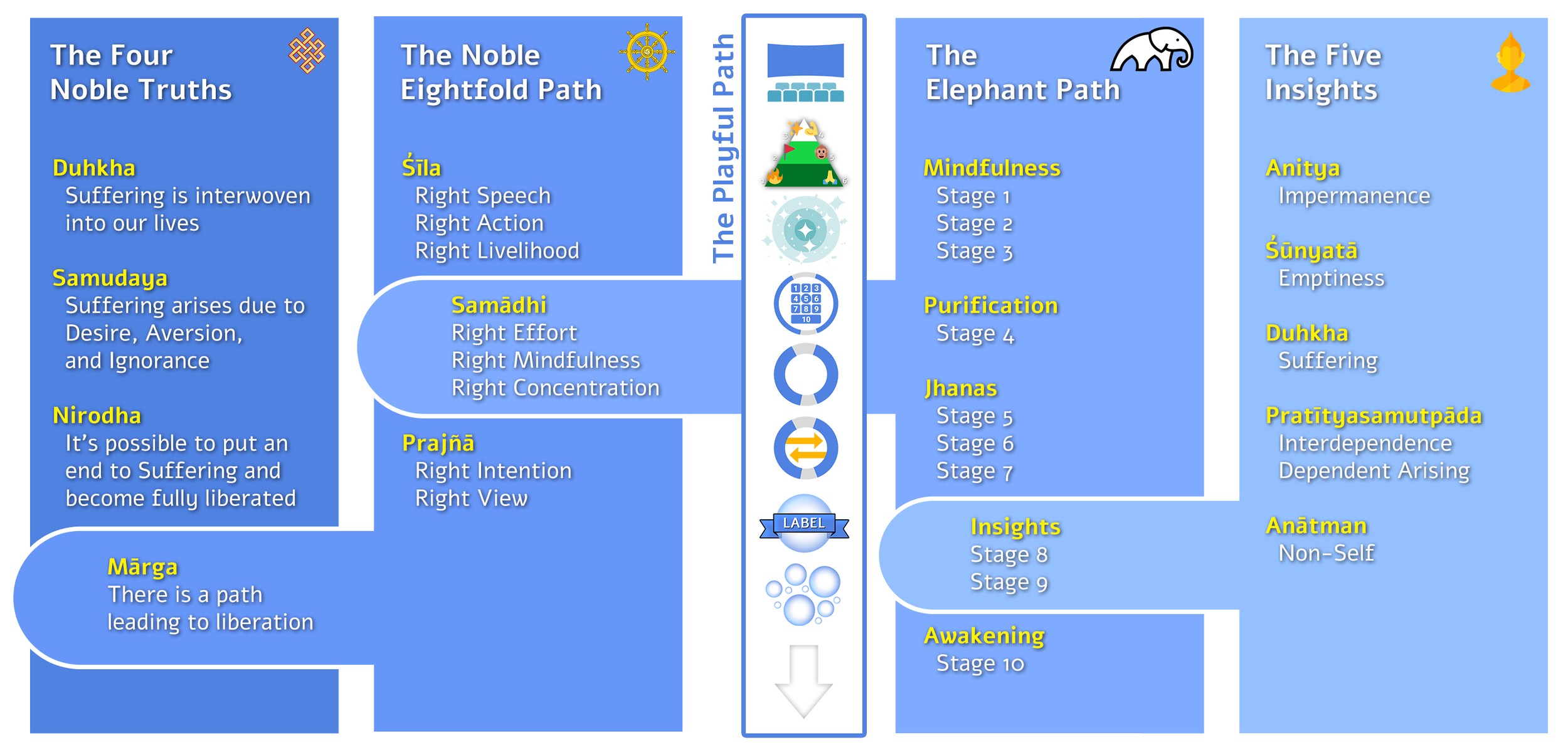
Our meditation method rests on solid traditional foundations: the Buddha’s Four Noble Truths and Noble Eightfold Path, and Asanga’s Elephant Path, as outlined in The Mind Illuminated (TMI) by Culadasa.
These teachings provide the broader context for our practice, connecting meditative training with ethical conduct and the development of wisdom. Inspired by Culadasa’s work, The Playful Path further develops the practical aspects of the mind-training process through its Meditative Games. Together, these foundations and practices support the maturation of Five Insights that lead to Awakening.
Explore the Solid Traditional Foundations article to gain a deeper understanding.
WHY IS THE PATH “PLAYFUL”?

As beneficial as meditation is, finding joy in our practice can still be challenging, especially when perceived as a tedious, routine chore. Therefore, on The Playful Path, we view our actions as “playing a series of games” rather than “completing a set of tasks.” Approached playfully, meditation becomes more engaging, increasing our motivation to establish a regular, enjoyable daily practice.
As we play the Games, we aim for results without craving them, identify and correct mistakes without rejecting them, and celebrate every success along the way. We let go of competitiveness (with ourselves or others) and recognize each Game as valuable in itself, without attachment to its immediate outcome.
By emphasizing playfulness, we cultivate a curious mindset, thereby reducing the stress and anxiety associated with over-achieving, “getting ahead,” “getting it right,” or “getting it over with.” We learn to appreciate every experience, as challenging as it may be. Just like when learning to ride a bike, the process itself can be fun and rewarding, with its results bound to come when they ripen.
THE MEDITATIVE GAMES
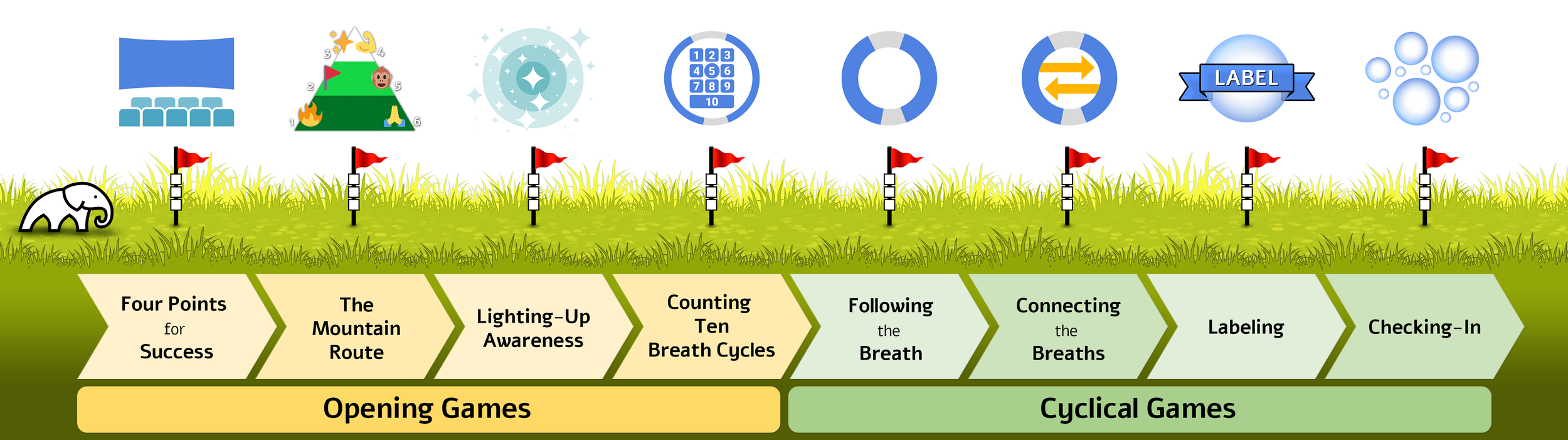
At the beginning of The Playful Path, we develop our fundamental meditative skills by playing eight Meditative Games in sequence:
|
1. Four Points for Success |
5. Following the Breath |
|
2. The Mountain Route |
6. Connecting the Breaths |
|
3. Lighting-Up Awareness |
7. Labeling |
|
4. Counting Ten Breath Cycles |
8. Checking-In |
The first four are Opening Games, which have clear start and finish points. The next four are Cyclical Games, which repeat until the relevant criteria for completion are met.
Each Game is a meditation in and of itself, and all of them are valuable. Therefore, we progress from one Game to the next in every sit without skipping, regardless of how many we completed in previous sessions. By starting every session from the beginning of The Playful Path, we ensure we never take any mental skill for granted, building a solid foundation for high meditative states to arise.
MASTERING THE GAMES
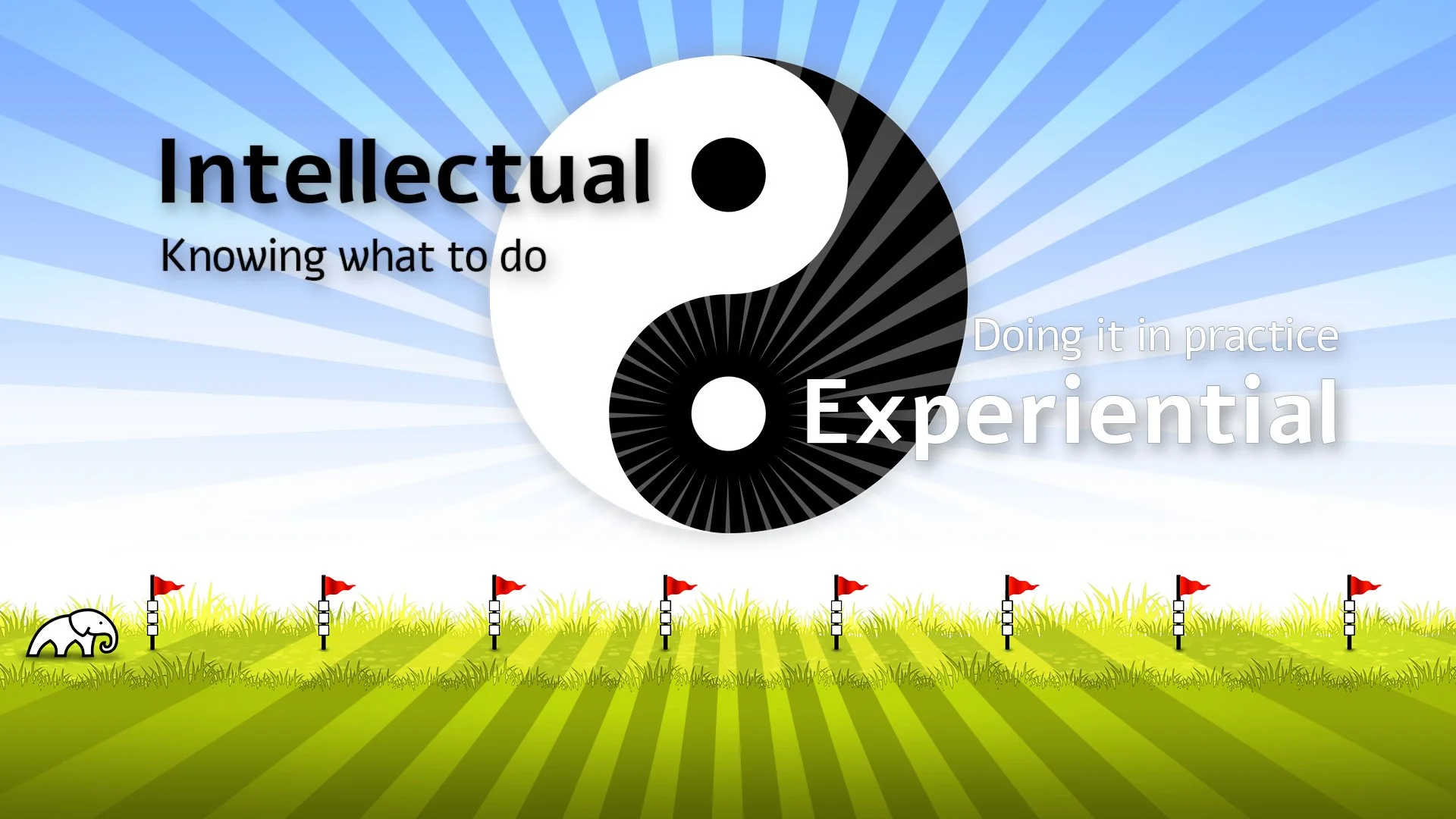
The Playful Path has two aspects: Intellectual & Experiential. The first is about knowing what to do, and the second is about doing it in practice. We must master these two aspects equally, as both are essential for our ultimate success.
Intellectual Mastery
To intellectually master the Games on the path, we must know the answers to Ten Essential Questions about them:
What do we do? What actions make up this Meditative Game?
How do we do it? How do we practice the Game well?
Why do we do it? How does the Game bring us closer to our goals? What mental skills does it cultivate?
What do we do if distracted? How do we respond to distractions and get back on track?
When do we move on to the next Game? How do we know we’ve completed it successfully?
What do we do as we move on to the next Game?
When do we revisit it? When should we return to a Game completed earlier in the session?
How do we increase the challenge (if it gets too easy)?
How do we reduce the challenge (if it gets too hard)?
At which Elephant Path Stages (in TMI) is this Game relevant?
The bottom-line answers to all these questions are detailed in comprehensive tables in The Playful Path Document for your review. Once you’ve comprehended and memorized the answers, you’ve reached intellectual mastery of the games.
NOTE: Learn and practice the Meditative Games one at a time and one after another.
Experiential Mastery
Just like in basketball, after we’ve intellectually mastered the rules of the game, we must then experientially master the physical ability to play it and get the ball in the hoop. The same is true with the Meditative Games of The Playful Path - perform each Game diligently and patiently until you consistently achieve the desired outcomes in every sit. Then, you’ve experientially mastered the games.
THE TEN ESSENTIAL QUESTIONS
Each Meditative Game is defined by its specific answers to the Ten Essential Questions, listed below. This detailed approach gives us a clear understanding of the Game and its value, leading to greater efficiency and effectiveness in our meditative practice.
The Ten Essential Questions for mastering the Meditative Games of The Playful Path are phrased as briefly as possible for simplicity. Here are fuller explanations of what their answers convey:
|
1 |
What do we do? Describes the bottom-line actions we perform to play the Meditative Game. |
|
2 |
How do we do it? Details the subtleties of playing the Meditative Game correctly; the method of practicing it well. |
|
3 |
Why do we do it? Lists the mental skills necessary for Awakening that the Game cultivates and the additional benefits it offers, explaining how it brings us closer to achieving our goals. |
|
4 |
What do we do if distracted? Defines the corrections we make after (inevitably) getting distracted: the universally beneficial reaction to distractions, the actions we should take specifically for each Meditative Game, and how we get back on track. This maps onto The Meditative Training Cycle. |
|
5 |
When do we move on (to the next Game)? Defines the criteria for completing a Game successfully, the results we are after, and how to know with confidence that we have achieved them. |
|
6 |
What do we do as we move on (to the next Game)? We celebrate our success and provide positive feedback to the parts of the mind that were involved in completing the Game. This answer is constant across all Meditative Games and is repeatedly highlighted because it is a key factor in making progress while enjoying it. |
|
7 |
When do we revisit it? Describes the conditions for returning to a Game we completed earlier in the session and playing it again. We revisit the Game to strengthen the mental skills it cultivates, which may have weakened later in the session. This helps us overcome the resulting obstacles. Once it is completed, we return to the later Game we left, without needing to repeat the Meditative Games in between. |
|
8 |
How do we increase the challenge (if it gets too easy)? With our growing skills as meditators, some Meditative Games may eventually become too easy. Just like adding weight at the gym, we may challenge ourselves by introducing additional aspects to the Game that will further develop our skills. |
|
9 |
How do we reduce the challenge (if it gets too hard)? Sometimes, a Meditative Game may be too challenging to complete, like a free weight too heavy to lift. Instead of getting stuck and frustrated, we may temporarily reduce the challenge, allowing continued development of mental skills alongside a sense of success. |
|
10 |
At which Elephant Path Stages (in TMI) is this Game relevant? The Playful Path goes hand in hand with the ten stages of The Elephant Path, as outlined in The Mind Illuminated. For each Meditative Game, the ten stages are represented in The Playful Path Document by numbered circles. Stages where the Game is irrelevant are grayed out, relevant stages remain clear, and the stage where the technique is mentioned in TMI is marked in bold black. |
THE MEDITATIVE TRAINING CYCLE
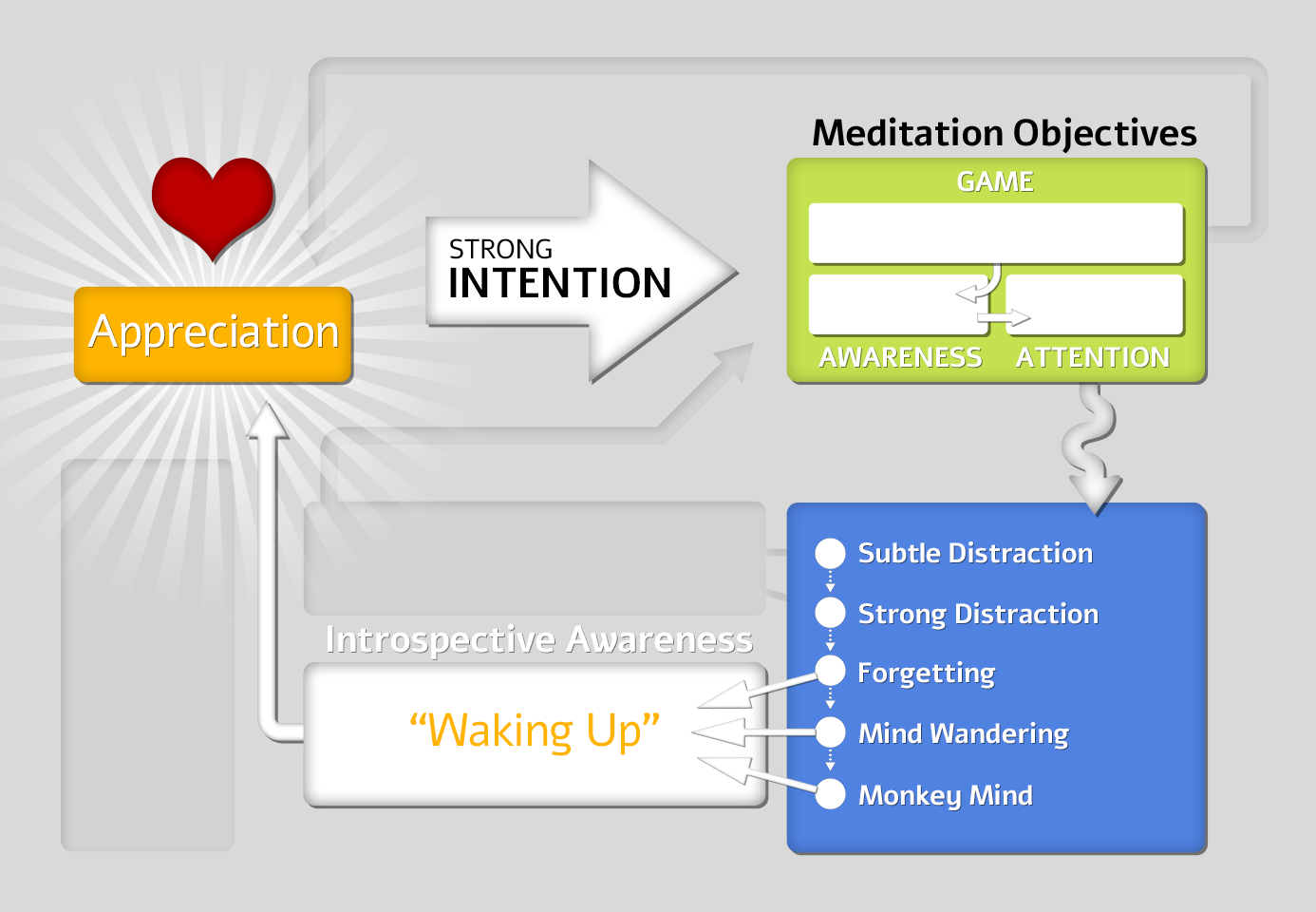
The Meditative Training Cycle, or MTC, is a powerful framework that enhances the effectiveness of any meditation technique where we direct and sustain attention on a specific meditation object.
When the Meditative Games of The Playful Path plug into the MTC, this flowchart defines the attitude we should hold, the intentions we need to set, the scope of awareness, the center of attention, and the way we should respond to distractions.
The MTC can also be seen as a Meditative Game in itself: the most fundamental Game we learn to play.
For a full explanation, explore our dedicated article on The Meditative Training Cycle.
DEEP MEDITATIVE STATES

The eight Meditative Games form the opening part of The Playful Path. They cultivate the fundamental skills required to approach the Jhānas (deep meditative states). The path continues beyond these foundations, all the way to Awakening. Detailed guidance will be shared gradually in future versions of The Playful Path Document.
If you’d like guidance in exploring these states, you’re welcome to reach out.
WHAT’S IN THE DOCUMENT?
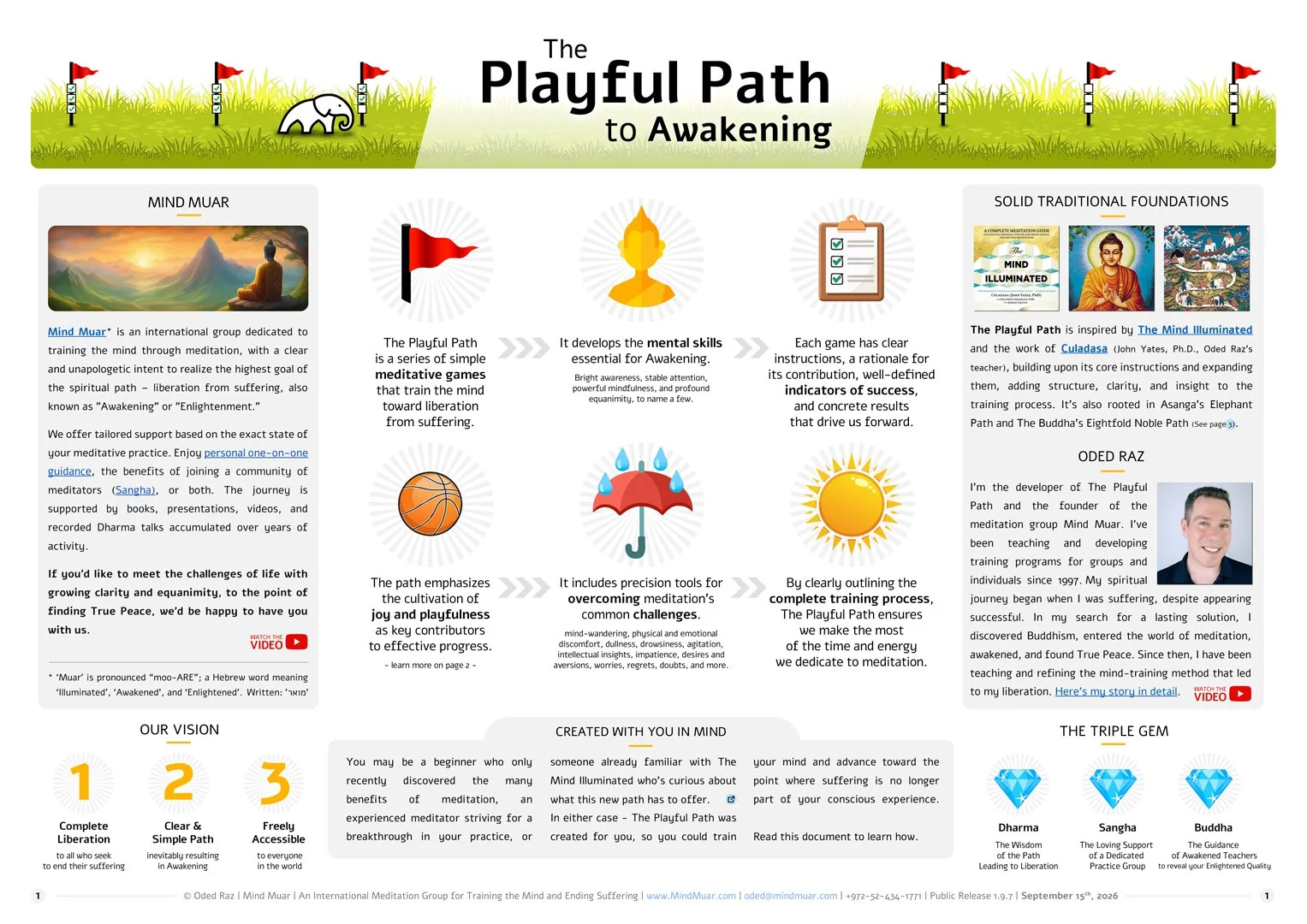
The Playful Path Document brings together explanations, practical instructions, overview tables, and visual reference tools, arranged in a retreat-friendly printable format. The following sections introduces its content and how each of its pages can support our practice.
Introduction and Orientation
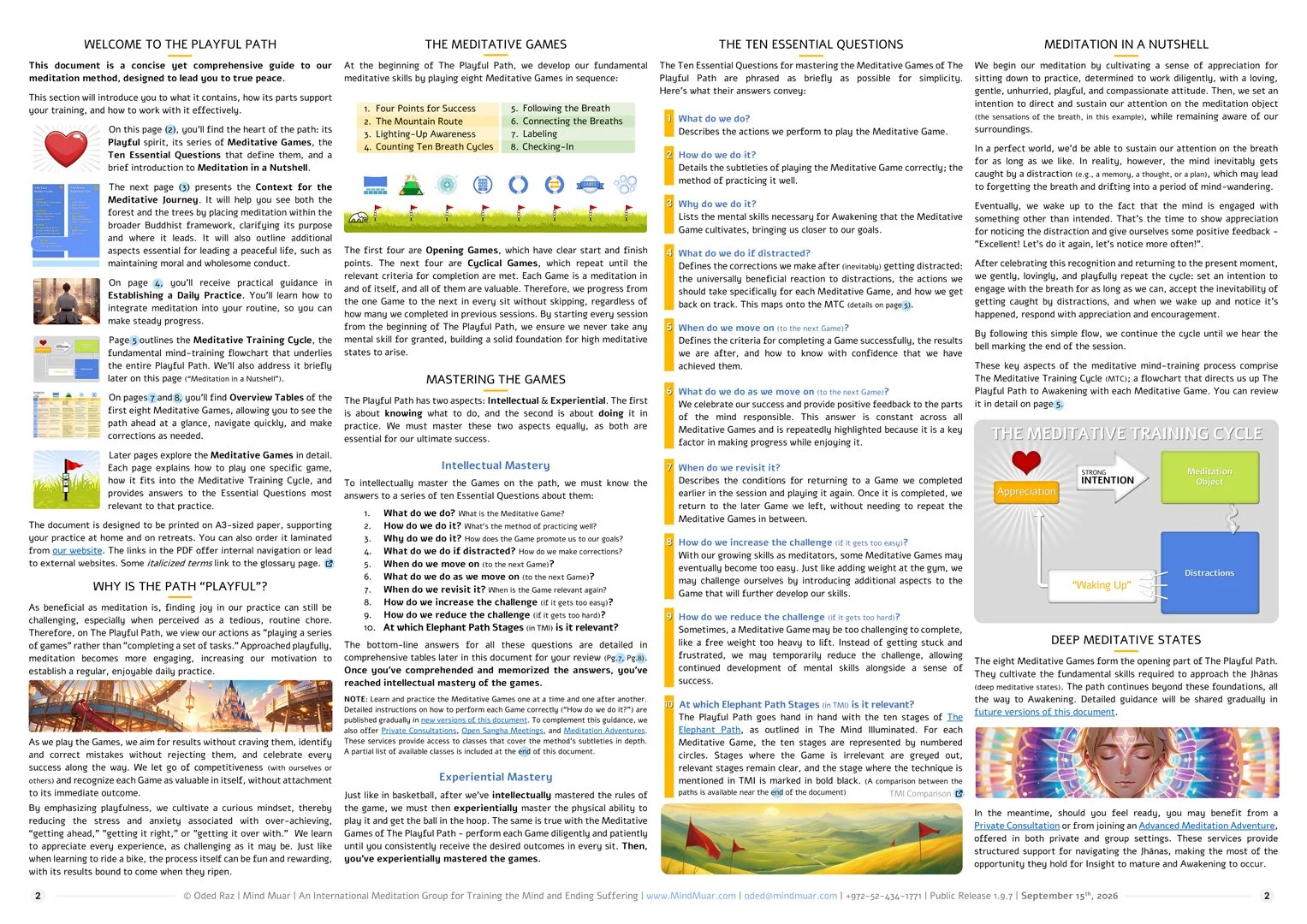
The opening pages mostly contain the information provided in this article. They introduce The Playful Path, its purpose, its traditional foundations, and the playful attitude at its heart. They explain how to use the document, introduce the first eight Meditative Games and Ten Essential Questions, and distinguish intellectual understanding from experiential mastery. A brief meditation walkthrough shows how the method works, while the discussion of deeper meditative states places these opening practices within the entire journey toward Awakening.
Context for the Meditative Journey
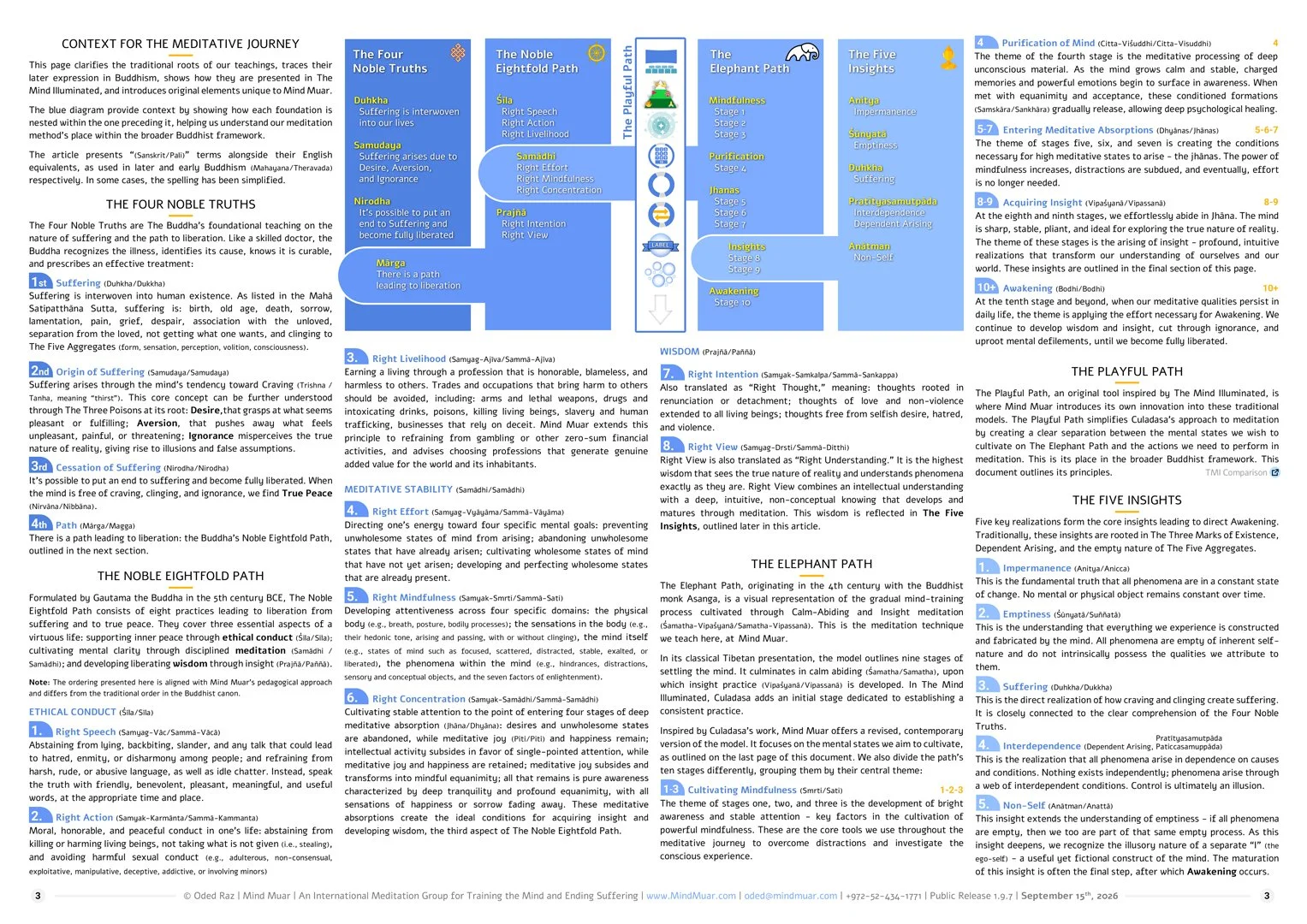
This page presents the Solid Traditional Foundations of our method. It helps us see both the forest and the trees by placing meditation within the broader Buddhist framework. It brings together the Four Noble Truths, the Noble Eightfold Path, The Playful Path, the Elephant Path, and Five Insights leading to Awakening. The accompanying diagram shows how they relate, clarifying the purpose of our training and the roles of ethical conduct, meditative development, and wisdom.
Establishing a Daily Practice
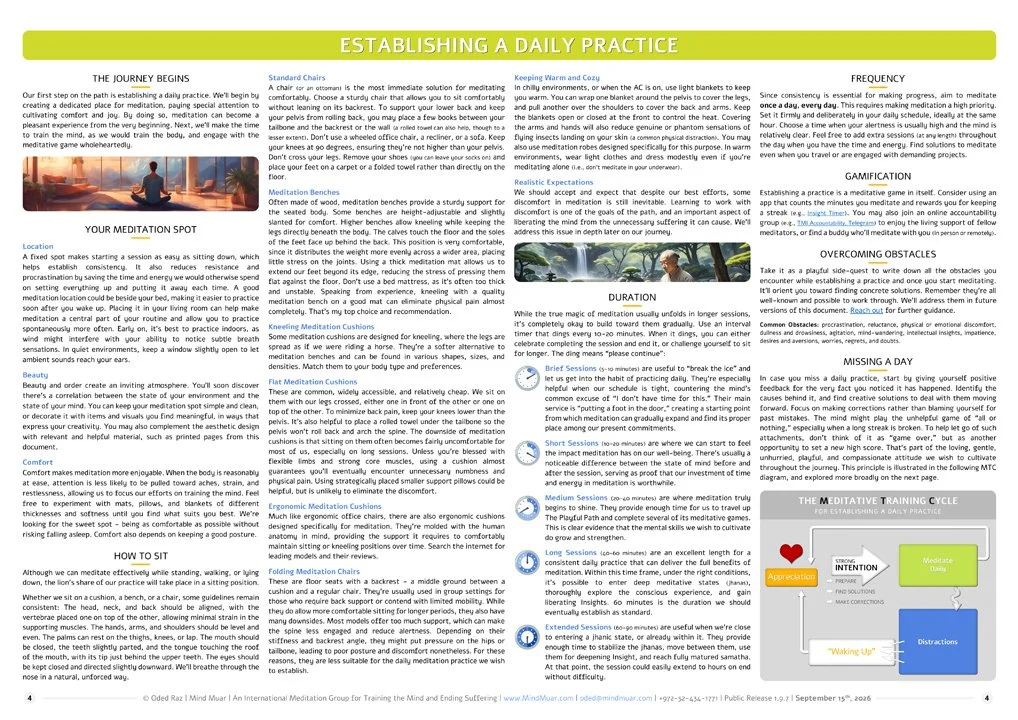
This page offers practical guidance for integrating meditation into our daily routine. It covers choosing a place, finding a comfortable posture and suitable seating, and setting the frequency and duration of our sessions. It also offers ways to support motivation and consistency, work through obstacles, and respond constructively when we miss a day.
The Meditative Training Cycle
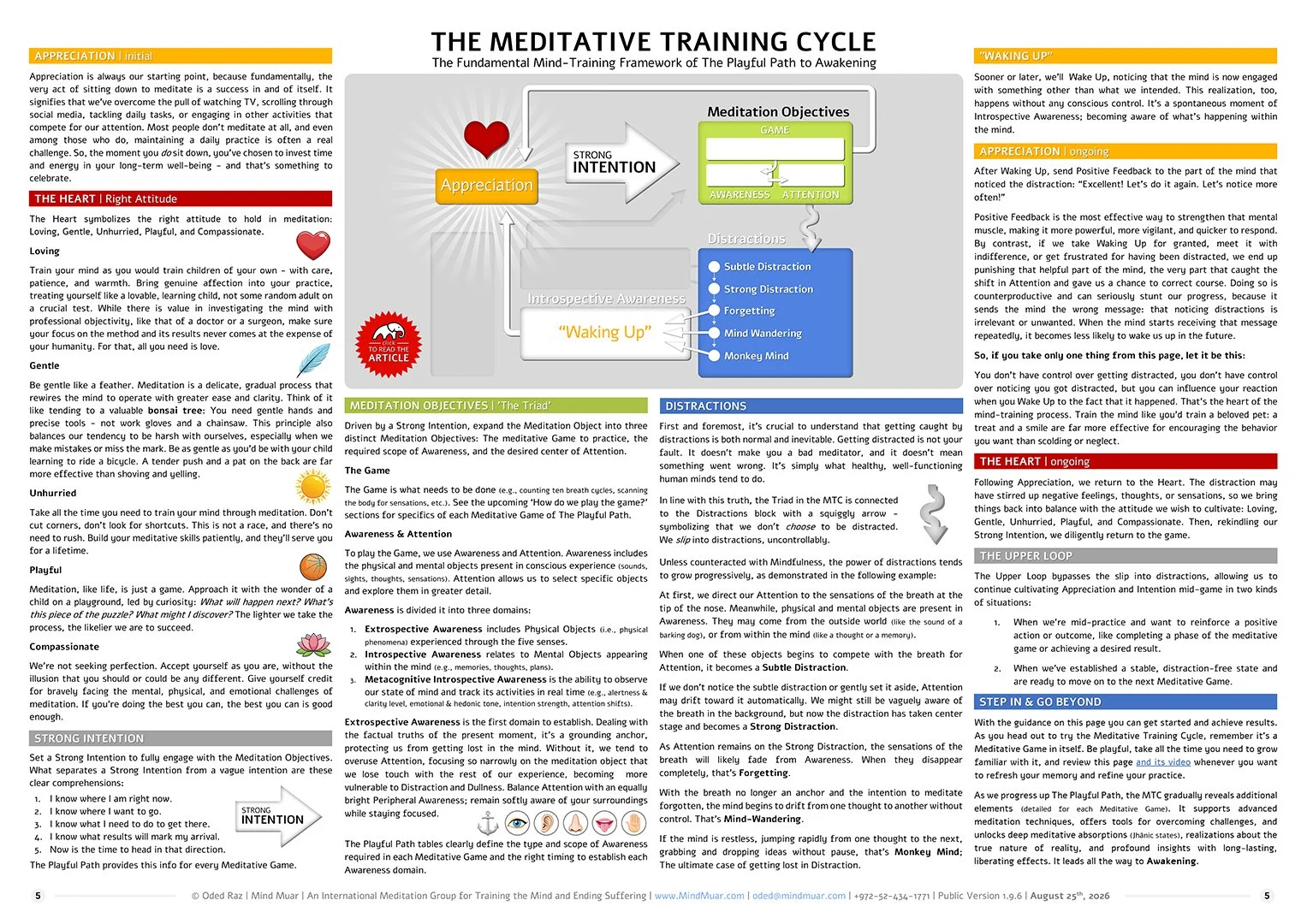
The Meditative Training Cycle is the fundamental mind-training flowchart underlying every Game. It addresses key aspects of effective meditation, such as Appreciation, Right Attitude, Strong Intention, and the roles of Awareness and Attention. It also outlines the progressive nature of Distractions, how we “wake up” to notice them, and the importance of skillful reactions and corrections in our meditative growth.
The Playful Path GPS
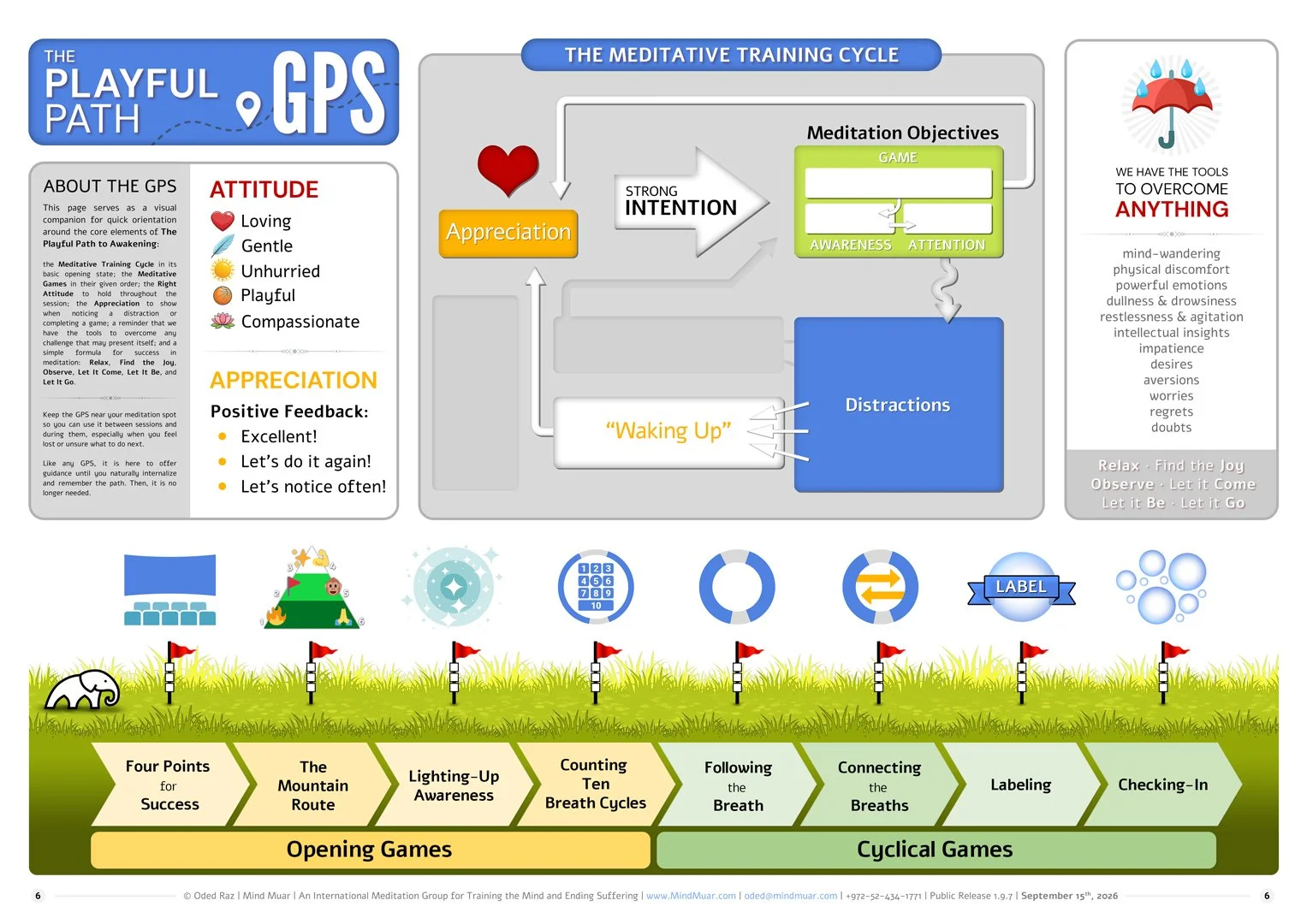
The Playful Path GPS serves as a visual companion for quick orientation around the core elements of our method:
The Meditative Training Cycle in its basic opening state.
The Meditative Games in their given order.
The Right Attitude to hold throughout the session: Loving, Gentle, Unhurried, Playful, and Compassionate.
The Appreciation to show when noticing a distraction or completing a Game.
A reminder that we have the tools to overcome any challenge that may present itself.
A simple formula for success in meditation: Relax, Find the Joy, Observe, Let It Come, Let It Be, and Let It Go.
We can keep the GPS near our meditation spot so we can use it between sessions and during them, especially when we feel lost or unsure what to do next. It offers guidance until we naturally internalize and remember the path.
Overview Tables of the Meditative Games
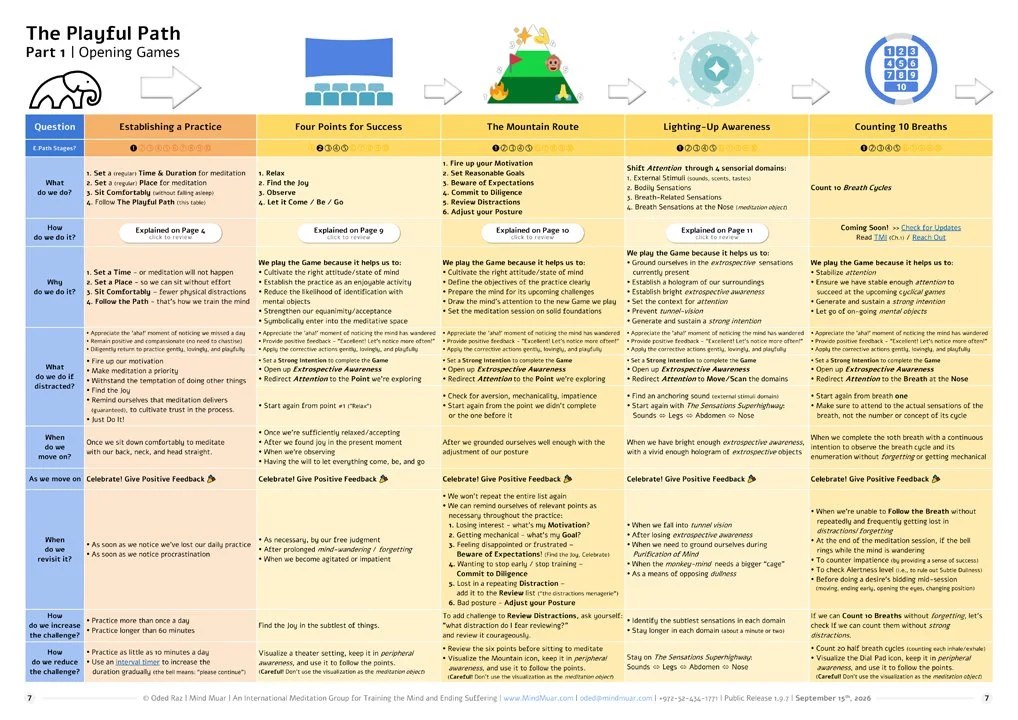
Two tables present the four Opening Games and four Cyclical Games side by side, with an additional column for establishing a practice. They provide a concise overview of the Meditative Games on the path through the lens of The Ten Essential Questions.
These tables allow us to see the path ahead at a glance, review the Games, navigate quickly, and make corrections as needed.
Meditative Games in Detail
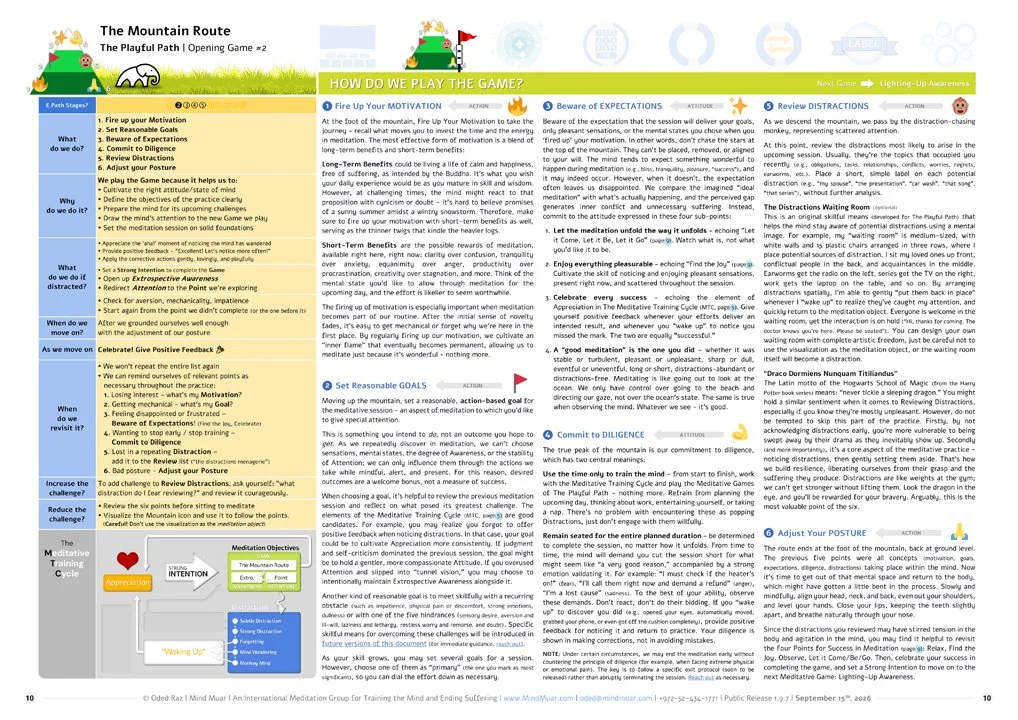
Dedicated instruction pages outline each Meditative Game in detail. They provide comprehensive answers to The Ten Essential Questions, with particular emphasis on the exact method of playing the Game well (“How do we do it?”).
They also include a diagram of the specific MTC state best suited for working with the Game. The explanations address subtleties of practice, common obstacles, and ways to vary the challenge as necessary.
This section expands gradually as detailed instructions for additional Games are published in new versions of The Playful Path Document.
Background, Further Learning, and Support
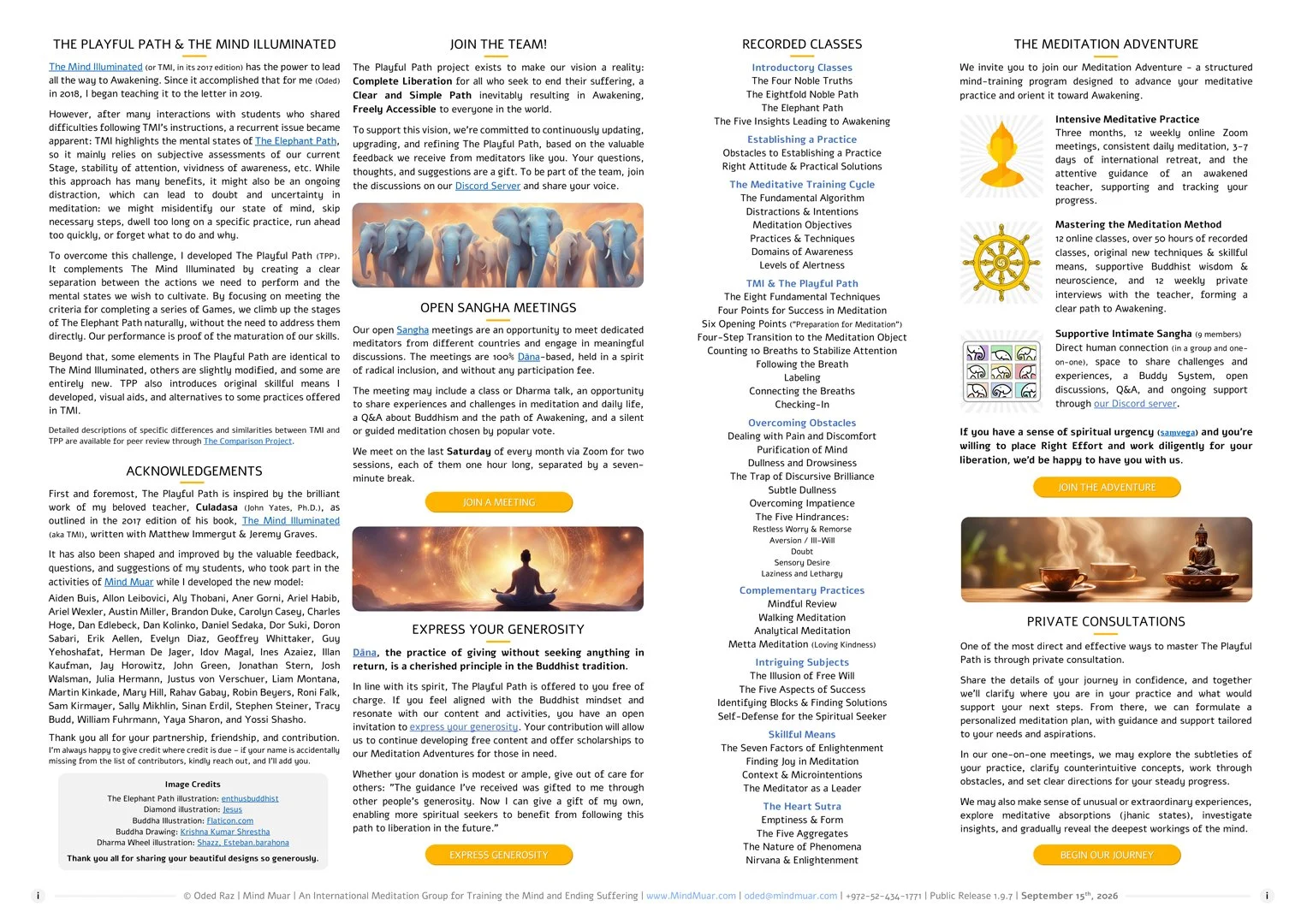
This page addresses the relationship between The Playful Path and The Mind Illuminated, acknowledges Culadasa and other contributors, and introduces the Comparison Project for exploring similarities and differences in detail.
It also presents opportunities for continued learning and offers ways to provide feedback, participate in the community, and support the project’s continued development.
Glossary
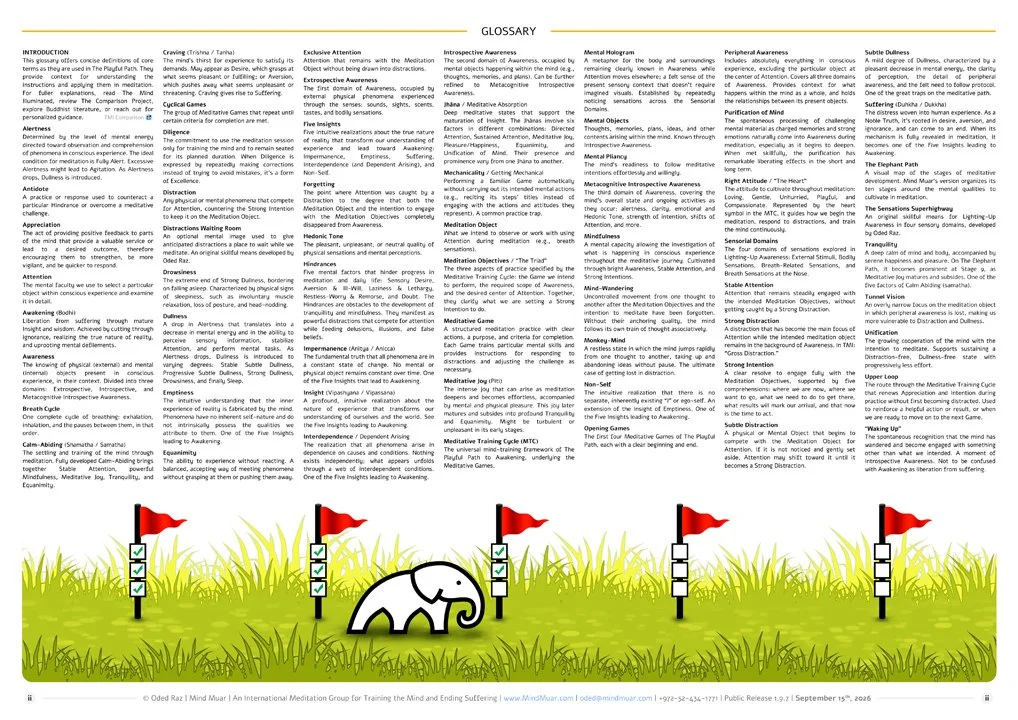
The glossary provides concise definitions of core terms as they are used in The Playful Path. It clarifies distinctions such as Attention and Awareness, different forms of Distraction, and “Waking Up” during meditation versus Awakening as liberation from suffering. Linked terms throughout the PDF make it easy to consult these explanations while reading.
The Elephant Path
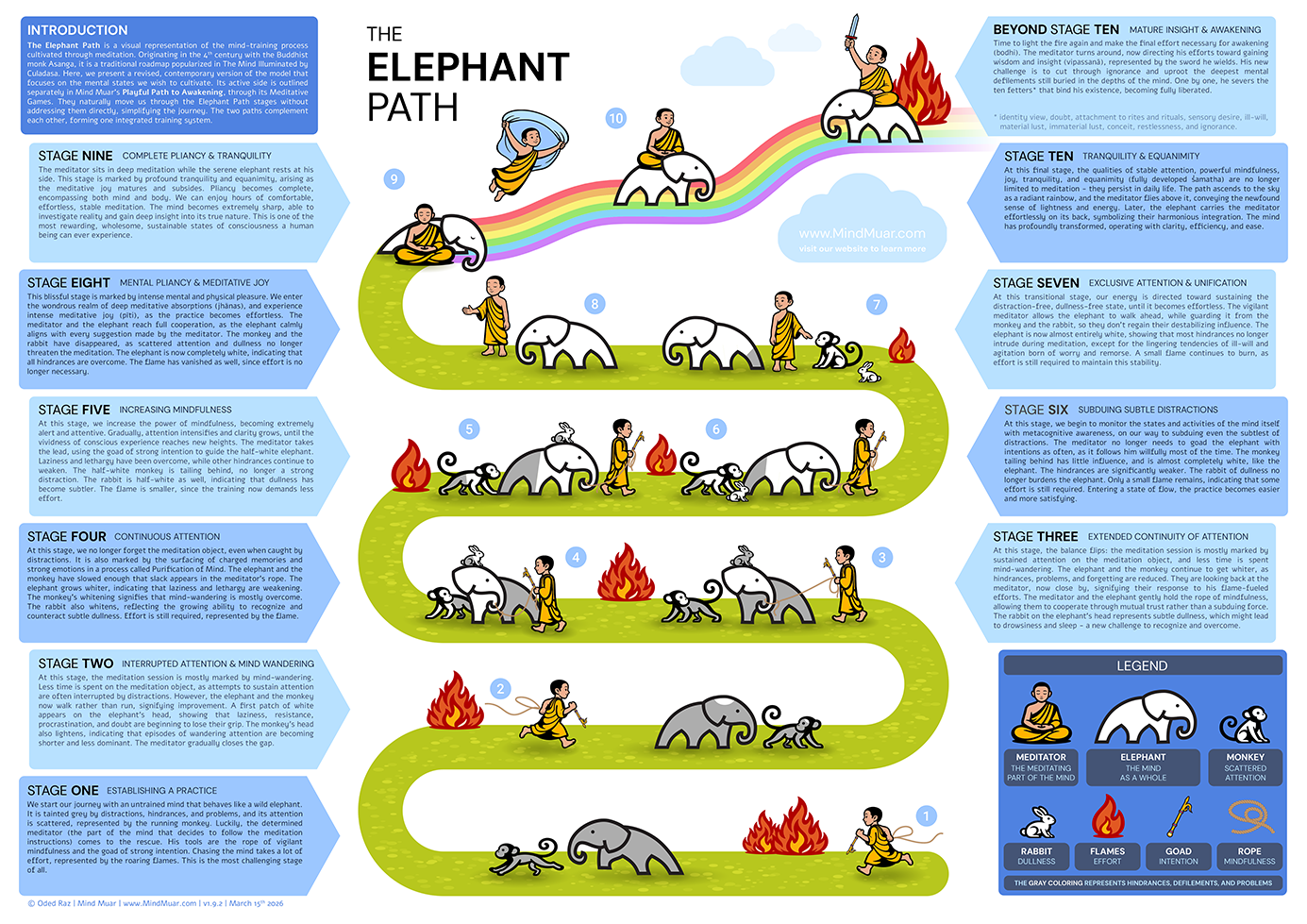
A full-page illustrated map presents the ten stages of meditative development and the continuation beyond Stage Ten toward mature Insight and Awakening. Descriptions accompany each stage, while a legend explains what the featured symbols represent, such as the meditator, the elephant, the monkey, and more.
The Elephant Path describes the mental states we wish to cultivate. The Meditative Games provide the actions that lead us through its stages.
GET YOUR FREE COPY
The Playful Path to Awakening is offered freely as a printable document.
You can continue to the access page to receive an A3-sized PDF for your personal use.